Front of the Card
Back of the Card
Japanese
English
Audio: NHK Creative Library
Read by LibriVox volunteer Larry Wilson.
Audio courtesy of LibriVox
参議篁
わたの原
八十島かけて
漕ぎ出でぬと
人にはつげよ
あまのつり舟
ひとにはつ
けよあまの
つりふね

わたのはらや


- Poem 11
- わたの原
八十島かけて
漕ぎ出でぬと
人にはつげよ あまのつり舟
Author: Councillor Takamura (802–853)
Source: Kokin Wakashū, Travel
- English Verse Translation
- Oh! Fishers in your little boats, Quick! tell my men, I pray, They'll find me at Yasoshima,
I'm being rowed away Far off across the bay.
— William N. Porter, 1909
- Modern Translation
- I have set out rowing across the vast sea, heading for the many islands far away. Tell the people back home.
- Commentary
- The Kokin Wakashū says this was sent to someone in the capital as Takamura set off by boat into exile on the island of Oki. He wrote it for the family he left behind.
- About the Poet
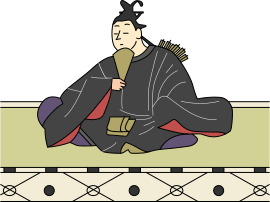
- Councillor Takamura (Ono no Takamura) was Ono no Komachi's grandfather. Sent as deputy envoy to Tang China, he refused an order to swap his ship for a leaking one, and wrote a Chinese poem mocking the mission. This angered Retired Emperor Saga, who exiled him to Oki. He was pardoned two years later and returned to office.
- Poem Illustration
-
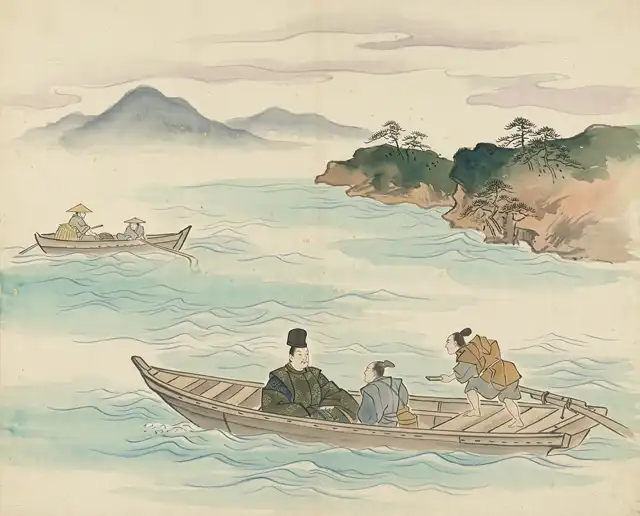
This image is based on an illustration from William N. Porter's A Hundred Verses from Old Japan, his 1909 English translation of the Hyakunin Isshu published in England, colorized and reworked using Adobe Firefly (generative AI).
- Ono no Takamura: A Short Timeline
-
- 802
- Born
- 822
- Passes the exam to become a student of literature at the court university
- 833
- Writes the preface to the Ryō no Gige, an official commentary on the law
- 834
- Named deputy envoy to Tang China
- 838
- Refuses to board the envoy ship and is exiled to Oki Province
- 840
- Pardoned and returns to the capital
- 847
- Becomes Councillor (Sangi)
- 852
- Given Junior Third Rank
- 853
- Dies
- Ono no Takamura's Family Tree
-
Takamura's ancestor, the first to go to China
The Ono clan was active from the Asuka period to the Heian period. Above all, Ono no Imoko of the Asuka period is remembered in history as the head of the mission to Sui China who delivered a letter written by Prince Shōtoku, beginning "The Son of Heaven in the land where the sun rises...," to the Sui emperor.
Takamura refuses to sail
With such an ancestor, Takamura too was supposed to go to China as deputy envoy. But it is said that he refused to board because he was given a faulty ship for the dangerous voyage. However, since Takamura also wrote "Saidōyō," a Chinese poem mocking the missions to China, it seems that by his time Tang China was in decline, there was less to learn from it, and the missions had lost much of their purpose.
Takamura's father, Minemori
Takamura's father, Minemori, was a high court official who served as Councillor and Senior Assistant Governor-General of Dazaifu. He was good at Chinese poetry and tutored the emperor in reading, and Takamura seems to have inherited his talent. Takamura is said to have been called "the Bai Juyi of Japan."
Takamura's descendants
Takamura's descendants include Ono no Komachi, whose poem is No. 9 in the Hyakunin Isshu, and the famous calligrapher Ono no Michikaze.
- Appendix
-
- A Poem Written on Oki
- This poem shows the hard life Takamura was forced to live after he was exiled to Oki.
In Japanese
思ひきや 鄙の別れに 衰へて
海人の縄たぎ 漁りせむとは omohikiya hinanowakareni otorohete
amanonawatagi isarisemutoha Kokin Wakashū, Ono no TakamuraIn English
I never dreamed of this: parted from the capital, worn out in the countryside, pulling a fisherman's net to catch fish.
- A Poem About Plum Blossoms
- The scene of lingering winter snow mixed with plum blossoms, which announce the coming of spring, has a special beauty, and it was a traditional theme from the time of the Man'yōshū. The learned Ono no Takamura carried on this tradition in the next poem.
In Japanese
花の色は 雪にまじりて 見えずとも
香をだに匂え 人の知るべく hananoiroha yukinimajirite miezutomo
kaodaninioe hitonoshirubeku Kokin Wakashū, Ono no TakamuraIn English
Even if the color of the plum blossoms is lost among the snow, at least let your scent drift, so that people will know you are there.
- The Poem Behind The Tale of Takamura
- The Tale of Takamura (Takamura Monogatari) is a tale told through poems about the sad, doomed love between Ono no Takamura and his half-sister.
Takamura wrote the next poem in deep despair after the half-sister he loved died. The heartbreaking world of this poem later grew into The Tale of Takamura. However, no one knows who wrote the tale or when.
In Japanese
泣く涙 雨と降らなむ 渡り川
水まさりなば 帰り来るがに nakunamida ametofuranamu watarigawa
mizumasarinaba kaerikurugani Kokin Wakashū, Ono no TakamuraIn English
Let the tears I cry fall as rain. If the river of the dead rises, perhaps she will turn back to me.
- The Envoy Ships to Tang China
- These were the ships that carried the Japanese missions to Tang China. From the Nara period on, a mission usually sailed in four ships, each thought to carry about 120 to 160 people. The voyage was dangerous, and crossings often failed. In 838, the ship of the ambassador, Fujiwara no Tsunetsugu, was damaged, and it was decided that he would take the ship of the deputy envoy, Ono no Takamura, instead. Takamura protested and refused to board.
- The Deputy Envoy
- Each mission to China was basically made up of an ambassador (first rank), a deputy envoy (second rank), secretaries (third rank), and clerks (fourth rank). Takamura was the deputy envoy, the second rank. The superior who pressed him to swap ships for a leaking one was the ambassador, Fujiwara no Tsunetsugu, a high court official from the Northern branch of the Fujiwara clan.
- "Saidōyō"
- "Saidōyō" is the Chinese poem Takamura wrote to protest against his superior on the envoy ship. Writing it angered Retired Emperor Saga, and Takamura was exiled to Oki.
Sadly, "Saidōyō" does not survive, so we do not know what it said. At the time Tang China was in decline and there was little to learn from it, and the envoy ships often sank and many people died. So Takamura may have had doubts about a policy of sending missions to China with no thought for the lives lost. - "Aku mu zen"
- The Gōdanshō, a Heian-period collection of tales, tells that in the reign of Emperor Saga, a graffiti message reading "悪無善" ("aku mu zen") appeared in the capital. No one could work out what it meant, but when it was shown to Takamura, he read it at once as "saga nakuba yokarinamashi" ("It would be good if there were no Saga," that is, no Emperor Saga). Because he read it so quickly, Takamura was suspected of having written it himself. As a test, he was ordered to read the string "子子子子子子子子子子子子," and he solved that easily too. His brilliant wit is said to have cleared him of suspicion.
- 子子子子子子子子子子子子
- A word game read as "neko no ko koneko, shishi no ko kojishi" ("the cat's child is a kitten, the lion's child is a lion cub"), using the different readings of the character 子 (ne, ko, shi, ji). The Uji Shūi Monogatari says Emperor Saga made it up and Ono no Takamura solved it.
- Ono no Michikaze and the Frog
-
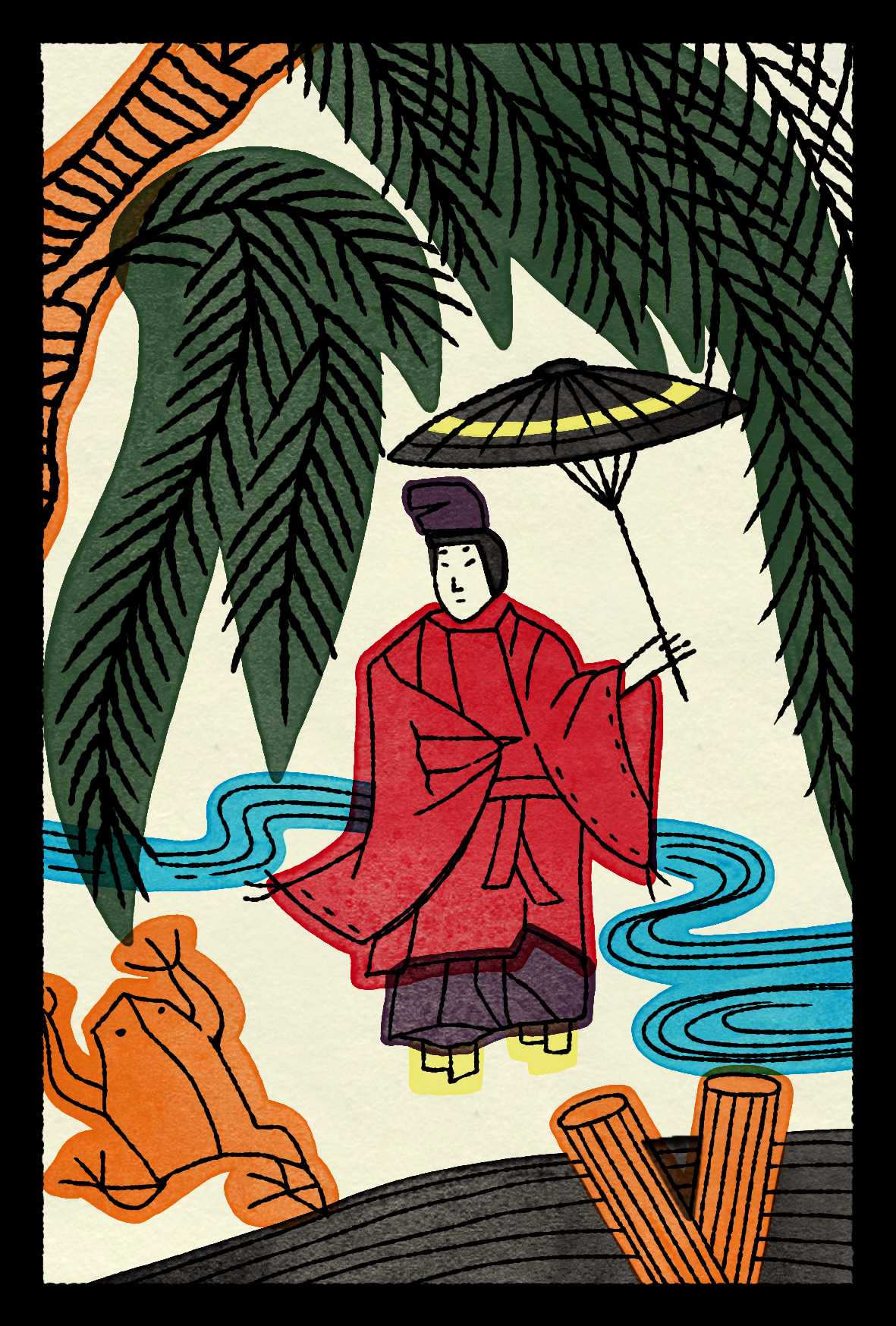
Ono no Takamura was a proud, rebellious man who even refused his mission to China, and there is even a legend that he helped King Enma, the judge of the dead, in hell at night. His grandson, Ono no Michikaze, was very different: though wonderfully talented, he was a sensitive man who worried about his own limits and nearly gave up calligraphy.
What woke Michikaze up was a frog in the rain, jumping again and again to reach a willow branch. He watched coldly, thinking, "It will never reach it." But then a sudden gust of wind bent the willow, and the frog caught the branch. At that moment he understood: "Those who are not prepared cannot make use of a lucky chance." Through steady effort he went on to become a "god of calligraphy," as great as his grandfather, who was called "the Bai Juyi of Japan."
This dramatic turning point is still loved today as the picture on the hanafuda card "Ono no Michikaze and the willow."
- Legends of Ono no Takamura
in the Konjaku Monogatari and the Gōdanshō -
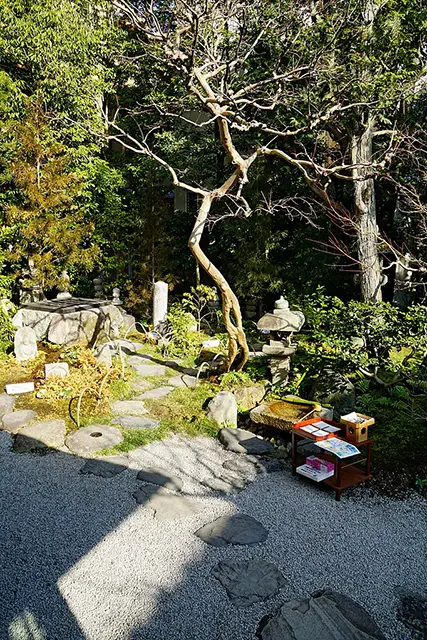
663highland, CC BY-SA 3.0 <http://creativecommons.org/licenses/by-sa/3.0/>, via Wikimedia Commons According to the Konjaku Monogatari Shū and the Gōdanshō, Ono no Takamura served at court by day and went to the underworld at night to work for King Enma.
No one knows for sure how this legend began. But perhaps it grew from the fact that Takamura was a powerful man over 180 cm tall, rebellious and passionate, and held a post in charge of punishments.
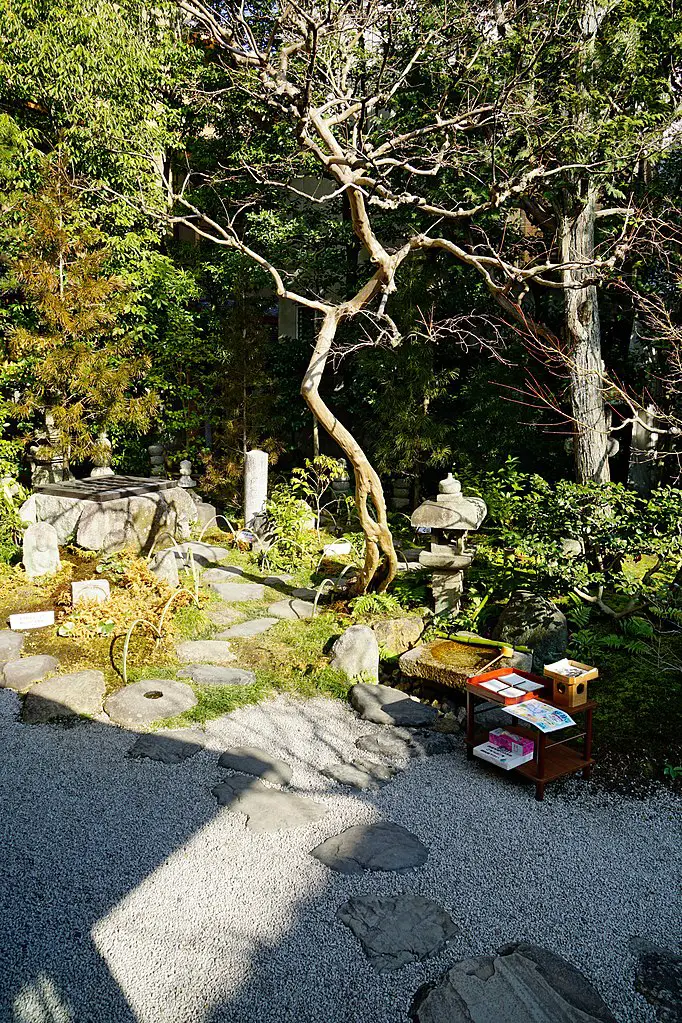
At Rokudō Chinnō-ji Temple in Higashiyama Ward, Kyoto, there is a well (at the back left of the photo) through which Takamura is said to have traveled to and from hell. - The Graves of Ono no Takamura and Murasaki Shikibu
-
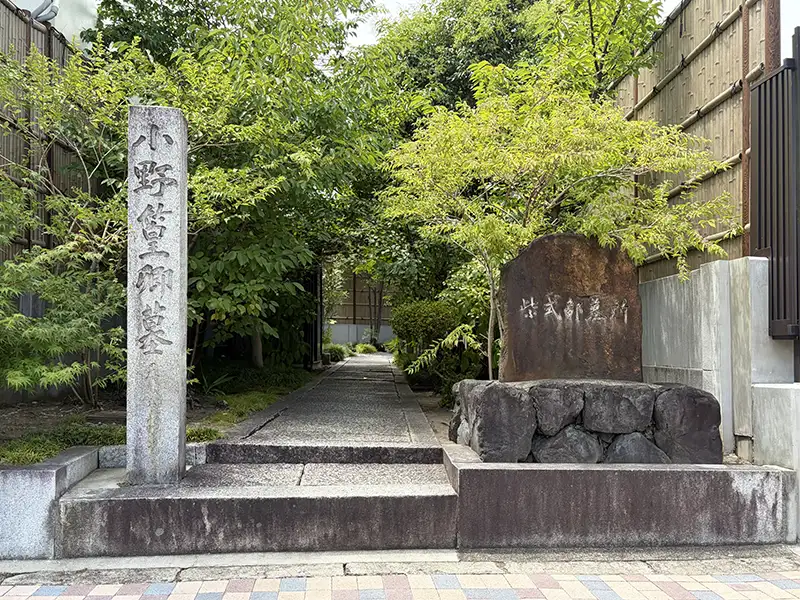
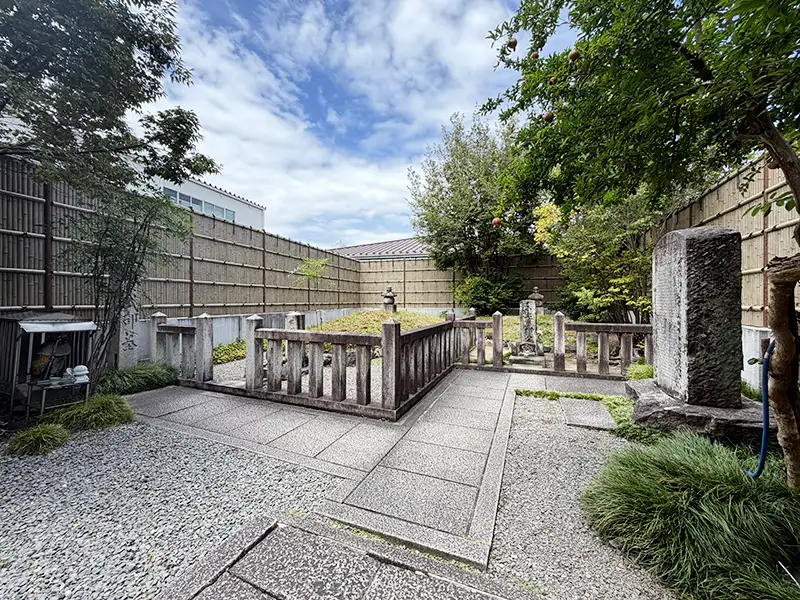
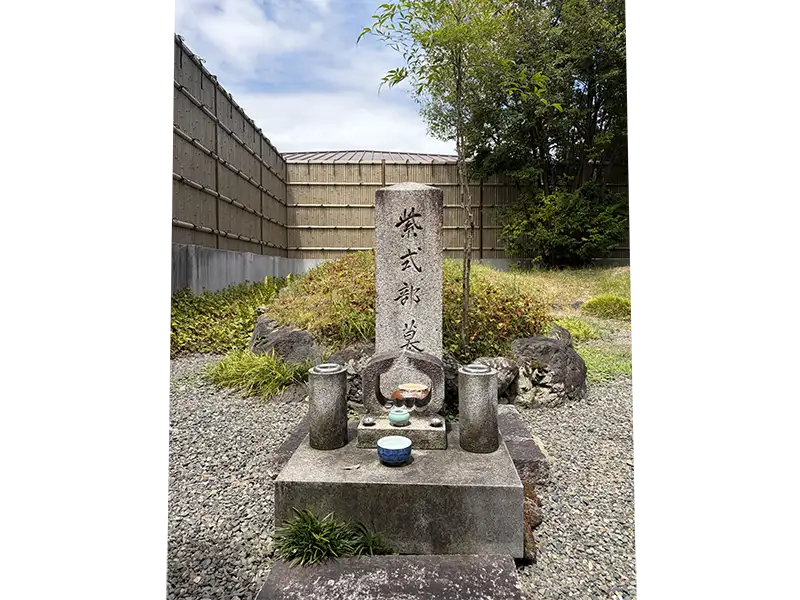
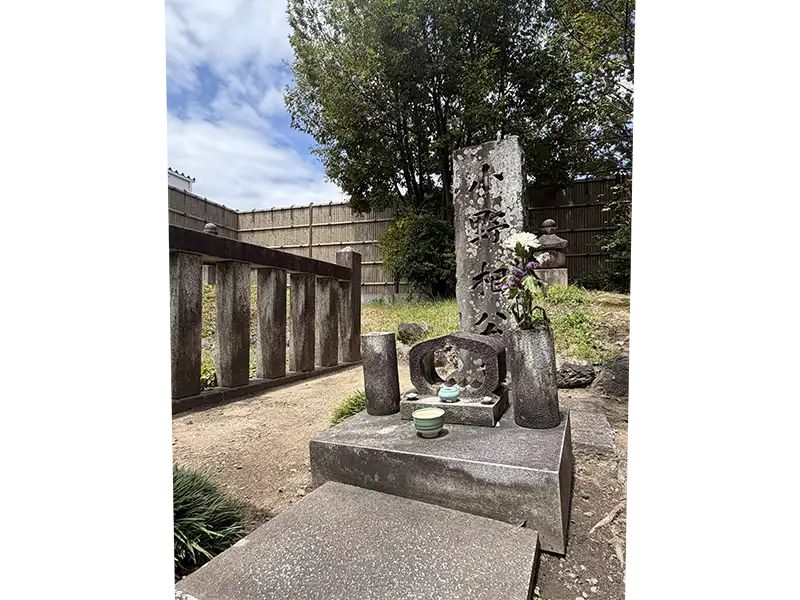
Ono no Takamura's grave stands side by side with the grave of Murasaki Shikibu (Poem 57).
In the late Heian period, people worried that Murasaki Shikibu, author of The Tale of Genji, a story about love and desire, might have fallen into hell after death.
A legend says that her grave was moved next to Takamura's so that Takamura, who worked at King Enma's court, could help save her. The graves still stand there quietly today.
(Photo taken August 8, 2026)
- Ukiyo-e by Katsushika Hokusai
-
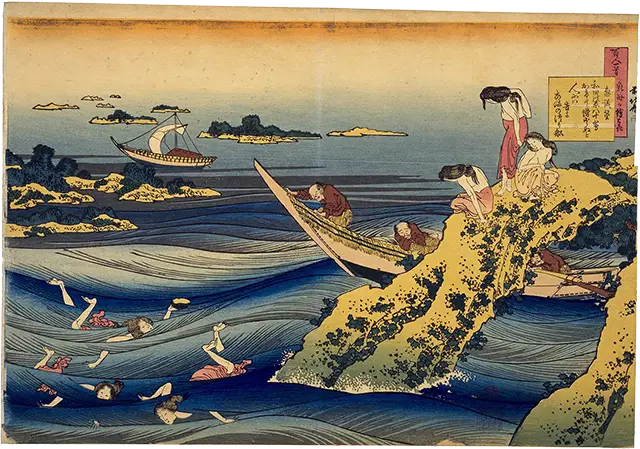
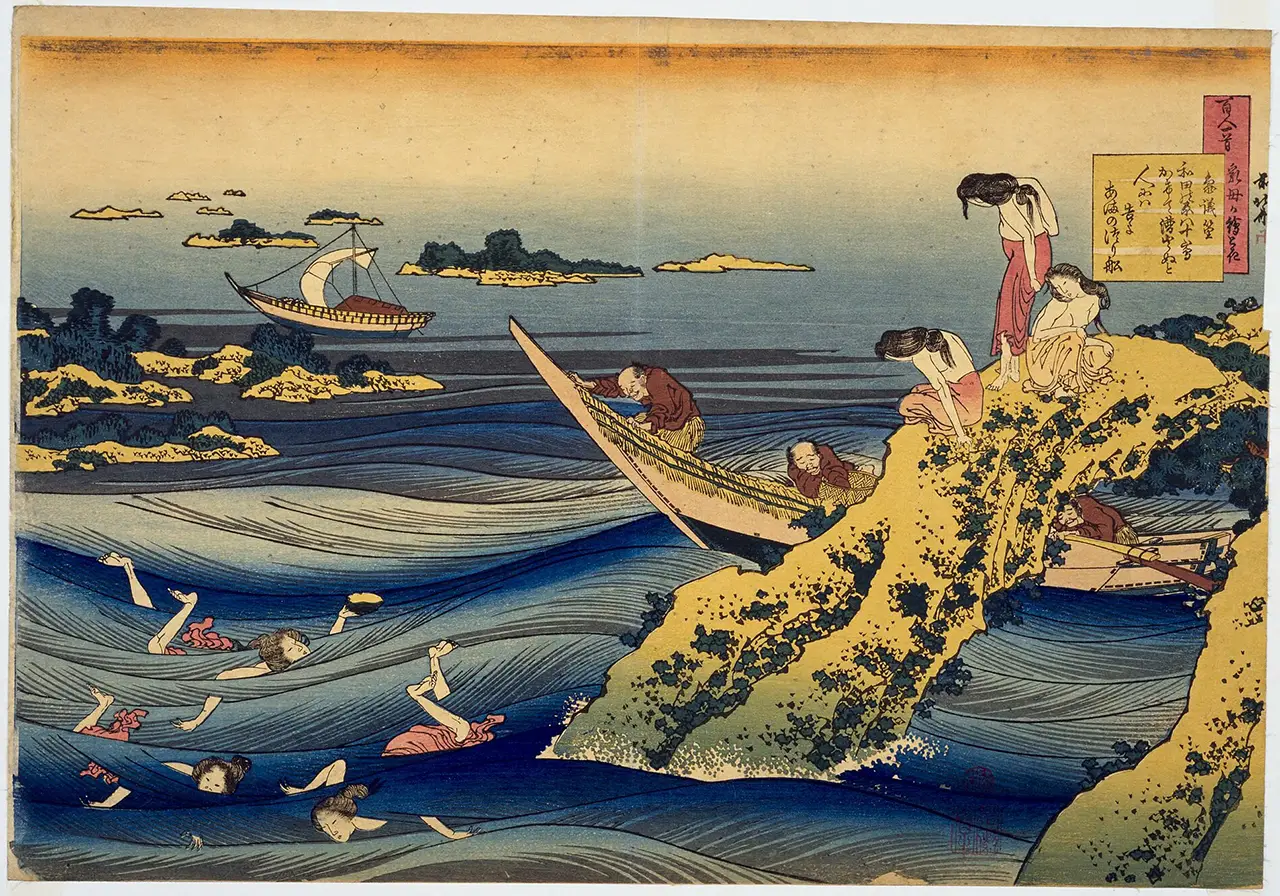
National Diet Library, Public domain, via Wikimedia Commons This print is from One Hundred Poems Explained by the Nurse (Hyakunin Isshu Uba ga Etoki) by Katsushika Hokusai, an ukiyo-e artist of the Edo period. The idea of the series is a nurse explaining the Hyakunin Isshu poems with easy-to-understand pictures.
It shows women diving for abalone and men waiting on a boat for their catch. Islands are drawn in the distance, recreating the "many islands" (yasoshima, the countless islands of the Seto Inland Sea) of the poem.
- Utagawa Kuniyoshi's Hyakunin Isshu no Uchi
-
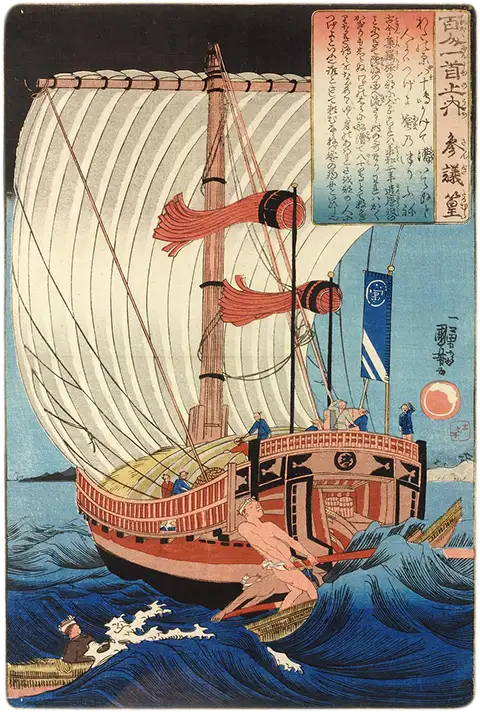
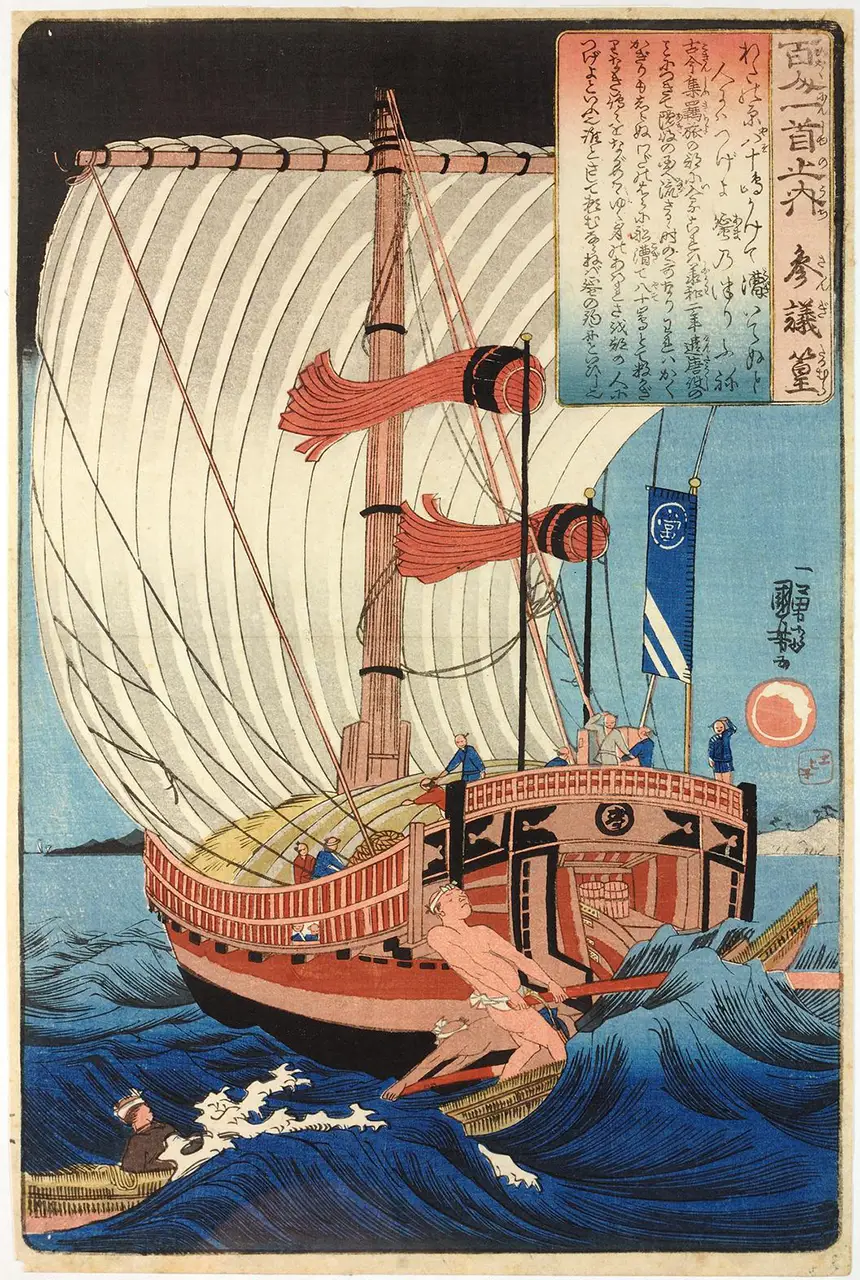
British Museum, Public domain, via Wikimedia Commons This ukiyo-e is by Utagawa Kuniyoshi, an artist of the Edo period.
If it shows the scene of the poem, the large ship would be the boat taking Takamura into exile, but it does not quite feel that way.
Perhaps the large ship is the envoy ship Takamura refused to board. Or is the small boat in front the one taking him into exile?
It is hard to imagine the envoy ship and the exile boat, both closely tied to Takamura, in the same place. So the large ship may stand for Takamura's longing for the past, and the small boat tossed by big waves for his uneasy feelings as he is about to be exiled.