Front of the Card
Back of the Card
Japanese
English
Audio: NHK Creative Library
Read by LibriVox volunteer Larry Wilson.
Audio courtesy of LibriVox
柿本人麻呂
あしびきの
山鳥の尾の
しだり尾の
ながながし夜を
ひとりかも寝む
なかなかし
よをひとり
かもねむ

あし


- Poem 3
- あしびきの
山鳥の尾の
しだり尾の
ながながし夜を ひとりかも寝む
Author: Kakinomoto no Hitomaro (dates unknown–c. 708)
Source: Shūi Wakashū, Love
- English Verse Translation
- Long is the mountain pheasant's tail That curves down in its flight; But longer still,
it seems to me, Left in my lonely plight, Is this unending night.
— William N. Porter, 1909
- Modern Translation
- As long as the trailing tail feathers of the mountain bird — through these long, long nights, must I sleep alone?
- Commentary
- The poem compares a long, lonely night to the long, drooping tail of the copper pheasant. Pheasant couples were believed to spend the day together but sleep apart, on mountains across a valley. The poet seems to see his own lonely nights in this habit.
- About the Poet
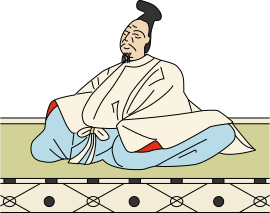
- Kakinomoto no Hitomaro served at court, writing poems praising the emperor and poems of mourning. Honored with Yamabe no Akahito as one of the two "Sages of Poetry," he is worshipped as a god of waka. He is said to have died in Iwami Province (Shimane Prefecture), but whether he collapsed on the road or was executed is unknown.
- Poem Illustration
-
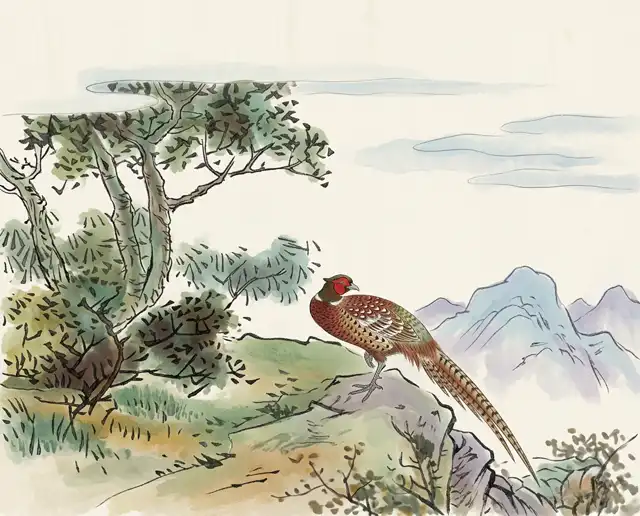
This image is based on an illustration from William N. Porter's A Hundred Verses from Old Japan, his 1909 English translation of the Hyakunin Isshu published in England, colorized and reworked using Adobe Firefly (generative AI).
- Kakinomoto no Hitomaro: A Short Timeline
-
- 680
- His poems begin to appear in the Man'yōshū
- 689
- Writes a poem mourning Prince Kusakabe
- c. 708
- Said to have died in Iwami Province
- 1723
- Given the highest court rank and the divine title Kakinomoto Daimyōjin
- Notes
-
- Counted as one of the Thirty-Six Immortal Poets
- Appendix
-
- The Original Poem
- Hitomaro's poem in the Hyakunin Isshu comes from the Shūi Wakashū, but its original is said to be a poem by an unknown author in the Man'yōshū (Book 11, Poem 2802). Over time it was reshaped and came to be known as Hitomaro's.
In Japanese
思へども 思ひもかねつ あしひきの
山鳥の尾の 長きこの夜を omohedomo omohimokanetsu ashihikino
yamadorinoono nagakikonoyoo Man'yōshū, author unknownIn English
However much I think of you, my longing never ends,
for this night is as long as the tail of the copper pheasant. - A Long Poem About the Copper Pheasant (Excerpt)
- Copper pheasants were believed to spend the day together as a pair, but to sleep apart at night, on mountains across a valley. This idea appears in the Man'yōshū, Japan's oldest poetry collection, so it seems to have been well known at the time.
In Japanese
あしひきの 山鳥こそば 峰向ひに
妻問ひすと言へ うつせみの
人なる我れや 何すとか
一日一夜も 離り居て 嘆き恋ふらむ ashihikino yamadorikosoba omukahini
tsumadohisutoihe utsusemino
hitonaruwareya nanisutoka
hitohihitoyomo sakariite nagekikofuramu Man'yōshū, Ōtomo no YakamochiIn English
The copper pheasant, they say, calls to its mate on the facing peak across the valley.
So why do I, a mere human, grieve and long for you so much
when we are apart for just one day and one night? - The Copper Pheasant in The Pillow Book
- Sei Shōnagon also seems to have heard that copper pheasant pairs spend the night apart across a valley. She wrote about it in The Pillow Book:
In Japanese
山鳥。友を恋ひてなくに、鏡を見すれば慰むらむ、心わかう、いとあはれなり。谷隔てたる程など心苦し。 The Pillow Book, Sei ShōnagonIn English
The copper pheasant cries out missing its mate, but it is said to calm down if you show it a mirror. How innocent and touching! It is sad to think of the pair apart, with a valley between them.
- Retired Emperor Go-Toba's Poem Based on This One
-
Retired Emperor Go-Toba wrote a poem borrowing from Hitomaro's "Ashibiki no yamadori no o no..." (a technique called honkadori).
"Tōyamadori" is another name for the copper pheasant.In Japanese
桜咲く 遠山鳥の しだり尾の
ながながし日も あかぬ色かな sakurasaku tooyamadorino shidariono
naganagashihimo akanuirokana Shin Kokin Wakashū, Retired Emperor Go-TobaIn English
Cherry blossoms bloom on the distant mountains. Even if I gaze at them all day long,
a day as long as the drooping tail of the copper pheasant, I never tire of their color. - A Romantic Poem About the Night Sky
-
The next poem is by Kakinomoto no Hitomaro. He sees the clouds as waves, the moon as a boat, and the stars as a forest.
In Japanese
天の海に 雲の波立ち 月の船
星の林に 漕ぎ隠る見ゆ amenoumini kumononamitachi tsukinofune
hoshinohayashini kogikakurumiyu Man'yōshū, Kakinomoto no HitomaroIn English
On the sea of heaven, waves of cloud rise, and I see the boat of the moon
rowing away and hiding in the forest of stars. - Hitomaro's Poems Mourning a Prince
-
Kakinomoto no Hitomaro was a court poet who served Empress Jitō.
When her son, Prince Kusakabe, died, Hitomaro wrote the following poem.In Japanese
あかねさす 日は照らせれど ぬばたまの
夜渡る月の 隠らく惜しも akanesasu hihateraseredo nubatamano
yowatarutsukino kakurakuoshimo Man'yōshū, Kakinomoto no HitomaroIn English
The sun is shining, yet how sad that Prince Kusakabe has passed away, like the moon that crosses the night sky and sets.
The next poem is set at Akino, where Prince Karu (Prince Kusakabe's son) was hunting. Hitomaro sees Prince Kusakabe as the setting moon and Prince Karu as the light of dawn. While mourning Prince Kusakabe, who passed away like the sinking moon, the poem grandly shows Prince Karu carrying on his father's will and ruling a new age, just as the dawn begins to light the world.
In Japanese
東の 野に炎の 立つ見えて
かへり見すれば 月傾きぬ hingashino nonikagirohino tatsumiete
kaherimisureba tsukikatamukinu Man'yōshū, Kakinomoto no HitomaroIn English
As the light of dawn begins to glow over the fields in the east,
I look back and see the moon sinking in the western sky. - A Poem on the Fleeting World, Written by the Uji River
- Hitomaro is said to have written the next poem by the Uji River on his way from the ruined province of Ōmi to Fujiwara-kyō.
"Mononofu no" is a makurakotoba (pillow word) that leads into "yaso" (many), and "uji" works as a pun on both "clans" and "Uji."
Having seen the abandoned capital of Ōtsu, Hitomaro is thought to have written about how nothing in the world lasts.In Japanese
もののふの 八十氏河の 網代木に
いさよふ波の 行く方知らずも mononofuno yasoujigawano ajirogini
isayofunamino yukueshirazumo Man'yōshū, Kakinomoto no HitomaroIn English
Like the waves that linger at the fish-trap stakes in the Uji River, no one knows where the many officials who serve the court will end up.
- Hitomaro's Farewell Poem
-
There are many theories about how Kakinomoto no Hitomaro died, and no one knows for sure. But in his last poem, he thought of his wife.
In Japanese
鴨山の 岩根し枕ける われをかも
kamoyamano iwaneshimakeru wareokamo
知らにと妹が 待ちつつある
shiranitoimoga machitsutsuaru Man'yōshū, Kakinomoto no HitomaroIn English
Here I lie dying, my head pillowed on the rocks of Mount Kamo. Does my wife, knowing nothing of this, still wait for me?
- The Iroha Poem
-
The Iroha is a poem that uses each of the 47 kana letters exactly once, and it has long been used to learn the kana.
No one knows for sure who wrote it, but one theory says it was written in memory of Kakinomoto no Hitomaro.
The Iroha is written in the imayō style, with a rhythm of seven and five syllables. But if you split it into lines of seven letters and read the last letter of each line, you get "to ka na ku te shi su," which can be read as "咎なくて死す" (toga nakute shisu, "I die without guilt"). So some think the poem is a hidden message mourning Hitomaro, who is said to have been put to death for a crime he did not commit.
In Japanese
色は匂へど 散りぬるを
irohanihohedo chirinuruo
我が世誰ぞ 常ならん
有為の奥山 今日超えて
浅き夢見じ 酔ひもせず
wagayotarezo tsunenaran
uinookuyama kefukoete
asakiyumemiji ehimosezu Author unknownIn English
Though flowers bloom brightly, they scatter in the end.
In this world of ours, who can stay unchanged?
Crossing today the steep mountains of life,
I will have no shallow dreams, nor lose myself in drink.The last letter of each line, when written in lines of seven
いろはにほへと
ちりぬるをわか
よたれそつねな
らむうゐのおく
やまけふこえて
あさきゆめみし
ゑひもせす - Akino Hitomaro Park
-
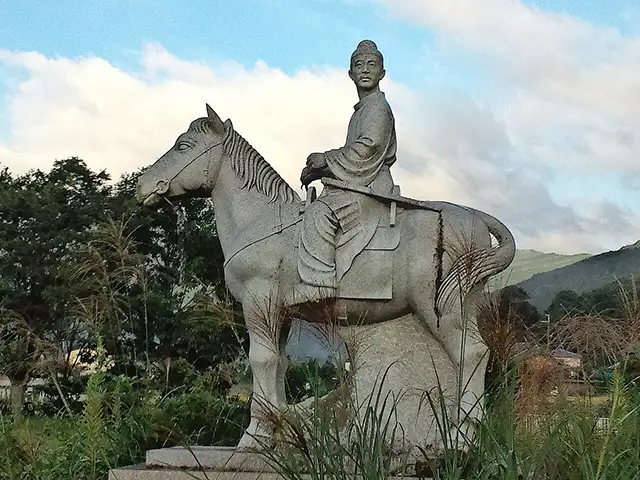
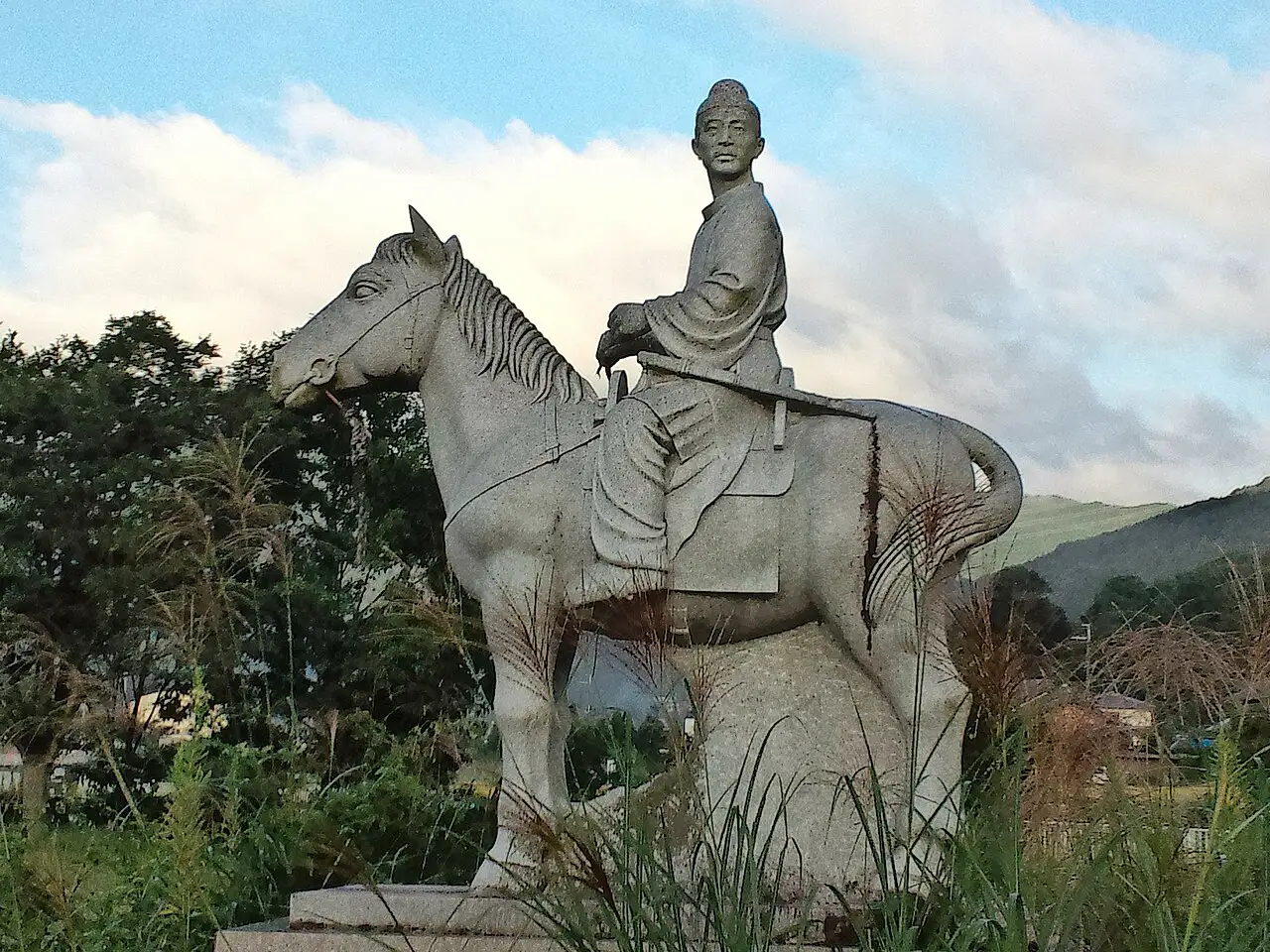
Yanajin33, CC BY-SA 3.0 <https://creativecommons.org/licenses/by-sa/3.0>, via Wikimedia Commons Remains from the Asuka period have been dug up in Uda City, Nara Prefecture. Akino Hitomaro Park was built there to recall the age of the Man'yōshū. In the park stands a stone statue of Kakinomoto no Hitomaro on horseback, gazing toward the east.
The base of the statue is carved with the poem he wrote here, "Hingashi no no ni kagiroi no...".
See the meaning of the poem above. - Ukiyo-e by Katsushika Hokusai
-
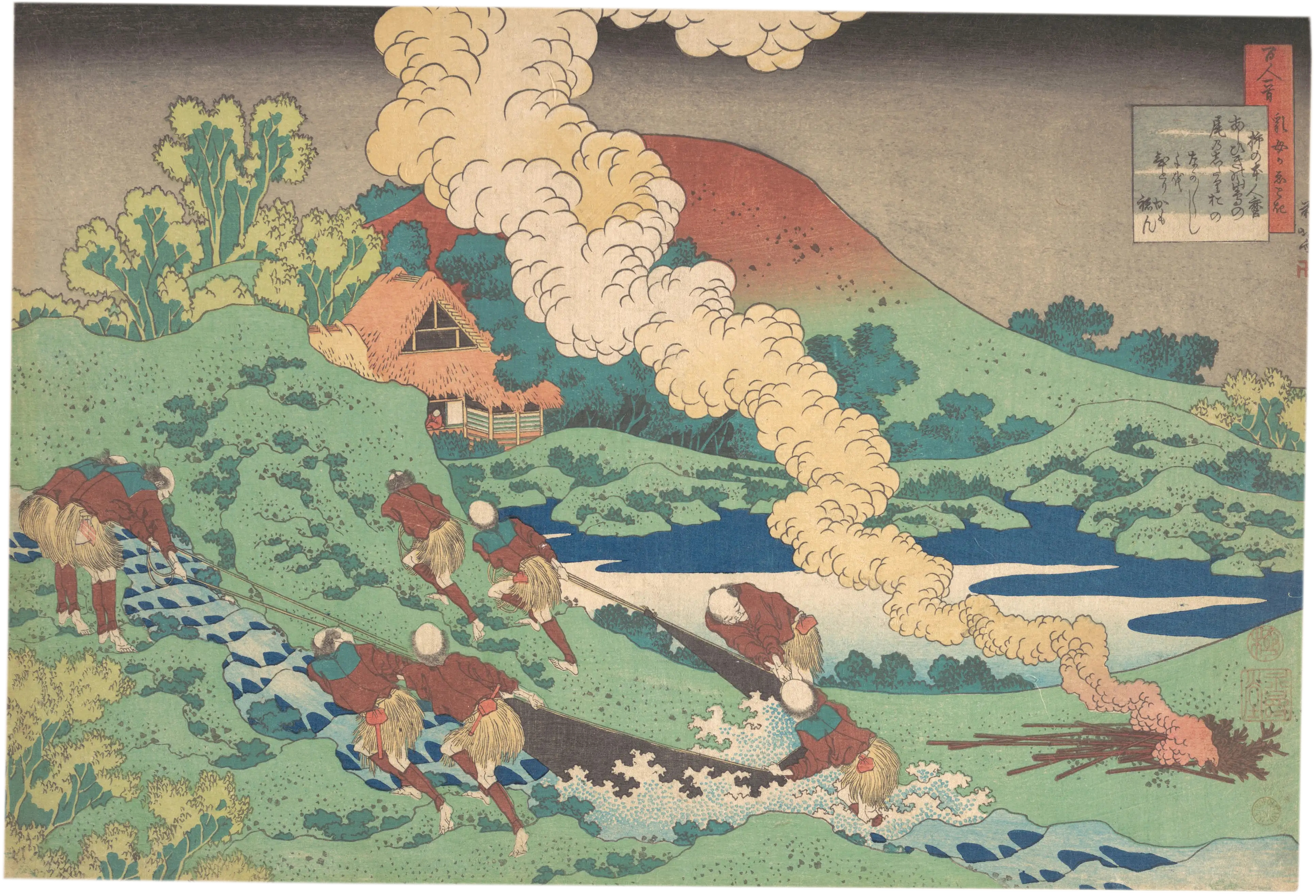
Katsushika Hokusai, CC0, via Wikimedia Commons This print is from One Hundred Poems Explained by the Nurse (Hyakunin Isshu Uba ga Etoki) by Katsushika Hokusai, an ukiyo-e artist of the Edo period. The idea of the series is a nurse explaining the Hyakunin Isshu poems with easy-to-understand pictures.
By drawing people pulling (hiku) a net, Hokusai seems to show the pillow word "ashibiki no." The long trail of smoke may also stand for the long night.
- Utagawa Kuniyoshi's Hyakunin Isshu no Uchi
-
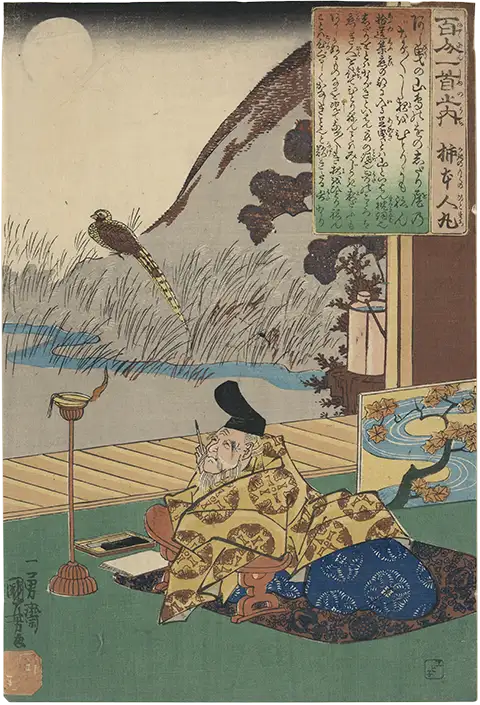
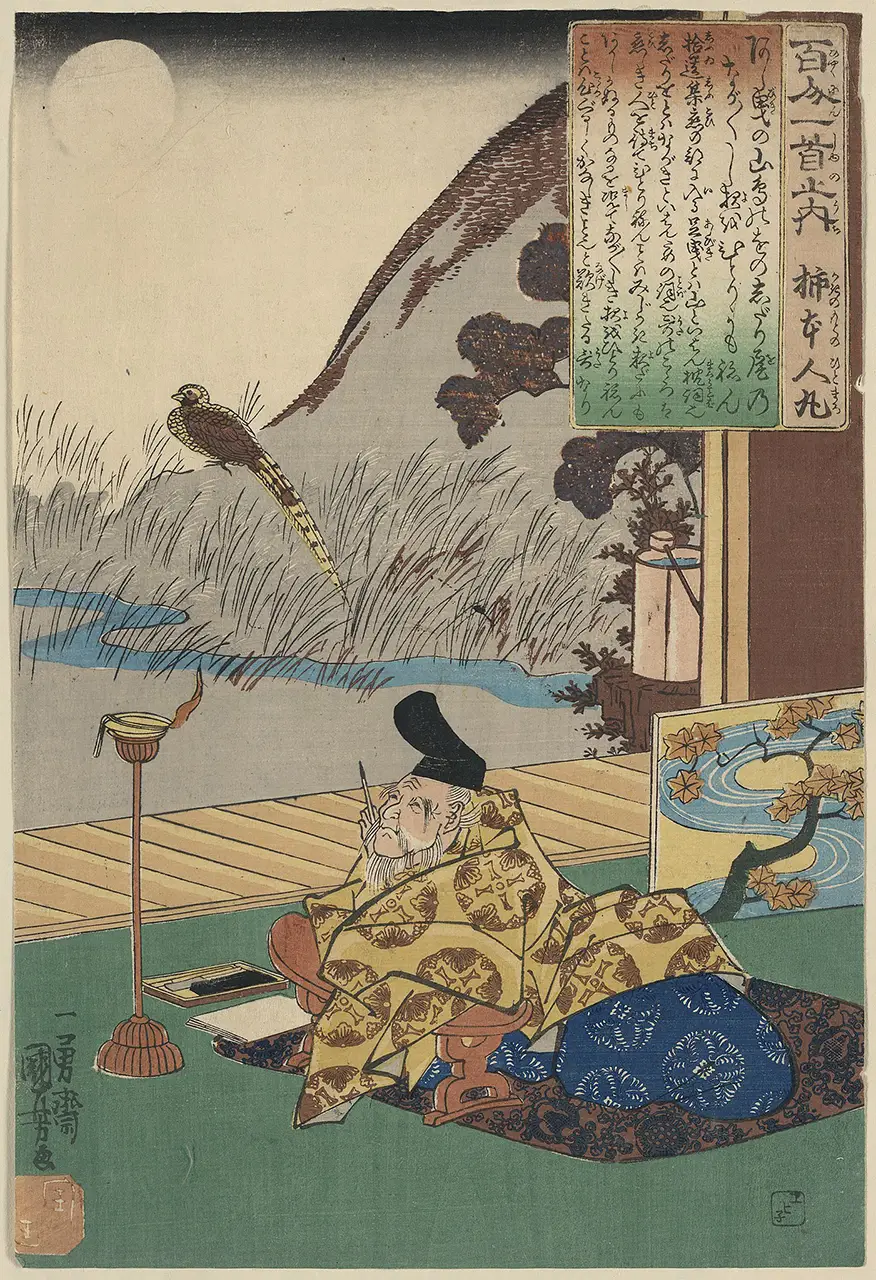
Utagawa, Kuniyoshi, 1798-1861, Public domain, via Wikimedia Commons This ukiyo-e is by Utagawa Kuniyoshi, an artist of the Edo period.
It shows a scene that matches the poem in the Hyakunin Isshu.