


Front of the Card
Back of the Card
Japanese
English
Audio: NHK Creative Library
Read by LibriVox volunteer Larry Wilson.
Audio courtesy of LibriVox
左京大夫道雅
いまはただ
思ひ絶えなむ
とばかりを
人づてならで
言ふよしもがな
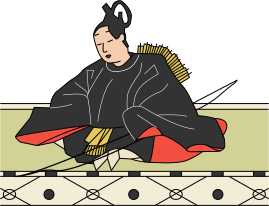
ひとつてな
らていふよ
しもかな

いまは


- Poem 63
- いまはただ
思ひ絶えなむ
とばかりを
人づてならで 言ふよしもがな
Author: Master of the Left Capital Michimasa (992–1054)
Source: Go Shūi Wakashū, Love
- English Verse Translation
- If we could meet in privacy, Where no one else could see, Softly I'd whisper in thy ear This
little word from me— "I'm dying, Love, for thee."
— William N. Porter, 1909
- Modern Translation
- If only I could say it directly: all I want is to end this love. But there is no way to tell you in person.
- Commentary
- Michimasa loved Princess Masako, who had served as the Ise priestess, but her father, Retired Emperor Sanjō, had her closely guarded and forbade him to see her. He put his sorrow at being unable to meet her into this poem.
- About the Poet
- Fujiwara no Michimasa was the eldest son of Fujiwara no Korechika. After his father shot arrows at a retired emperor in the Chōtoku Incident, the family declined. Michimasa held the third rank but had no real power, and grew reckless. His bad behavior earned him the nickname "the wild third rank," and his name was even linked to a murder.
- Poem Illustration
-
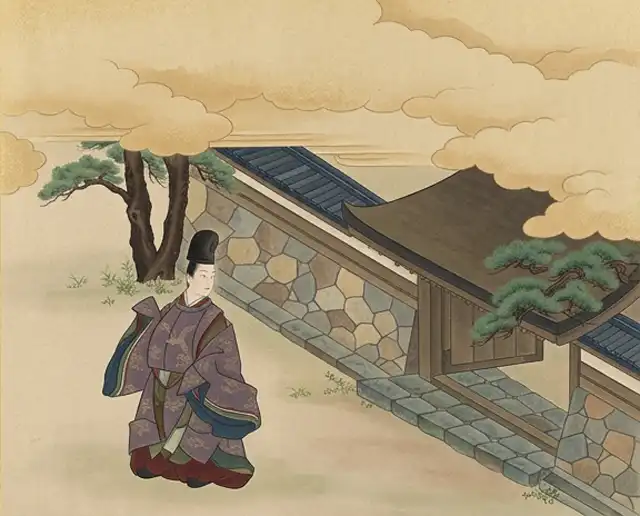
This image is based on an illustration from William N. Porter's A Hundred Verses from Old Japan, his 1909 English translation of the Hyakunin Isshu published in England, colorized and reworked using Adobe Firefly (generative AI).
- Fujiwara no Michimasa: A Short Timeline
-
- 992
- Born as a son of Fujiwara no Korechika
- 1004
- Given Junior Fifth Rank, Lower Grade
- 1016
- Becomes Middle Captain of the Left Palace Guards and is given Junior Third Rank
- 1017
- His secret affair with Princess Masako is found out, and Retired Emperor Sanjō punishes him
- 1026
- Demoted to Acting Master of the Right Capital
- 1054
- Becomes a monk and dies
- Michimasa's Family Tree
-
When Michimasa's father, Fujiwara no Korechika, was sent away from the capital after the Chōtoku Incident, the Naka-no-Kanpaku family, which had been at the height of its power, quickly fell. Fujiwara no Michimasa rose to Middle Captain of the Left Palace Guards at 25 and was given Junior Third Rank, but the next year his secret affair with Princess Masako was discovered. Emperor Sanjō punished him, and the lovers were torn apart. His Hyakunin Isshu poem was written at that time. The poem seems to accept the fate he brought on himself, but his life afterward was so wild that he was called "the wild third rank" (Ara-sanmi) and "the wicked third rank" (Aku-sanmi); in his despair he sometimes turned to violence.
- Appendix
-
- Poems of Tears for a Love He Could Not Meet
- Fujiwara no Michimasa was a man suspected of rough words and deeds, brawls, and even of being behind a murder, and he was called "the wicked third rank."
Yet when his love with Princess Masako was torn apart, even he wrote poems of tragic love full of feeling.In Japanese
逢坂は あづま路とこそ 聞きしかど
心づくしの 関にぞありける afusakaha azumajitokoso kikishikado
kokorozukushino sekinizoarikeru Go Shūi Wakashū, Fujiwara no MichimasaIn English
I had heard that the Ōsaka Barrier was on the road to the eastern lands, but in fact it was a barrier that wears out the heart (kokorozukushi), like a barrier in faraway Tsukushi.
"Kokorozukushi" also contains "Tsukushi," the old name of Kyūshū (today's Fukuoka Prefecture).

In Japanese
榊葉の 木綿四手かけし
そのかみに
押し返しても
似たる頃かな sakakibano yufushidekakeshi sonokamini
oshikaeshitemo nitarukorokana Go Shūi Wakashū, Fujiwara no MichimasaIn English
When you were the Ise priestess, you served the gods, hanging yūshide on sakaki branches, and no one was allowed to touch you. These days, when nothing goes as I wish, it is as if we have been pushed back to that time.
Yūshide are shide made of yū (mulberry-bark fiber). Shide are the strips of paper hung on a tamagushi (sacred branch).
In Japanese
みちのくの 緒絶の橋や これならむ
ふみみふまずみ 心まどはす michinokuno odaenohashiya korenaramu
fumimifumazumi kokoromadohasu Go Shūi Wakashū, Fujiwara no MichimasaIn English
So this is what they mean by the "Odae Bridge" (the bridge where the cord breaks) in Michinoku. Now that I no longer see your letters (fumi), I am thrown into confusion, afraid our bond will break.
The "Odae Bridge" is Odae-bashi in Ōsaki City, Miyagi Prefecture. A tragic legend says that Princess Odae, loved by Emperor Saga, was driven from the capital and threw herself from this bridge.
In Japanese
涙やは またも逢ふべき つまならん
泣くよりほかの なくさめぞなき namidayaha matamoafubeki tsumanaran
nakuyorihokano nakusamezonaki Go Shūi Wakashū, Fujiwara no MichimasaIn English
Will shedding tears give me a chance to meet her again? Of course not. Yet I have no comfort but to weep.
"Tsuma," written with the character for "edge," means a chance or a clue.
- His Father Korechika's Last Words
- His father, Korechika, who had brought about the fall of the Naka-no-Kanpaku family, told Michimasa in his will: "Rather than live by flattering others, become a monk."
Late in life, in 1054, Michimasa became a monk, just as his father had told him. - Utagawa Kuniyoshi's Hyakunin Isshu no Uchi
-
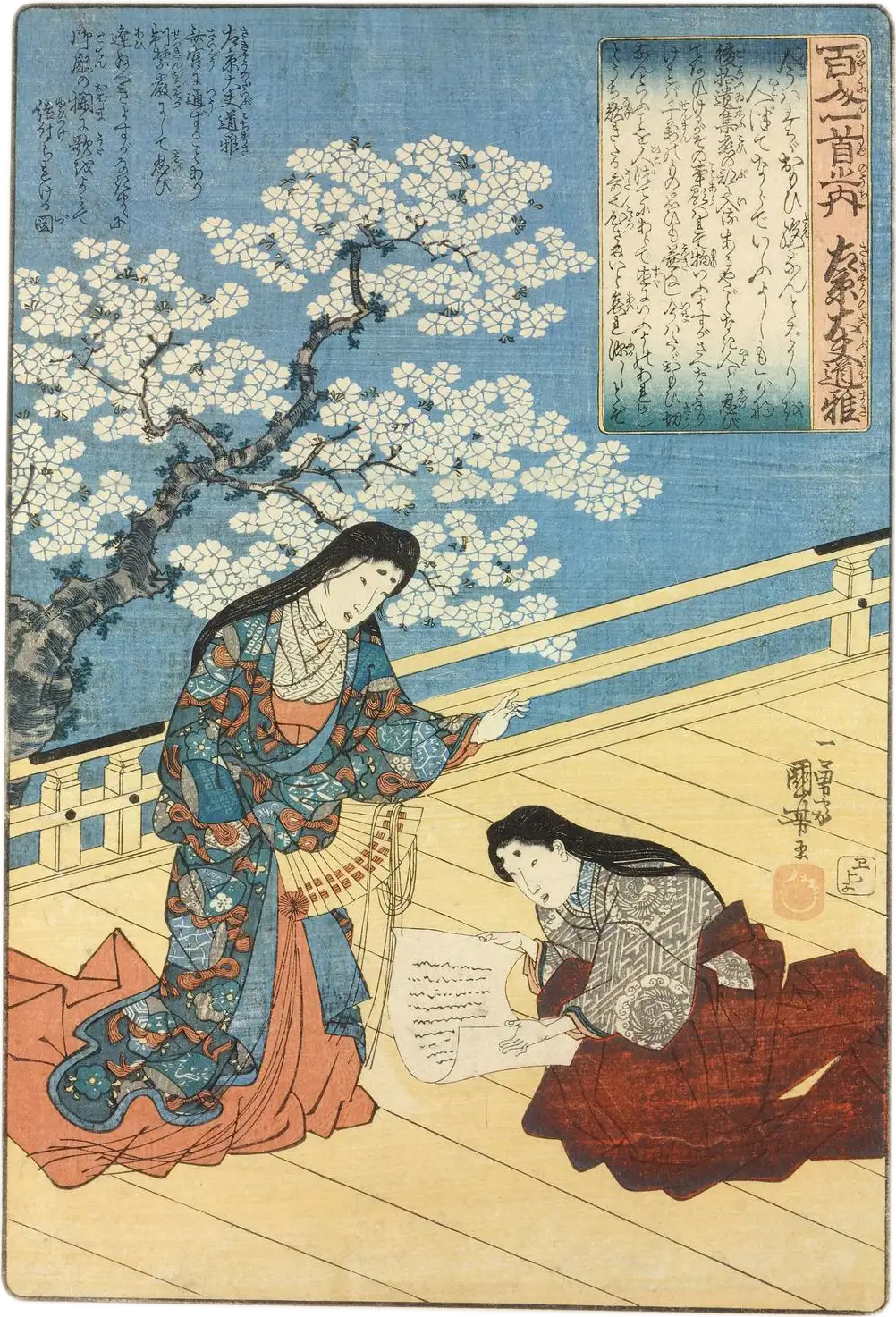
British Museum, Public domain, via Wikimedia Commons This ukiyo-e print is by Utagawa Kuniyoshi, an artist of the Edo period.
It shows a scene to go with the Hyakunin Isshu poem.