Front of the Card
Back of the Card
Japanese
English
Audio: NHK Creative Library
Read by LibriVox volunteer Larry Wilson.
Audio courtesy of LibriVox
中納言家持
かささぎの
渡せる橋に
おく霜の
白きをみれば
夜ぞふけにける
しろきをみ
れはよそふ
けにける

かさ


- Poem 6
- かささぎの
渡せる橋に
おく霜の
白きをみれば 夜ぞふけにける
Author: Middle Counselor Yakamochi (c. 718–785)
Source: Shin Kokin Wakashū, Winter
- English Verse Translation
- When on the Magpies' Bridge I see The Hoar-frost King has cast His sparkling mantle, well I know
The night is nearly past, Daylight approaches fast.
— William N. Porter, 1909
- Modern Translation
- Looking up at the Milky Way that magpies wing across — its white shimmer seems to be scattered frost. The night deepens.
- Commentary
- The Tanabata legend came to Japan from China in the Nara period. The poem describes the Milky Way across the winter night sky, sparkling as if frost had settled on it.
- About the Poet
- Ōtomo no Yakamochi was a Nara-period poet thought to have compiled the Man'yōshū. He clashed with the Fujiwara clan and was demoted and promoted many times before reaching Middle Counselor. After his death he was accused of a plot and stripped of his rank, but some 20 years later Emperor Kanmu, fearing his angry spirit, pardoned him.
- Poem Illustration
-
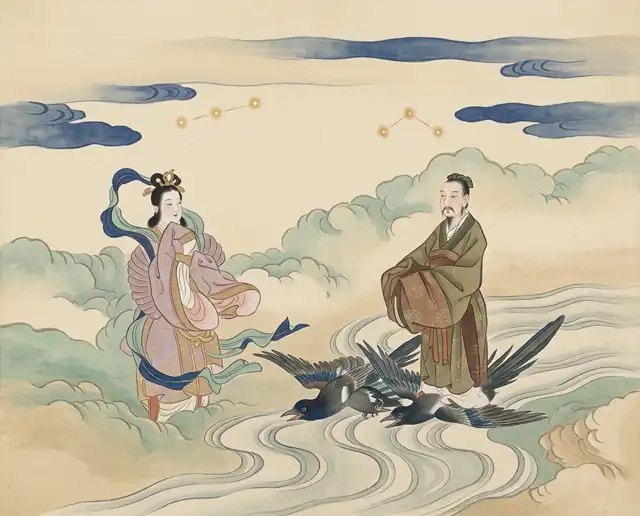
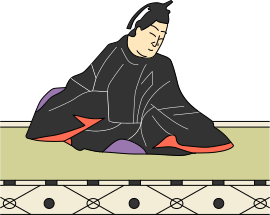
This image is based on an illustration from William N. Porter's A Hundred Verses from Old Japan, his 1909 English translation of the Hyakunin Isshu published in England, colorized and reworked using Adobe Firefly (generative AI).
- Ōtomo no Yakamochi: A Short Timeline
-
- c. 718
- Born as a son of Ōtomo no Tabito
- 738
- Becomes a palace guard (Udoneri)
- 746
- Becomes governor of Etchū Province
- 751
- Becomes Minor Counselor and returns to the capital
- 758
- Becomes governor of Inaba Province
- 759
- In Inaba, writes the last poem of the Man'yōshū
- 780
- Becomes Councillor (Sangi)
- 783
- Becomes Middle Counselor
- 785
- Dies
After his death, he is blamed for the murder of Fujiwara no Tanetsugu and stripped of his rank - 806
- Pardoned and given back his rank
- Notes
-
- Counted as one of the Thirty-Six Immortal Poets
- Ōtomo no Yakamochi's Family Tree and the Fall of the Ōtomo Clan
-
In 785, Middle Counselor Fujiwara no Tanetsugu, who was overseeing the building of the new capital Nagaoka-kyō, was shot dead with arrows. Ōtomo no Takeyoshi was arrested as one of the killers, and after questioning, Ōtomo no Yakamochi (Middle Counselor, Junior Third Rank) was named as the leader of the plot, and the Ōtomo clan was punished as a group. Although Yakamochi had died about a month before the murder, he was refused burial and removed from the official records. But in 806, more than 20 years after his death, Yakamochi was cleared and given back the Junior Third Rank.
Emperor Kanmu's younger brother, Prince Sawara, was also said to be involved. He lost his place as crown prince and is said to have died after refusing food on the way to exile in Awaji. Before becoming crown prince, he had been a monk at Tōdai-ji Temple. One reason for moving the capital from Heijō-kyō to Nagaoka-kyō was to get away from the powerful Buddhist temples of Heijō-kyō. Because Prince Sawara had close ties to Tōdai-ji, he may have been seen as against the move and suspected of the murder.
Later, in 866, the Ōtenmon gate of the Heian palace was set on fire (the Ōtenmon Incident). Tomo no Yoshio, an Upper Counselor, was named as the culprit and exiled, and once again his whole clan was punished with him. After this incident, the Ōtomo clan fell into decline.
As the Ōtomo clan declined, the Northern branch of the Fujiwara grew powerful, so some believe the Northern Fujiwara were secretly behind both incidents.
- Appendix
-
- Tanabata
-

Tanabata is a legend that began in China. The Weaver Girl, who wove clothes by order of the Emperor of Heaven (the highest god), married the Cowherd. After that, the two only played and stopped working. The gods' clothes became ragged, and the Cowherd's cattle grew thin and sick. In anger, the Emperor of Heaven separated them on opposite banks of the Milky Way. Then the two did nothing but cry and could not work, so he allowed them to meet once a year, on the night of the seventh day of the seventh month. On that night, magpies form a bridge so the two can meet. This is the story of Tanabata.
In Japan, the Chinese Tanabata story was joined with an old Japanese legend of the weaving maiden (Tanabatatsume), and the Cowherd came to be called Hikoboshi. The custom of writing wishes on strips of paper in five colors and hanging them on bamboo is unique to Japan.
- The Man'yōshū
-
The Man'yōshū, compiled in the 7th–8th centuries, is the oldest surviving collection of Japanese poetry. Hiragana did not yet exist, so it was written in man'yōgana, Chinese characters used for their sounds or meanings, the way hiragana is used today.
Besides about 4,200 tanka (5-7-5-7-7 syllables), it has about 260 chōka, long poems that repeat lines of 5 and 7 syllables and end with 5-7-7, and about 60 sedōka, which repeat 5-7-7 twice. - The Top 4 Poets in the Man'yōshū
-
This graph shows the top 4 poets in the Man'yōshū, along with the number of poems by unknown authors. The Man'yōshū holds 4,516 poems by people of every class, from farmers to emperors, written all over Japan from Tōhoku to Kyushu. Nearly half of them, about 2,000, are by unknown authors. The poets with the most poems are:
- Ōtomo no Yakamochi: 473 poems
- Kakinomoto no Hitomaro: 88 poems
- Lady Ōtomo no Sakanoue
(who raised Yakamochi): 84 poems - Ōtomo no Tabito
(Yakamochi's father): 78 poems
- Takaoka, Home of the Man'yōshū
-
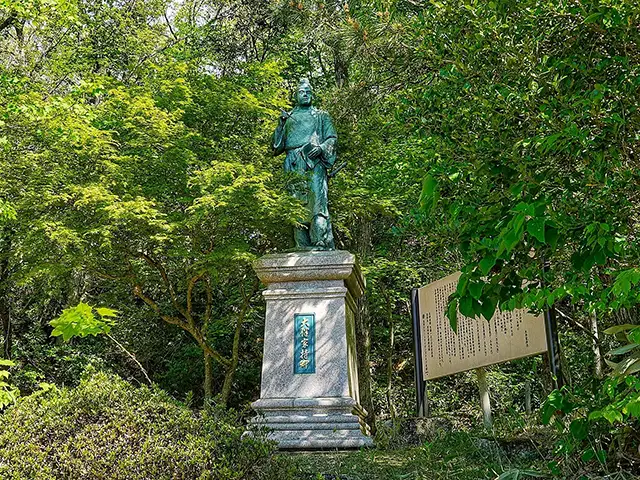
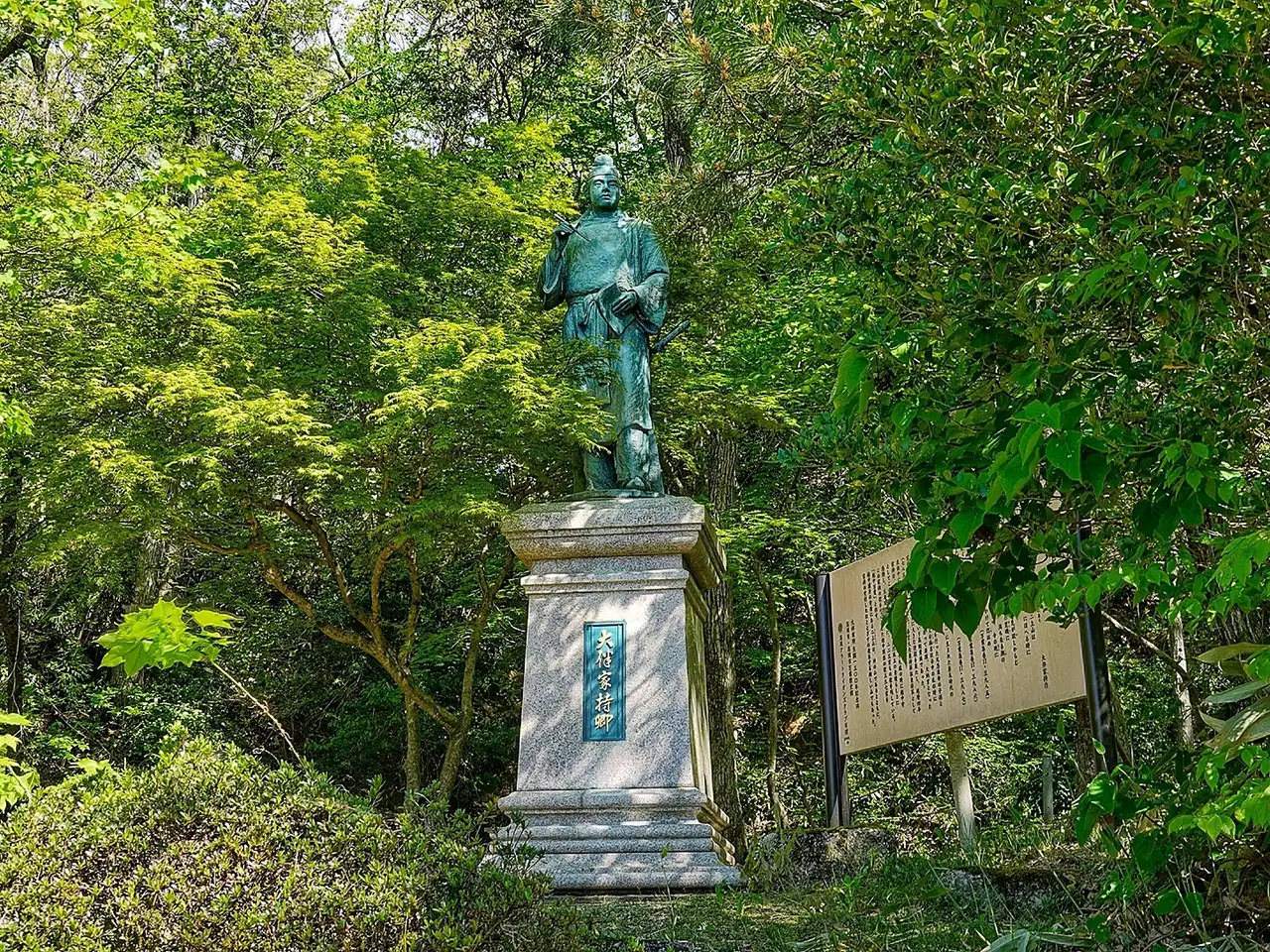
The photo shows the statue of Ōtomo no Yakamochi on Mount Futagami (274 m) in Takaoka City, Toyama Prefecture. Yakamochi lived in Etchū Province for about five years, from 746 to 751, as its governor.
Of the 4,516 poems in the Man'yōshū, 473, about one in ten, are by Yakamochi. Nearly half of them, 223 poems, were written while he was in Etchū.
Because Yakamochi wrote so many poems there, Takaoka is called "the home of the Man'yōshū."
- A Poem About a Calm Spring Day
- Yakamochi went to Etchū Province (present-day Toyama Prefecture) as its governor in 746. He wrote this poem there.

In Japanese
春の苑 紅にほふ 桃の花
下照る道に 出で立つ娘子 harunosono kurenainihofu momonohana
shitaterumichini idetatsuotome Man'yōshū, Ōtomo no YakamochiIn English
The spring garden glows with crimson peach blossoms.
On the path lit by their color, a young girl appears and stands. - A Poem of Spring Sadness
- Yakamochi wrote the next poem in Yamato Province (present-day Nara Prefecture) in 753.
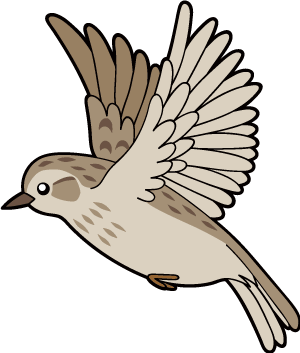
In Japanese
うらうらに 照れる春日に
ひばり上がり
心悲しも
独りし思へば uraurani tererukasugani hibariagari
kokorokanashimo hitorishiomoheba Man'yōshū, Ōtomo no YakamochiIn English
On a bright, mild spring day, a skylark soars high into the sky.
Alone with my thoughts, I feel drawn into the sky, and sad. - A Poem for the New Year
- Yakamochi went to Inaba Province (present-day Tottori Prefecture) as its governor in 758 and wrote this poem on New Year's Day the next year. It is the very last poem in the Man'yōshū. "Iya shike" means "more and more often," linking the falling snow with good things (yogoto).

In Japanese
新しき 年の初めの 初春の
今日降る雪の いや重け吉事 atarashiki toshinohajimeno hatsuharuno
kefufuruyukino iyashikeyogoto Man'yōshū, Ōtomo no YakamochiIn English
At the start of the new year, in early spring,
may good things pile up more and more, like the snow falling today. - Poems by Lady Kasa, Who Loved Yakamochi in Vain
-
Lady Kasa (Kasa no Iratsume) loved Yakamochi with all her heart and wrote many poems for him. Twenty-nine of her poems are in the Man'yōshū, and every one is about her love for Yakamochi. But her love was never returned. Here is one of them.

In Japanese
思ふにし 死にするものに
あらませば
千遍そわれは 死に返らまし omofunishi shinisurumononi aramaseba
chitabisowareha shinikaeramashi Man'yōshū, Lady KasaIn English
If one could die of love,
I would have died a thousand times over. - Mibu no Tadamine's Poem Based on This One
-
Mibu no Tadamine, who served as an attendant to Fujiwara no Sadakuni, wrote the next poem borrowing from Yakamochi's (honkadori). One night, Sadakuni, drunk, dropped in on Minister of the Left Fujiwara no Tokihira, who asked suspiciously, "Did you just stop by on your way somewhere?" Tadamine then made this poem on the spot, borrowing from Yakamochi's poem. The Yamato Monogatari says his quick wit eased the mood.
In Japanese
かささぎの 渡せる橋の 霜の上を
夜半にふみわけ ことさらにこそ kasasagino wataseruhashino shimonoueo
yowanifumiwake kotosaranikoso Yamato Monogatari, Mibu no TadamineIn English
Treading at midnight through the frost on the steps of your hall, like the bridge the magpies make,
I have come here to you on purpose. - Kasasagi Bridge
-
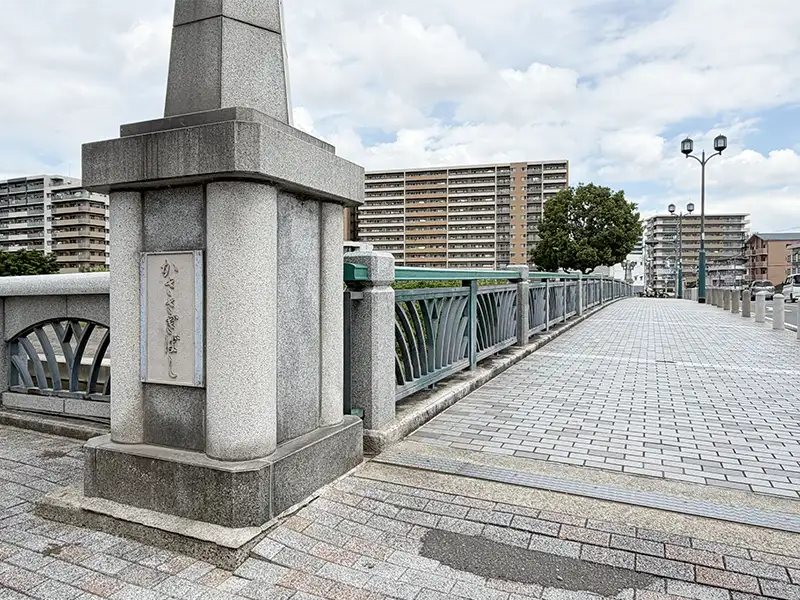
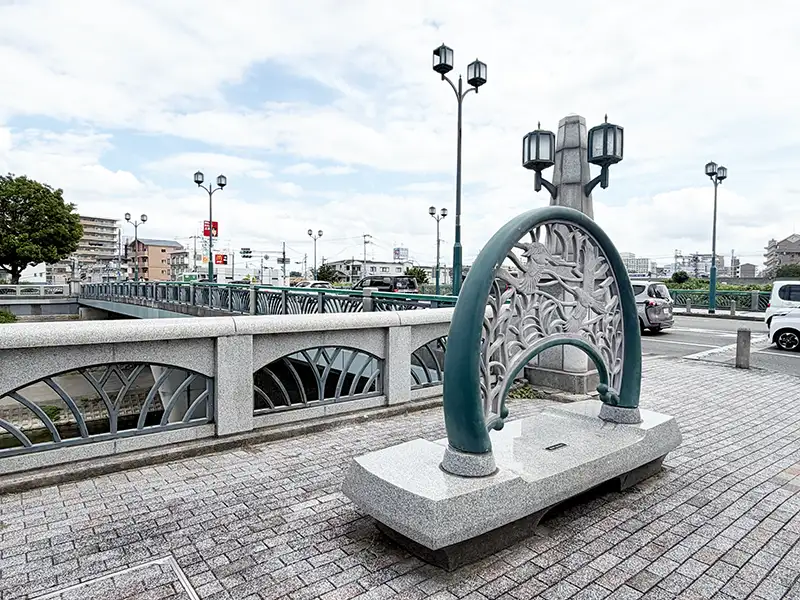
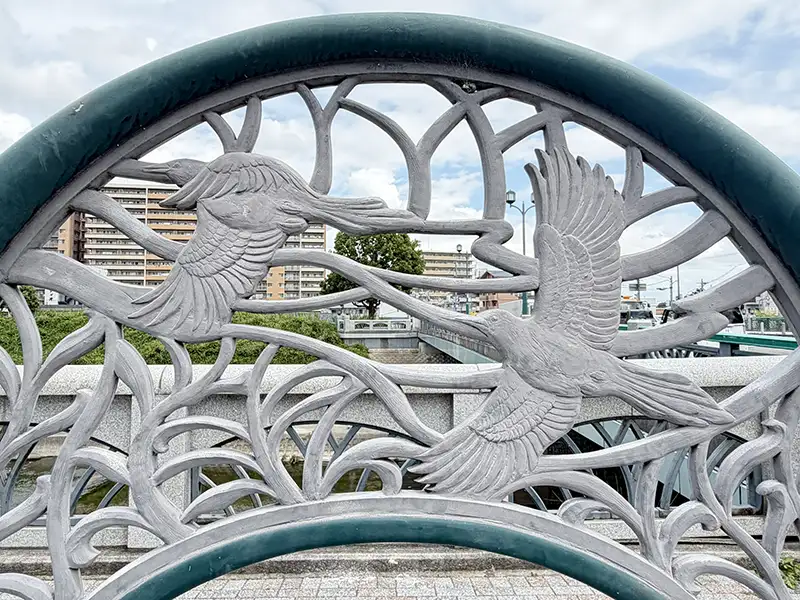
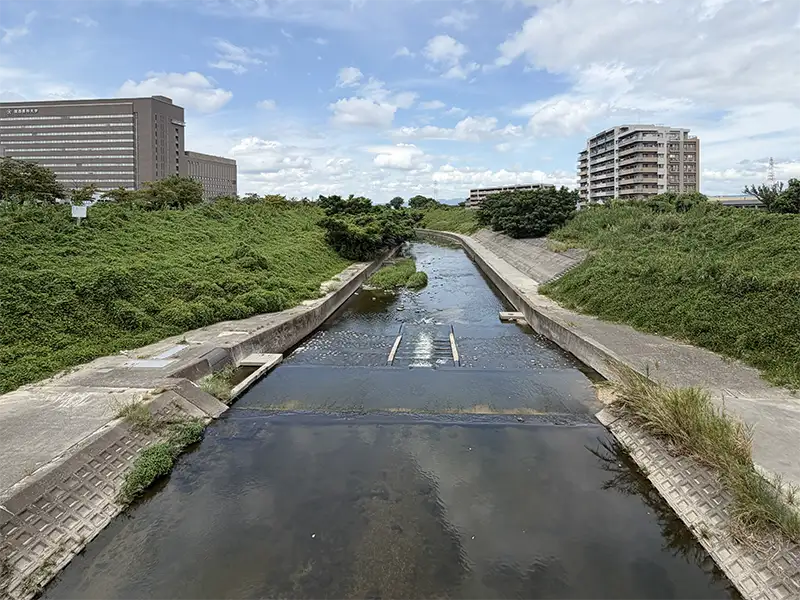
In Katano City, Osaka Prefecture, flows the Amanogawa River, named after the Milky Way (Amanogawa) of the Tanabata legend. "Kasasagi Bridge" crosses its lowest stretch. The bridge's name also comes from the magpies (kasasagi) of the Tanabata story.
It is about a 5-minute walk from Hirakatashi Station on the Keihan Line.
(Photo taken August 10, 2026)
- The Amanogawa River, Visited by Ariwara no Narihira
-
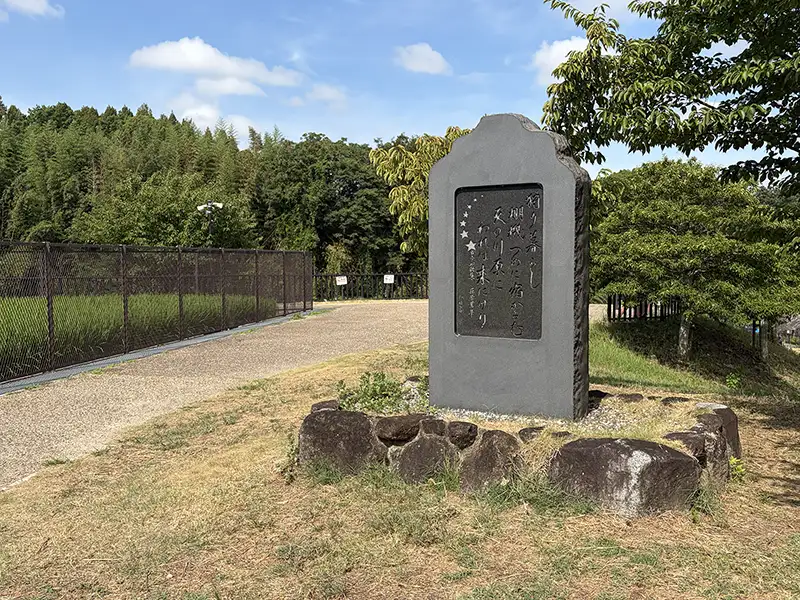
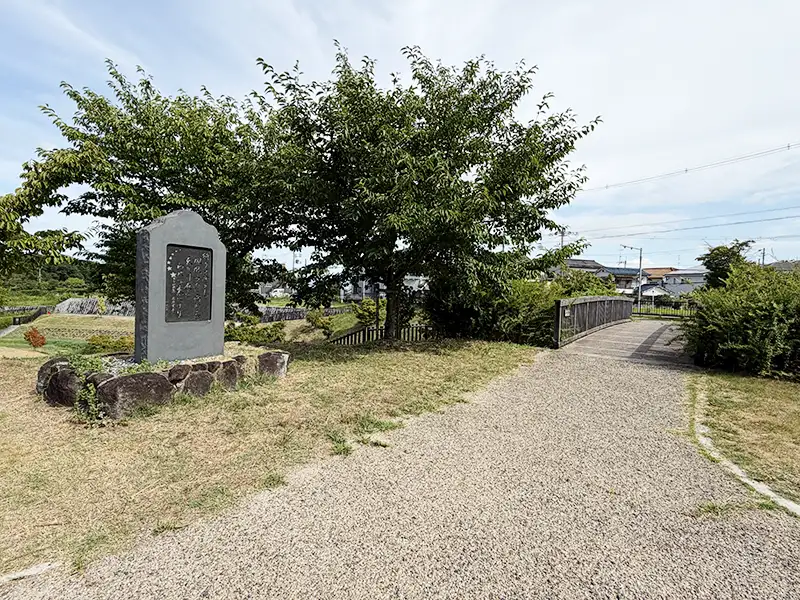
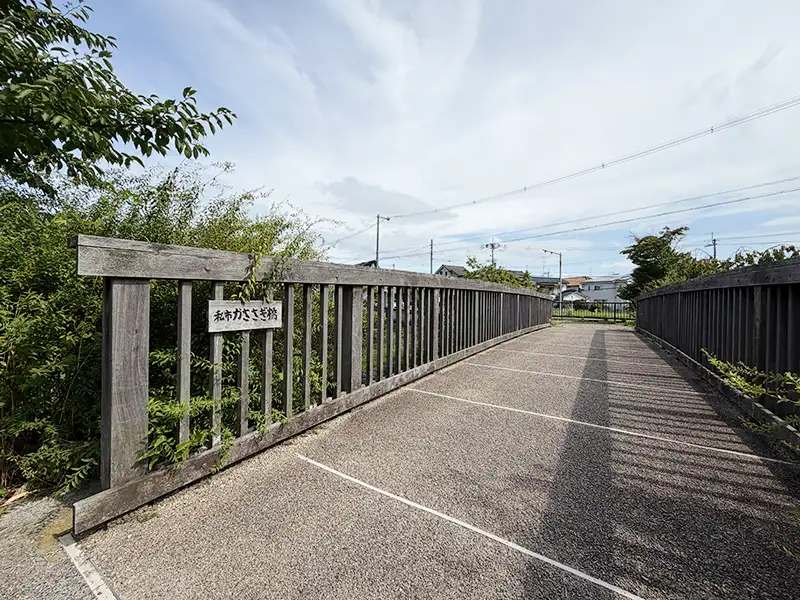
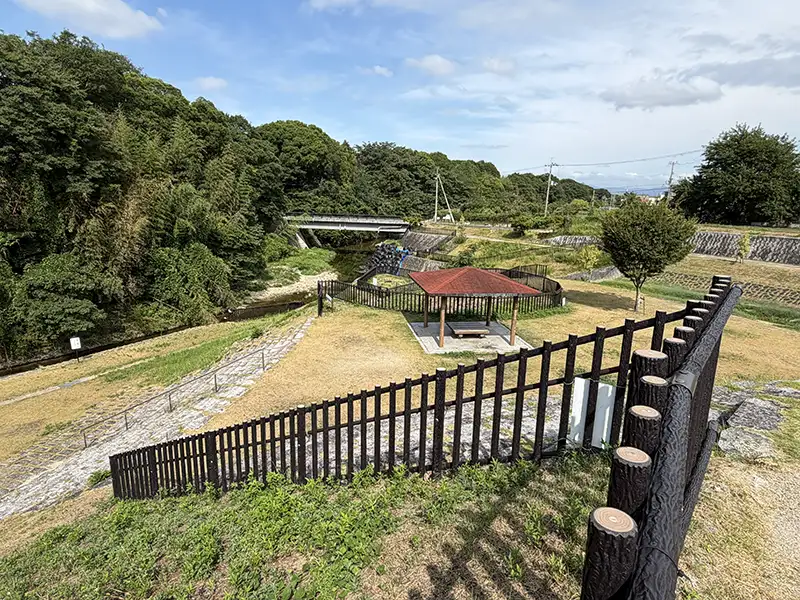
Going upstream along the Amanogawa, you reach Kisaichi Waterside Plaza (Kisaichi Mizube Plaza), where you can play in the river and walk in rich nature.
In the Heian period, the area around Katano was a hunting ground for the imperial family and nobles. Ariwara no Narihira is known to have come here for falconry, and a stone monument with the poem he is said to have written here stands quietly nearby. Next to it is a charming little bridge, Kisaichi Kasasagi Bridge.
It is about a 5-minute walk from Kisaichi Station on the Keihan Katano Line.
(Photo taken August 10, 2026)
- Narihira's Poem About the Amanogawa
-
This poem by Ariwara no Narihira is carved on the monument at Kisaichi Waterside Plaza. What did Narihira feel about the Tanabata legend?
In Japanese
狩り暮らし 棚機つめに 宿からむ
天の河原に 我は来にけり karikurashi tanabatatsumeni yadokaramu
amanokawarani warehakinikeri Kokin Wakashū, Ariwara no NarihiraIn English
I have hunted until evening, so tonight I will ask the Weaver Girl for a place to stay, for I have come to the banks of the River of Heaven.
- Ukiyo-e by Katsushika Hokusai
-
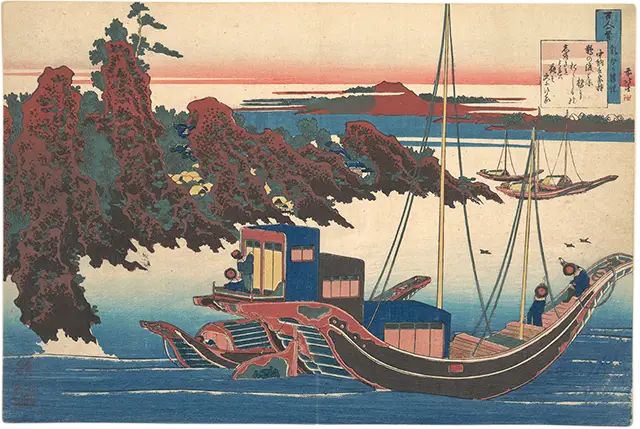
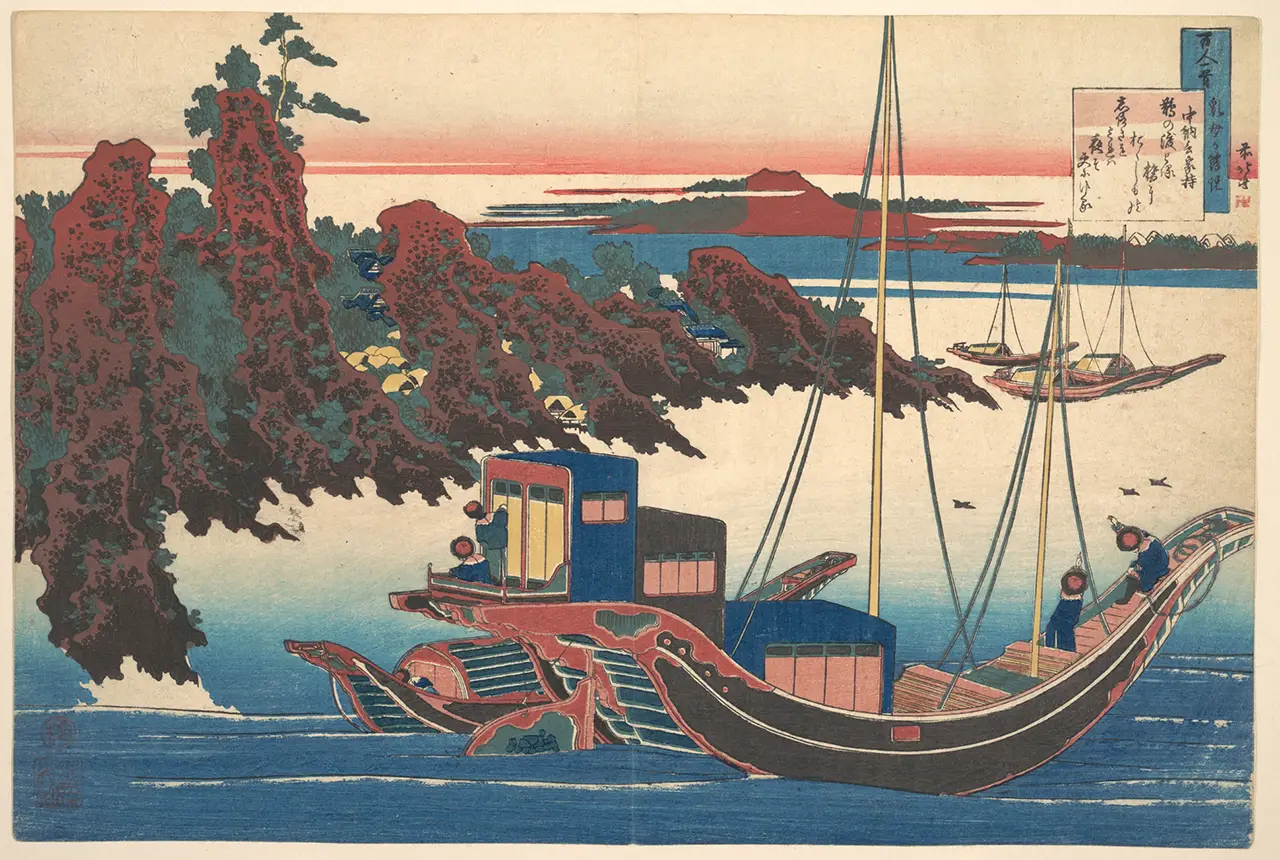
Katsushika Hokusai, CC0, via Wikimedia Commons This print is from One Hundred Poems Explained by the Nurse (Hyakunin Isshu Uba ga Etoki) by Katsushika Hokusai, an ukiyo-e artist of the Edo period.
Perhaps because the Tanabata legend (the bridge of magpies) came from China, Hokusai drew a Chinese ship. Could the bird the sailor at the bow is pointing at be a magpie?
- Utagawa Kuniyoshi's Hyakunin Isshu no Uchi
-
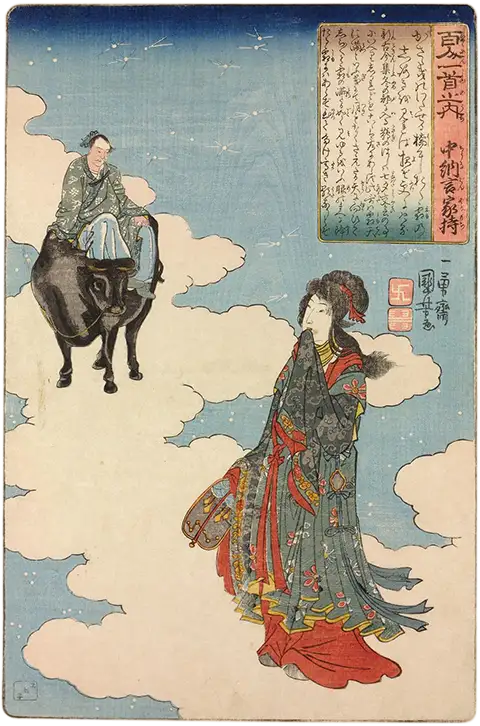
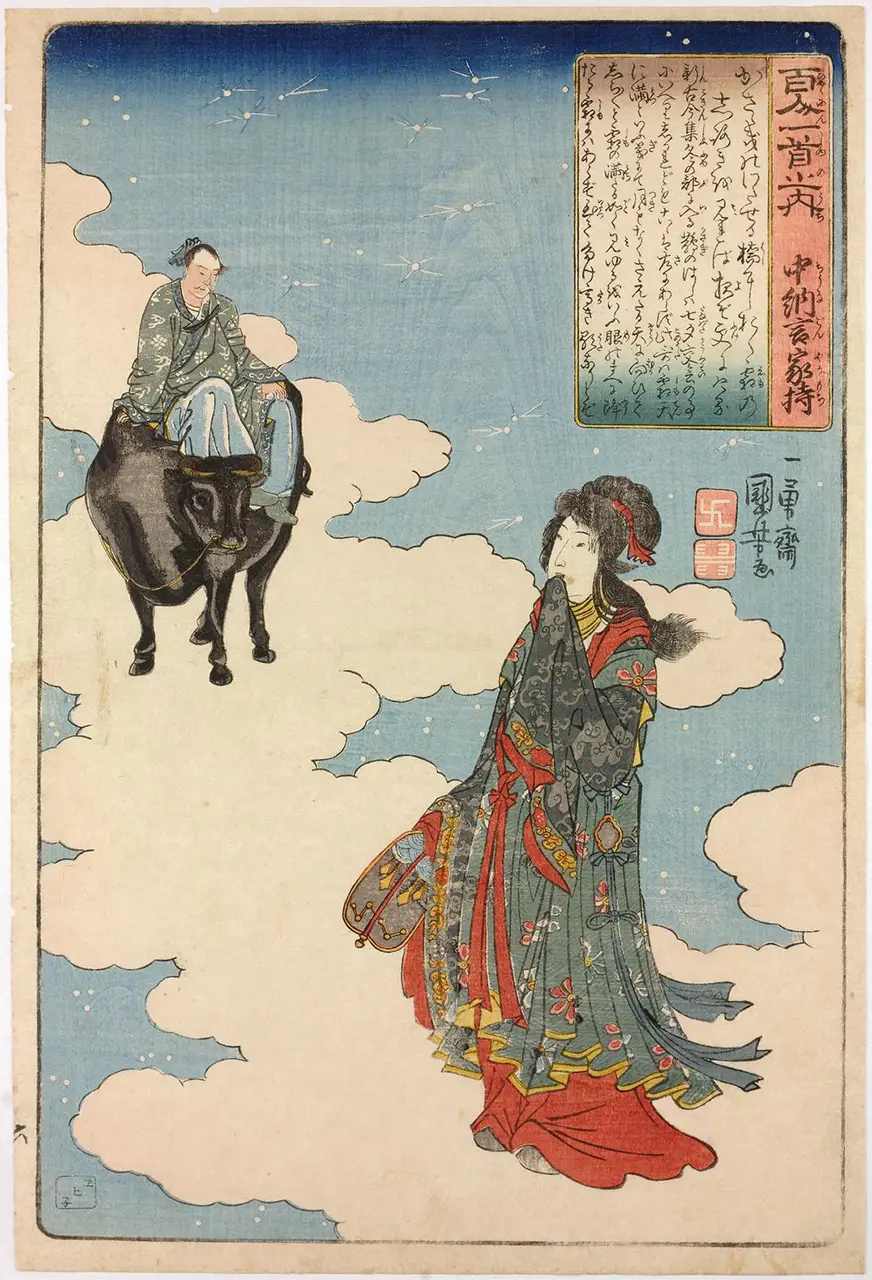
British Museum, Public domain, via Wikimedia Commons This ukiyo-e is by Utagawa Kuniyoshi, an artist of the Edo period.
It shows a scene that matches the poem in the Hyakunin Isshu.