


The Hyakunin Isshu's
Prefatory Poem
In competitive karuta, a poem is read aloud as the joka (prefatory poem) before each game begins: "Sakuya kono hana," also known as the Naniwazu Poem.
This column introduces this poem.
In Japanese
難波津に 咲くやこの花 冬ごもり
今は春べと 咲くやこの花 naniwazuni sakuyakonohana fuyugomori
imahaharubeto sakuyakonohana
In English
At Naniwa harbor the flowers are blooming! They kept to their buds all through the winter, and now, saying spring has come, the flowers are blooming!
About the Poet, the Scholar Wani
The poem is said to have been composed by Wani, a scholar who came to Japan from the kingdom of Baekje in the Kofun period, around the 4th to 5th century. He appears in the Nihon Shoki and the Kojiki, and is said to have served Emperor Ōjin and brought Confucianism and Chinese characters to Japan. In particular, the ten volumes of the Analects and the one volume of the Thousand Character Classic that he is said to have brought with him are said to have laid the foundation of learning in Japan.
However, the tradition that Wani composed this poem has been pointed out to contain a contradiction in time. The Thousand Character Classic, which he is said to have brought, is thought not to have existed yet in the age when Emperor Nintoku is said to have reigned. For this reason, Wani is sometimes said to be a legendary figure, but a "Traditional Tomb of Wani" honoring his achievements stands in Fujisaka, Hirakata City, Osaka Prefecture.
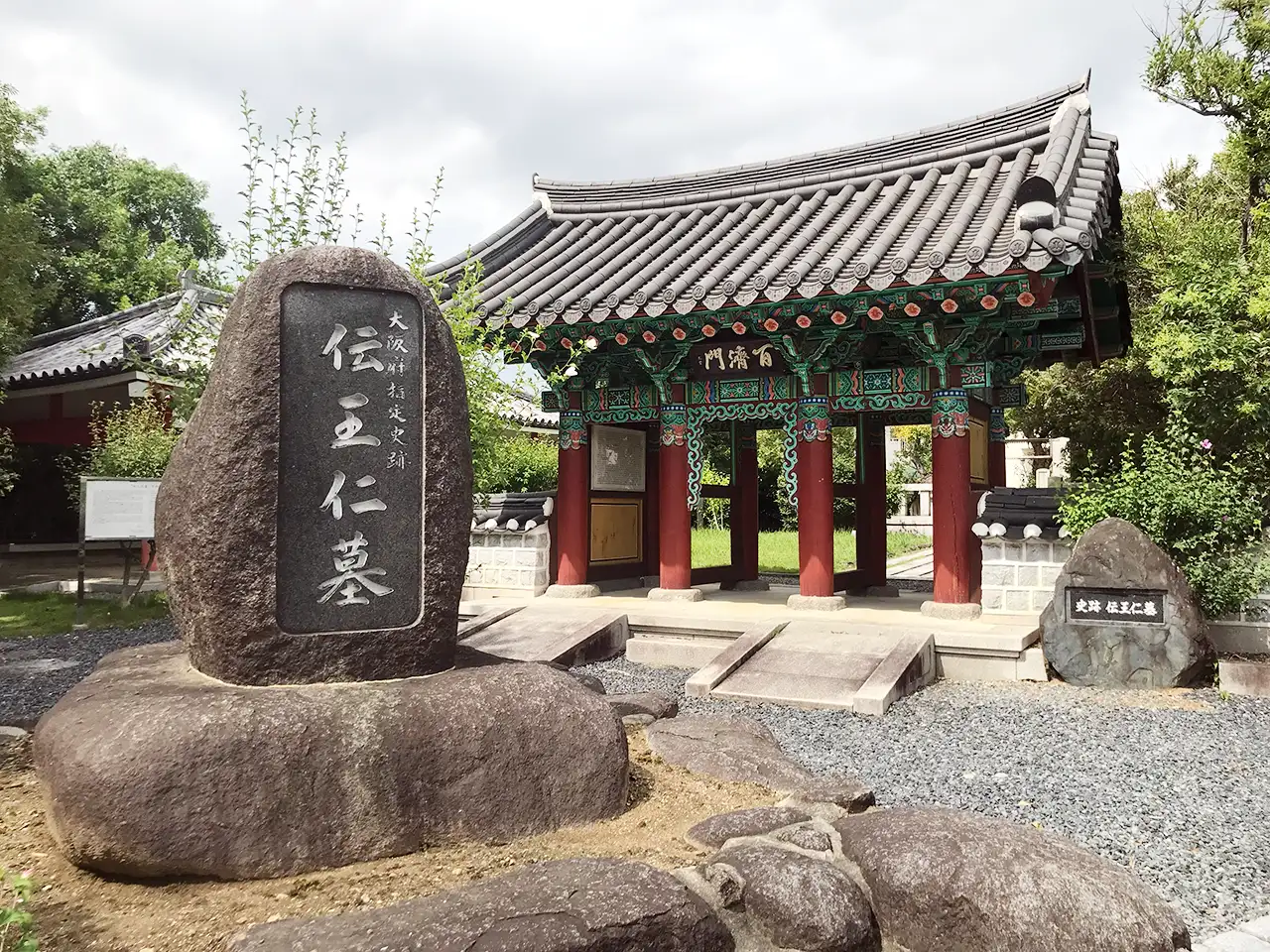
The Traditional Tomb of Wani in Hirakata City, Osaka Prefecture. The brightly colored gate in the back is the "Baekje Gate." It is said that the materials and equipment were brought over from Korea and that it was built by Korean master temple carpenters.
It is a 10-minute walk from Nagao Station on the JR Gakkentoshi Line.
(Photo taken on August 14, 2025)
"Sakuya Kono Hana" (the Naniwazu Poem),
the Basis of Learning to Write
The Naniwazu Poem is known to have played an important role in learning to write. Excavations across Japan have turned up wooden tablets (mokkan) from the 7th century and the Nara period, and among those with poems written on them, the Naniwazu Poem appears more often than any other. These tablets are thought to have been used for writing practice in an age when paper was still precious.
In the Kana Jo, the preface to the Kokin Wakashū compiled in 913–914, the Naniwazu Poem and the Asakayama Poem are described as "like the father and mother of poetry, the first poems learned by those learning to write." And in The Tale of Genji, finished around 1008, there is a scene in which Hikaru Genji asks to marry the young Murasaki, and her grandmother answers, "She cannot yet even write out the Naniwazu Poem properly, so it would be of no use." This shows that the poem had become firmly established as the basis of learning to write at the time.
A Melody of Hope That Echoes Across the Ages
Today the Naniwazu Poem is known as the prefatory poem of competitive karuta, but its essence may lie not only in symbolizing the beginning of learning to write and to compose waka, but also in the way it has stayed close to people's hearts across the ages. Even though it was composed long ago in the Kofun period, its universal scene and its message full of hope still speak naturally to us today.
Flowers that "kept to their buds through the winter" beginning to bloom as spring arrives is a scene familiar to everyone, and one that makes us feel hope. Spring, coming after a hard winter has been endured, is truly a new beginning and hope itself. Perhaps it is precisely because the poem stays close to people and lets them feel the joy of living that it has been handed down for so long.