


The Spark of the Waka Boom:
the Kana Jo Preface of the Kokin Wakashū
The Heian period is often thought of as the golden age of waka, but in the early Heian period waka was not yet popular. After the missions to Tang China were discontinued, however, a uniquely Japanese culture known as kokufū bunka (national-style culture) began to flourish. In this climate, Emperor Daigo set out to revive waka, which had long been in decline, and ordered the compilation of the Kokin Wakashū. Ki no Tsurayuki, who led the compilation, wrote a preface in hiragana at the beginning of the anthology: the Kana Jo. This was the first time hiragana was used in an official document, and it became a symbol of the revival of waka. Aristocrats who had been devoted to Chinese poetry gradually grew interested in waka, and this eventually sparked a great waka boom.
Here we introduce the famous opening passage of the Kana Jo. In it, Ki no Tsurayuki says that waka is born from the "heart," and that it expresses scenes and feelings in "words" by entrusting them to the things we see and hear.
In Japanese
やまとうたは、人の心を種として、Yamato uta wa, hito no kokoro o tane to shite, 万の言の葉とぞなれりける。yorozu no koto no ha to zo narerikeru. 世の中にある人、Yo no naka ni aru hito, ことわざ繁きものなれば、kotowaza shigeki mono nareba, 心に思ふことを、kokoro ni omou koto o, 見るもの聞くものにつけて、miru mono kiku mono ni tsukete, 言ひ出せるなり。iiidaseru nari. 花に鳴く鶯、Hana ni naku uguisu, 水に住む蛙の声を聞けば、mizu ni sumu kawazu no koe o kikeba, 生きとし生けるもの、ikitoshi ikeru mono, いづれか歌をよまざりける。izure ka uta o yomazarikeru. 力をも入れずしてChikara o mo irezu shite 天地を動かし、ametsuchi o ugokashi, 目に見えぬ鬼神をもme ni mienu onikami o mo あはれと思はせ、aware to omowase, 男女のなかをも和らげ、otoko onna no naka o mo yawarage, 猛き武士の心をもtakeki mononofu no kokoro o mo 慰むるは歌なり。nagusamuru wa uta nari.
In English
Japanese poetry takes the human heart as its seed
and grows into countless leaves of words.
The people of this world,
caught up in so many affairs,
take what they feel in their hearts
and, entrusting it to the things they see and hear,
put it into words as poems.
When we hear the warbler singing among the blossoms,
or the voice of the frog that lives in the water,
which of all living things
does not compose poetry?
Without using any force,
it moves the gods of heaven and earth,
stirs even the invisible spirits
to deep feeling,
brings men and women closer together,
and soothes even the hearts
of fierce warriors: this is what poetry does.
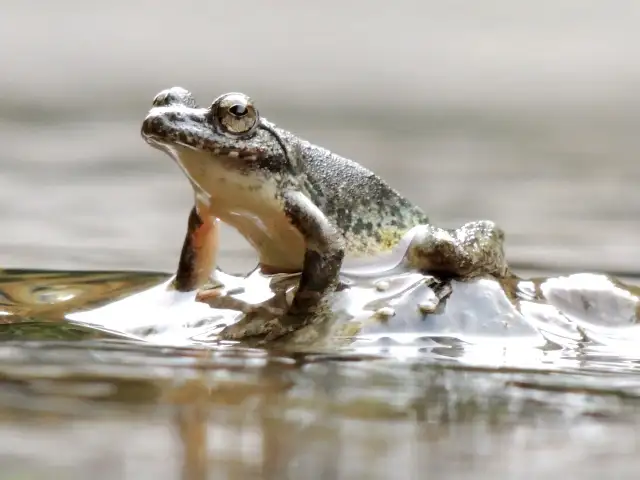
The "frog that lives in the water" is the kajika frog. As the photo shows, it looks rather plain, but it sings beautifully, like a bird. In kanji, kajika-gaeru is written 河鹿蛙, "river deer frog." It seems to have been named because its call resembles that of a male deer, but to my ear it actually sounds closer to birdsong.
Listen to the kajika frog's call
Kajika frog audio: Miyanova
The Compilers of the Kokin Wakashū
All of the compilers of the Kokin Wakashū are poets who appear in the Hyakunin Isshu.
Be sure to read their poems as well.