


The Tragic Emperor Sanjō:
The Background of His Sad Poem
The following poem, chosen for the Hyakunin Isshu, was composed by Retired Emperor Sanjō.
He composed it the year before he was made to give up the throne.
In Japanese
心にも あらで憂き世に ながらへば
恋しかるべき 夜半の月かな kokoronimo aradeukiyoni nagaraheba
kohishikarubeki yohanotsukikana Retired Emperor Sanjō (Poem 68)
In English
If I live on in this painful world without purpose, I am sure I will come to miss this night and its lonely moon.
Why did Emperor Sanjō, despite holding the high position of emperor, come to compose such a sad poem? In this column, we trace the politics of the time and Emperor Sanjō's life to uncover the background.
Emperor Sanjō's Birth and His Ties to the Fujiwara
Emperor Sanjō was born in 976 to Retired Emperor Reizei and Chōshi, a daughter of Fujiwara no Kaneie. For Kaneie, Sanjō was a precious grandson, and at the same time someone who would strengthen his family's political base.
This was because, at the time, whoever led the government had to hold the post of regent (sesshō), who assisted a child emperor, or Kampaku, who assisted an adult emperor. That is why Kaneie, too, gave his daughter Chōshi to the imperial family and had her bear a child who would become emperor.
So although the emperor held a high position, his place was not secure unless he walked the path of coexistence and shared prosperity with the Fujiwara, who held power.
Emperor Sanjō's Family Tree
Alternating Succession (Ryōtō Tetsuritsu)
At the time, the imperial line was passed on by a method called ryōtō tetsuritsu, in which the Reizei line and the En'yū line took turns on the throne. In this section, we look at how this alternating succession came about and how it affected Emperor Sanjō.
Going back a little in time: Retired Emperor Sanjō's father, Emperor Reizei, suffered from a mental illness. From the moment he took the throne, his reign was expected to be short, so a crown prince had to be named quickly. But Emperor Reizei had no son at the time, so his younger brother by the same mother, Prince Morihira (later Emperor En'yū), was made crown prince.
Emperor En'yū took the throne as a stopgap emperor, but when he stepped down, he did so on the condition that his own son, Prince Yasuhito (later Emperor Ichijō), be made crown prince. From then on, the Reizei line and the En'yū line took turns on the throne.
Later, when friction arose between Emperor Sanjō and Fujiwara no Michinaga, Michinaga pressed Sanjō to step down and pressed Sanjō's son, Prince Atsuakira, to give up his position as crown prince. From Michinaga's point of view, if he could not become the maternal relative of the Reizei line, he had the option of becoming the maternal relative of the En'yū line instead. For Emperor Sanjō, it was an unfavorable situation.
The Enthronement of Emperor Kazan, Sanjō's Elder Brother
When Emperor En'yū stepped down, Sanjō's elder brother, Prince Morosada (later Emperor Kazan), took the throne. By then, however, Emperor Kazan's maternal grandfather, Fujiwara no Koremasa, had already died, and control of the government was held by Koremasa's son, Fujiwara no Yoshichika, and Emperor Kazan's foster brother, Fujiwara no Korenari.
Fujiwara no Yoshichika and Fujiwara no Korenari put forward innovative policies such as an estate regulation edict and price controls, but many of the court nobles around them were conservative, and there was strong opposition to leaving the government in the hands of these young men.
Emperor Kazan Steps Down
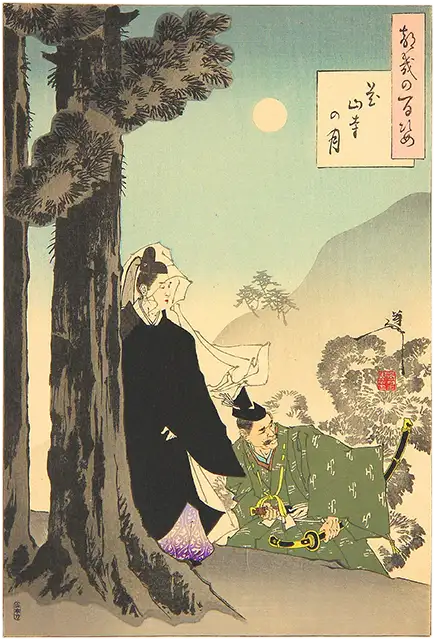
Emperor Kazan deeply loved Shishi, a daughter of Fujiwara no Tamemitsu, but she died at only 17. Deeply shaken, Emperor Kazan came to wish to become a monk and pray for her. Then, as if to take advantage of his weakness, Fujiwara no Kaneie set a plot in motion, and events took a sudden turn.
Kaneie's third son, Michikane, skillfully talked Emperor Kazan into slipping out of the palace in secret and had him become a monk. Because of this, Emperor Kazan was forced to step down after a reign of less than two years.
This ukiyo-e is "The Moon at Kazan Temple" from Tsukioka Yoshitoshi's One Hundred Aspects of the Moon. It shows Emperor Kazan on his way to Kazan Temple (Gangyō-ji) to become a monk. The figure in front is Emperor Kazan, and the figure behind him is Fujiwara no Michikane.
Emperor Ichijō Takes the Throne
When Emperor Kazan stepped down, Prince Yasuhito, Emperor En'yū's son, took the throne as Emperor Ichijō. Fujiwara no Kaneie gained the long-desired post of regent and promoted his sons Michitaka, Michikane, and Michinaga one after another, laying the foundation for his family's prosperity.
Emperor Ichijō's Two Empresses
Emperor Ichijō deeply loved his chūgū, Teishi, but Fujiwara no Michinaga forced his daughter Akiko into Emperor Ichijō's court and created the system called "one emperor, two empresses" (ittei nikō), with Teishi as kōgō and Akiko as chūgū. Prince Iyasada (later Emperor Sanjō) is thought to have watched these moves and clearly recognized that a precedent for "one emperor, two empresses" had been set. He may also have felt uneasy about, or resentful of, Michinaga's hard-line methods, which stopped at nothing.
Emperor Sanjō as Crown Prince
In 986, the year Emperor Kazan became a monk and Emperor Ichijō took the throne, Prince Iyasada (later Emperor Sanjō) was made crown prince at 11 with Kaneie's backing. Because the crown prince was four years older than the emperor, he seems to have been called "the upside-down heir" (sakasa no mōke no kimi). Emperor Ichijō reigned for 25 years, so Prince Iyasada spent a long time as crown prince, until he was 36.
In 989, Fujiwara no Kaneie's daughter Yasuko entered the household of Prince Iyasada, and in 991, Seishi, a daughter of Fujiwara no Naritoki, entered it as a consort of the crown prince. Seishi was deeply loved by Prince Iyasada and bore him four sons and two daughters, but in 995 her father, Fujiwara no Naritoki, died of smallpox, and her backing weakened. Also in 995, Fujiwara no Michitaka's daughter Motoko entered his household, but Yasuko and Motoko died young, and in the end only Seishi became Prince Iyasada's consort (nyōgo).
To build his family's position as maternal relatives, Fujiwara no Michinaga sent his second daughter, Kenshi, into Prince Iyasada's household in 1010.
Emperor Sanjō's Consorts
| Consort | Entered | Guardian (father) |
| Yasuko (974–1004) |
989 | Fujiwara no Kaneie (929–990) |
| Seishi (972–1025) |
991 | Fujiwara no Naritoki (941–995) |
| Motoko (c. 980–1002) |
995 | Fujiwara no Michitaka (953–995) |
| Kenshi (994–1027) |
1010 | Fujiwara no Michinaga (966–1028) |
Prince Iyasada (Emperor Sanjō) was born in 976 and died in 1017.
He reigned from 1011 to 1016.
Emperor Sanjō's Enthronement and
His Feud with Michinaga
In 1011, when Emperor Ichijō, gravely ill, stepped down, Prince Iyasada at last took the throne at 36. The next year, Fujiwara no Michinaga made his second daughter, Kenshi, chūgū. In response, Emperor Sanjō made his beloved Seishi kōgō. This was the reverse of the "one emperor, two empresses" system that Michinaga had created under Emperor Ichijō, and it was unacceptable to Michinaga. But Michinaga himself had set the precedent for "one emperor, two empresses," and Seishi had borne sons, so he could not go against Emperor Sanjō's wishes.
This situation, however, was hard to accept not only for Michinaga but also for the court nobles of the time. Empress Seishi's father, Fujiwara no Naritoki, had once held the post of Upper Counselor, but he had already died, and her only guardian was Fujiwara no Michitō. Michitō, too, had only just been promoted to Councillor (sangi) and ranked lowest among the court nobles. At the time it was extremely rare for anyone but a minister's daughter to become empress, so Emperor Sanjō's making Seishi empress was seen as something that could upset the balance of power.
In 1013, Kenshi gave birth, but the child was not a boy. If a son had been born, Michinaga would have become the emperor's maternal relative, and the relationship between Emperor Sanjō and Michinaga would likely have improved, but in the end Kenshi never had a son. As a result, the feud between Emperor Sanjō and Fujiwara no Michinaga was never resolved and only deepened.
Incidentally, Michinaga was Emperor Sanjō's uncle, but Sanjō's mother, Fujiwara no Chōshi, had died when he was six, and it seems that even the bond of nephew and uncle could not close the rift between the two.
Emperor Sanjō's Eye Disease and Abdication
In 1014, Emperor Sanjō suffered from an eye disease and is said to have taken kin'ekitan, a medicine believed to give eternal youth and long life. But this medicine contained harmful sulfur and mercury, and it is thought to have made his condition worse. On top of this, the inner palace burned down in both 1014 and 1015, and besides the suffering of his illness, the emperor was under great strain.
In these hard circumstances, Emperor Sanjō was pressed to step down by Fujiwara no Michinaga and the other court nobles. Emperor Sanjō's sad poem in the Hyakunin Isshu, "Kokoro ni mo arade ukiyo ni nagaraeba koishikarubeki yowa no tsuki kana," expresses his feelings after many court nobles had turned against him and he had become more and more isolated. In 1016, the year after he composed this poem, Emperor Sanjō stepped down on the condition that his own son, Prince Atsuakira, be made crown prince.
What Became of Prince Atsuakira
Prince Atsuakira was made crown prince, but none of the nobles wanted to take posts in the crown prince's household. Michinaga also withheld the Tsubokiri sword, which was supposed to be passed down to the crown prince, putting silent pressure on him. Seeing the situation around him, Prince Atsuakira judged that it would be difficult for him ever to take the throne, and in 1017 he asked on his own to give up his position as crown prince.
Emperor Sanjō's Bloodline Lives On
Emperor Sanjō's wish to pass the throne to Prince Atsuakira did not come true, but Princess Yoshiko, born to him and Kenshi, became the empress of Emperor Go-Suzaku and gave birth to Prince Takahito. Prince Takahito later became Emperor Go-Sanjō, and Emperor Sanjō's bloodline was carried on without a break.
Emperor Go-Sanjō, Who Took Back Power
from the Fujiwara Regents
Because Emperor Go-Sanjō's maternal grandfather was Emperor Sanjō, he, unlike the emperors before him, could keep his distance from the Fujiwara. He issued the Enkyū Estate Regulation Edict (Enkyū no shōen seiri-rei) and pushed through a reform of the estate (shōen) system. At the time, many farmers donated their land to the powerful Fujiwara to escape harsh tax collection. From that land the Fujiwara took a fee for the use of their name, smaller than the tax would have been, and made enormous profits. Emperor Go-Sanjō sorted out such estates, reformed the system so that taxes would be paid properly, and took back the court's power from the Fujiwara regent family.
Afterword
Emperor Sanjō's poem reveals the feelings of an emperor who struggled against the tide of his times. In it, I sense not only resignation but also a wish to entrust his hopes to his descendants and, after stepping down, to watch quietly over their future like the moon. If Emperor Sanjō could have known that his grandson, Emperor Go-Sanjō, took back the court's power from the Fujiwara, he would surely have been deeply moved.
Glossary
- Regency government (sekkan seiji)
- Marrying one's daughter to the emperor and having her bear a future emperor, so as to become the emperor's maternal relative (gaiseki), deepen ties with the imperial family, and govern in the emperor's place.
- One emperor, two empresses (ittei nikō)
- A state in which one emperor had two principal wives at the same time. Fujiwara no Michinaga brought it about by using separately the titles chūgū and kōgō, which originally meant the same thing.
- Tsubokiri sword (Tsubokiri no mitsurugi)
- A sword handed down from generation to generation to the crown prince or heir to the throne. It is thought to have been created originally from a sword of the Fujiwara, modeled on the Kusanagi sword, a symbol of the imperial throne, and it is still handed down today.
- Enkyū Estate Regulation Edict
- A law issued by Emperor Go-Sanjō to sort out the estates (shōen) that formed the economic base of the Fujiwara and the great temples and shrines, with the aim of strengthening the emperor's power and the state's finances.