


Emperor Tenji,
Who Opens the Hyakunin Isshu
When people think of the Hyakunin Isshu, many picture poets of the Heian period. Yet the first poem of the Hyakunin Isshu was composed by Emperor Tenji, an emperor of the Asuka period. So why does Emperor Tenji's poem open the Hyakunin Isshu?
The Taika Reforms
In the Asuka period, after the death of Prince Shōtoku, the Soga clan held power. Overseas, Tang China was extending its power into the Korean Peninsula, and tension was rising across East Asia. Under these circumstances, Prince Naka no Ōe (later Emperor Tenji), who felt the need for a centralized government, joined with Nakatomi no Kamatari to carry out the Isshi Incident in 645, destroying the Soga clan. He then pushed forward the political reforms known as the Taika Reforms. By building up the ritsuryō legal system, these reforms aimed to curb the power of the great clans and create a government centered on the emperor.
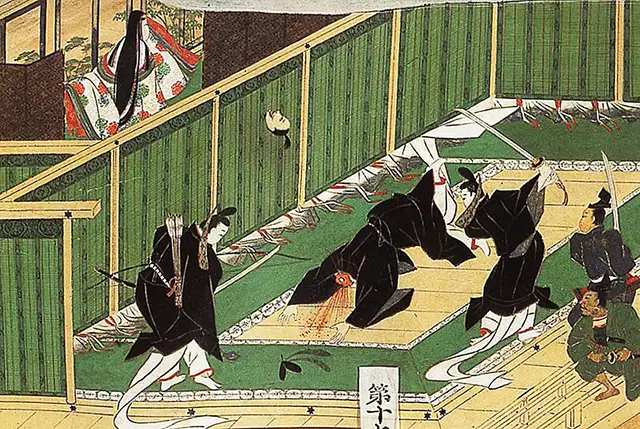
The painting below, by Sumiyoshi Jokei and Gukei of the Edo period, shows the Isshi Incident. It depicts Prince Naka no Ōe cutting off the head of Soga no Iruka. The man holding a bow on the left is Nakatomi no Kamatari.
The Jinshin War
When Emperor Tenji died in 671, a great struggle broke out over who would succeed him: the Jinshin War, fought between Emperor Tenji's younger brother, Prince Ōama, and Emperor Tenji's son, Prince Ōtomo. The war began in 672 and lasted about a month, ending in victory for Prince Ōama. In 673, Prince Ōama took the throne as Emperor Tenmu.
Why the Jinshin War Broke Out
Emperor Tenji (Prince Naka no Ōe) first named his younger brother, Prince Ōama (later Emperor Tenmu), as his successor. In his later years, however, he named his son, Prince Ōtomo (Emperor Kōbun), instead. At the time, the throne did not pass to the emperor's eldest son by rule; by custom, a powerful member of the imperial family took the throne. This change of successor is therefore thought to have set off the Jinshin War.
From the Tenmu Line Back to the Tenji Line
After Emperor Tenmu's reign, emperors of the Tenmu line followed for some time. But when Empress Shōtoku died in 770, the Tenmu bloodline came to an end. Emperor Kōnin, a grandson of Emperor Tenji, then took the throne, and the imperial line returned to the Tenji line. In the reign of his son, Emperor Kanmu, the capital of Heian-kyō was built in 794.
Emperor Tenji, Founder of the Heian Dynasty
Through the Taika Reforms, Emperor Tenji built a system of government centered on the emperor. He was also the direct ancestor of Emperor Kanmu, who founded Heian-kyō. For these reasons, the people of the Heian period revered Emperor Tenji as the "great founder of the Heian dynasty." This view of history is thought to lie behind the decision of Fujiwara no Sadaie, the compiler of the Hyakunin Isshu, to place Emperor Tenji at the head of the anthology.
Emperor Tenji's Family Tree
Trivia: The Fujiwara Clan
Nakatomi no Kamatari, Founder of the Fujiwara Clan
Nakatomi no Kamatari (614–669) was born into a family whose duty was to perform Shinto rites, but from a young age he was interested in China. At the school of the monk Minabuchi no Shōan, who had been to Sui and Tang China, he studied the state of the world. He came to believe that Japan, like Tang, should become a ritsuryō state centered on the emperor, and he resolved to overthrow the Soga clan, which controlled the government at the time. He had neither power nor political influence of his own, however, so he put forward Prince Naka no Ōe (later Emperor Tenji) as the leader of a force against the Soga, carried out the Isshi Incident, and pushed forward the political reforms known as the Taika Reforms. He received the family name "Fujiwara" from Emperor Tenji the day before he died, together with the Taishokukan, the highest cap rank of the time.
Fujiwara no Fuhito, Kamatari's Second Son
Fujiwara no Fuhito, Nakatomi no Kamatari's second son, lost his father at the age of 11. During the Jinshin War, the powerful members of Kamatari's clan were swept from the center of the court, so he had no one to back him and began his career as a low-ranking official. He soon rose to prominence, however, and was favored by Empress Jitō. By order of Emperor Monmu, he worked on the Taihō Code. He also made his eldest daughter, Fujiwara no Miyako, a consort of Emperor Monmu, strengthening his ties with the imperial family and gaining power.
The Rise of the Fujiwara
Fujiwara no Fuhito had four sons. The eldest, Muchimaro, founded the Southern House (Nanke); the second, Fusasaki, the Northern House (Hokke); the third, Umakai, the Ceremonial House (Shikike); and Maro, the Capital House (Kyōke). Each became a branch of the Fujiwara clan. Of these, the Northern House rose highest: Fujiwara no Yoshifusa of the Northern House became the first regent (sesshō) from outside the imperial family, and after that the Northern House held the posts of regent and chancellor (kanpaku) to itself. Most of the Fujiwara active in the Heian period came from the Northern House. Fujiwara no Michinaga, who held enormous power in the mid-Heian period, and Murasaki Shikibu, the author of The Tale of Genji, were both members of the Northern House of the Fujiwara.