


Front of the Card
Back of the Card
Japanese
English
Audio: NHK Creative Library
Read by LibriVox volunteer Larry Wilson.
Audio courtesy of LibriVox
坂上是則
朝ぼらけ
有明の月と
見るまでに
吉野の里に
降れる白雪
よしののさ
とにふれる
しらゆき

あさぼらけあ


- Poem 31
- 朝ぼらけ
有明の月と
見るまでに
吉野の里に 降れる白雪
Author: Sakanoue no Korenori (dates unknown–930)
Source: Kokin Wakashū, Winter
- English Verse Translation
- Surely the morning moon, I thought, Has bathed the hill in light But, no; I see it is the snow
That, falling in the night, Has made Yoshino white.
— William N. Porter, 1909
- Modern Translation
- In the early morning light, the village of Yoshino is blanketed in white — it looks just like the pale glow of the dawn moon.
- Commentary
- "Asaborake" means the moment just before dawn, used mostly in autumn and winter. Yoshino (Nara Prefecture) is now famous for cherry blossoms, but then it was known for snow. Yoshino, where Emperor Tenmu and Empress Jitō once withdrew, was a place Heian nobles dreamed of.
- About the Poet
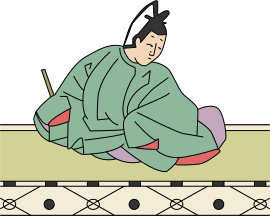
- Sakanoue no Korenori was a descendant of Sakanoue no Tamuramaro, the general who conquered the Emishi. He once served as an official in Yamato Province (Nara), so he probably knew Yoshino well. Besides poetry, he was famous as a master of kemari (court football).
- Poem Illustration
-
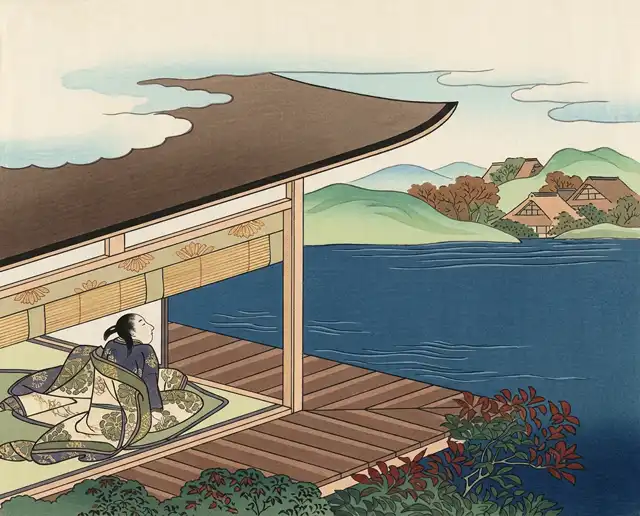
This image is based on an illustration from William N. Porter's A Hundred Verses from Old Japan, his 1909 English translation of the Hyakunin Isshu published in England, colorized and reworked using Adobe Firefly (generative AI).
- Sakanoue no Korenori: A Short Timeline
-
- 905
- Kicks a ball 206 times in a row at a palace kemari (court football) game and is given silk as a reward
- 908
- Becomes an official of Yamato Province
- 912
- Becomes a junior inspector of the Ministry of Central Affairs
- 921
- Becomes a senior palace secretary
- 924
- Given Junior Fifth Rank, Lower Grade, and becomes Assistant Governor of Kaga Province
- 930
- Dies
- Notes
-
- Counted as one of the Thirty-Six Immortal Poets
- Sakanoue no Korenori's Family Tree
-
Sakanoue no Korenori was a descendant of Sakanoue no Tamuramaro, who, as Seii Taishōgun (shogun), made the Emishi, the people of the northeast who resisted the court, surrender.
Korenori was very good at kemari (court football, keeping a ball in the air by kicking it). It is said that in 905, at a game of kemari before Emperor Daigo, he kicked the ball 206 times without once letting it fall, and the emperor gave him silk as a reward.
- Appendix
-
- The Ariake Moon and the Phases of the Moon
-
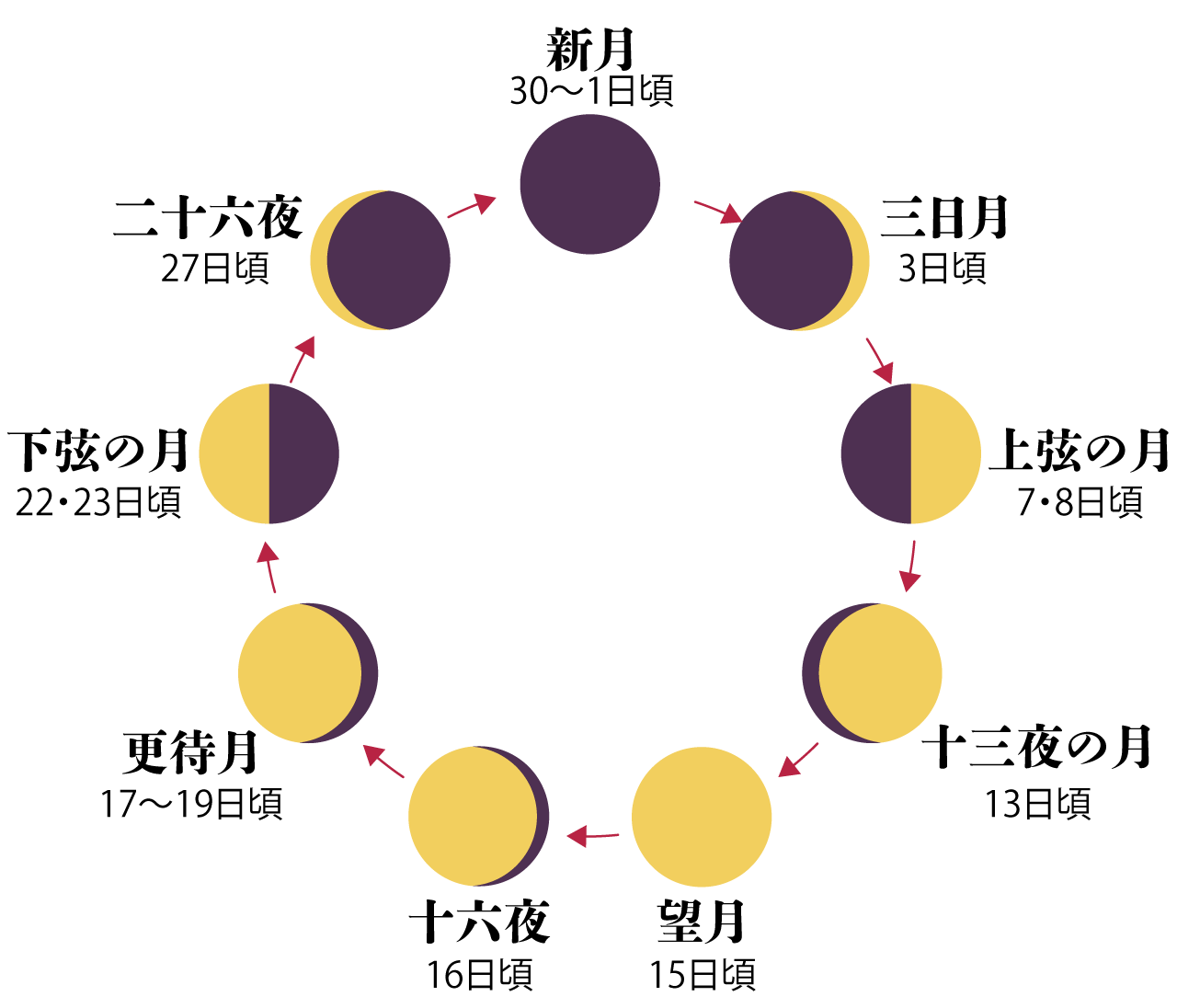
The ariake no tsuki is the moon that is still in the sky after dawn. From about the 15th to the 29th day of the lunar month, the moon can be seen in the early-morning sky.
In the Heian period, only privileged people could have calendars. So for ordinary people, the changing shape of the moon probably served as a kind of natural calendar.
Phase Moonrise Moonset New moon 6:00 18:00 First quarter 12:00 24:00 Full moon 18:00 6:00 Last quarter 24:00 12:00 - Li Bai's Chinese Poem "Quiet Night Thoughts"
- Sakanoue no Korenori's Hyakunin Isshu poem is thought to draw on the scene of "Quiet Night Thoughts" (Seiyashi), a famous Chinese poem by Li Bai. In "Quiet Night Thoughts," moonlight shining on the ground is seen as "frost on the ground," and the poet longs for his faraway home. Korenori, in turn, saw the white snow piled up in the village of Yoshino as "the light of the dawn moon left in the sky," and captured the quiet beauty of a winter daybreak. Here we see a tribute in verse across time and place.
In Chinese
牀前看月光
疑是地上霜
挙頭望山月
低頭思故郷
"Quiet Night Thoughts," Li BaiIn English
Before my bed, I see the moonlight.
I wonder if it is frost on the ground.
I raise my head and gaze at the mountain moon,
I lower my head and think of home. - Sakanoue no Korenori, a Provincial Official
- In the capital, Sakanoue no Korenori held posts such as Senior Secretary (Dainaiki), and he also served in a series of provincial posts (as a kokushi, provincial official), such as Acting Junior Secretary of Yamato, Senior Secretary of Yamato, and Assistant Governor of Kaga. According to the headnote in the Kokin Wakashū, he wrote his Hyakunin Isshu poem while serving as Acting Junior Secretary of Yamato. For the central government offices, see this page. For the provincial government system, see this page.