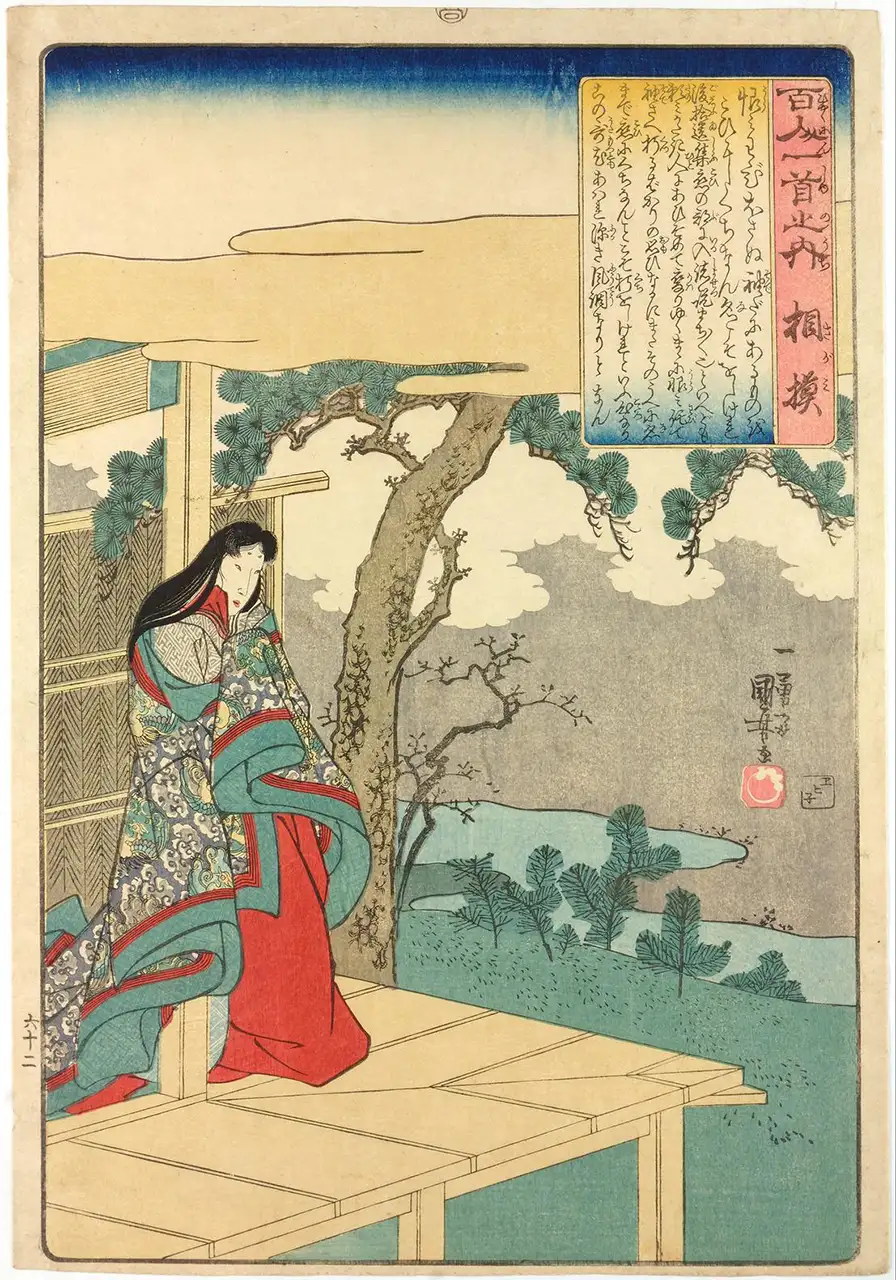
Front of the Card
Back of the Card
Japanese
English
Audio: NHK Creative Library
Read by LibriVox volunteer Larry Wilson.
Audio courtesy of LibriVox
相模
恨みわび
ほさぬ袖だに
あるものを
恋にくちなむ
名こそをしけれ

こひにくち
なむなこそ
をしけれ

うら


- Poem 65
- 恨みわび
ほさぬ袖だに
あるものを
恋にくちなむ 名こそをしけれ
Author: Sagami (c. 998–after 1061)
Source: Go Shūi Wakashū, Love
- English Verse Translation
- Be not displeased, but pardon me, If still my tears o'erflow; My lover's gone, and my good
name, Which once I valued so, I fear must also go.
— William N. Porter, 1909
- Modern Translation
- My sleeves are never dry — and I grieve not for myself, but that my name as a lover will be ruined before it is known.
- Commentary
- Written on the theme "love" for the palace poetry contest of 1051, it won. A woman who loved a cold man grieves that she has lost his love and that her name is now the subject of gossip.
- About the Poet
- Sagami's name comes from her husband, Ōe no Kinsuke, governor of Sagami, but they later parted. She then served Princess Shūshi, a daughter of Emperor Ichijō, and lived a life of free love. Highly praised as a poet, she has 40 poems in the Go Shūi Wakashū. She was the adopted daughter of Minamoto no Yorimitsu, who in legend slew the demon of Mount Ōe.
- Poem Illustration
-
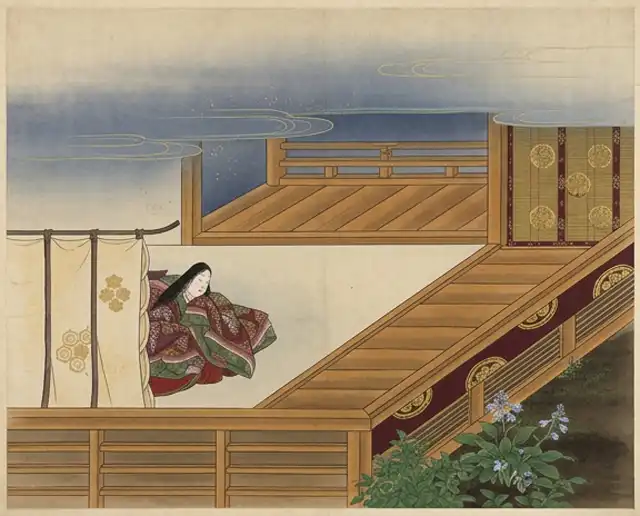
This image is based on an illustration from William N. Porter's A Hundred Verses from Old Japan, his 1909 English translation of the Hyakunin Isshu published in England, colorized and reworked using Adobe Firefly (generative AI).
- Sagami: A Short Timeline
-
- c. 998
- Born
- c. 1020
- Becomes the wife of Ōe no Kinsuke
- 1024
- Offers 100 poems to the Izusan Gongen shrine in Izu
- c. 1025
- Separates from Kinsuke
- Unknown
- Serves Princess Shūshi
- 1049
- Serves Princess Yūshi
- 1051
- Takes part in the Palace Root Contest
- 1061 or later
- Dies
- Sagami's Relationship Chart
-
She became the wife of Ōe no Kinsuke, Governor of Sagami, and so her court name (nyōbō-na) was "Sagami."
But she parted from that husband after about four years, and is said to have begun a relationship with Fujiwara no Sadayori, who wrote the poem "Asaborake Uji no kawagiri taedae ni...."
Later, Sagami served Princess Shūshi, the first daughter of Emperor Ichijō.
- Appendix
-
- A Poem Written When Her Husband Forgot Her
-
The headnote to this poem says it was written "when Ōe no Kinsuke forgot me."
In Japanese
夕暮れは 待たれしものを 今はただ
行くらむ方を 思ひこそやれ yuugureha matareshimonoo imahatada
yukuramukatao omohikosoyare Go Shūi Wakashū, SagamiIn English
I always used to wait for you at dusk, but now all I can think of is where you must be going, and to whom.
- A Poem Giving Up on Her Husband, Yet Missing Him
-
The husband who left Sagami went to his new post in Tōtōmi Province (today's western Shizuoka Prefecture) with another woman.
This poem expresses her mixed feelings for the husband who crossed the Ōsaka Barrier and went away: she has given up on him, yet still cannot let go.In Japanese
逢坂の 関に心は かよはねど
見し東路は なをぞ恋しき ousakano sekinikokoroha kayohanedo
mishiazumajiha naozokoishiki Go Shūi Wakashū, SagamiIn English
My heart no longer reaches you as you cross the Ōsaka Barrier, but I still remember fondly the eastern road we once saw together.
- Utagawa Kuniyoshi's Hyakunin Isshu no Uchi
-
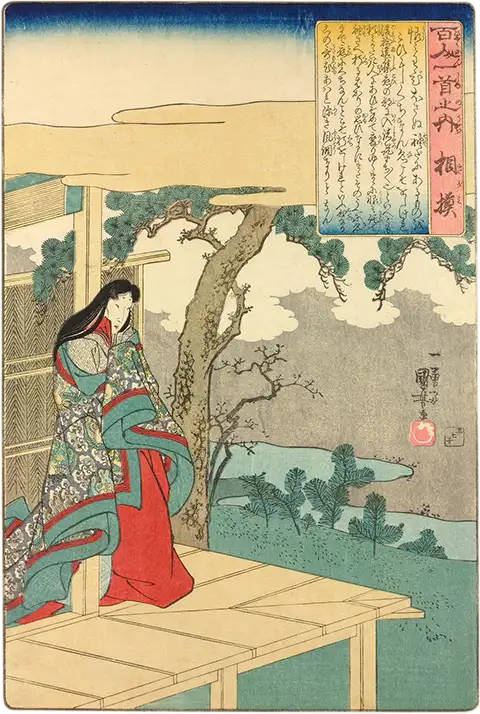
British Museum, Public domain, via Wikimedia Commons This ukiyo-e print is by Utagawa Kuniyoshi, an artist of the Edo period.
It shows a scene to go with the Hyakunin Isshu poem.In this picture, a woman quietly gazes into the distance from the veranda. Lost in thought, she seems to reflect the feelings of Sagami, troubled by love.