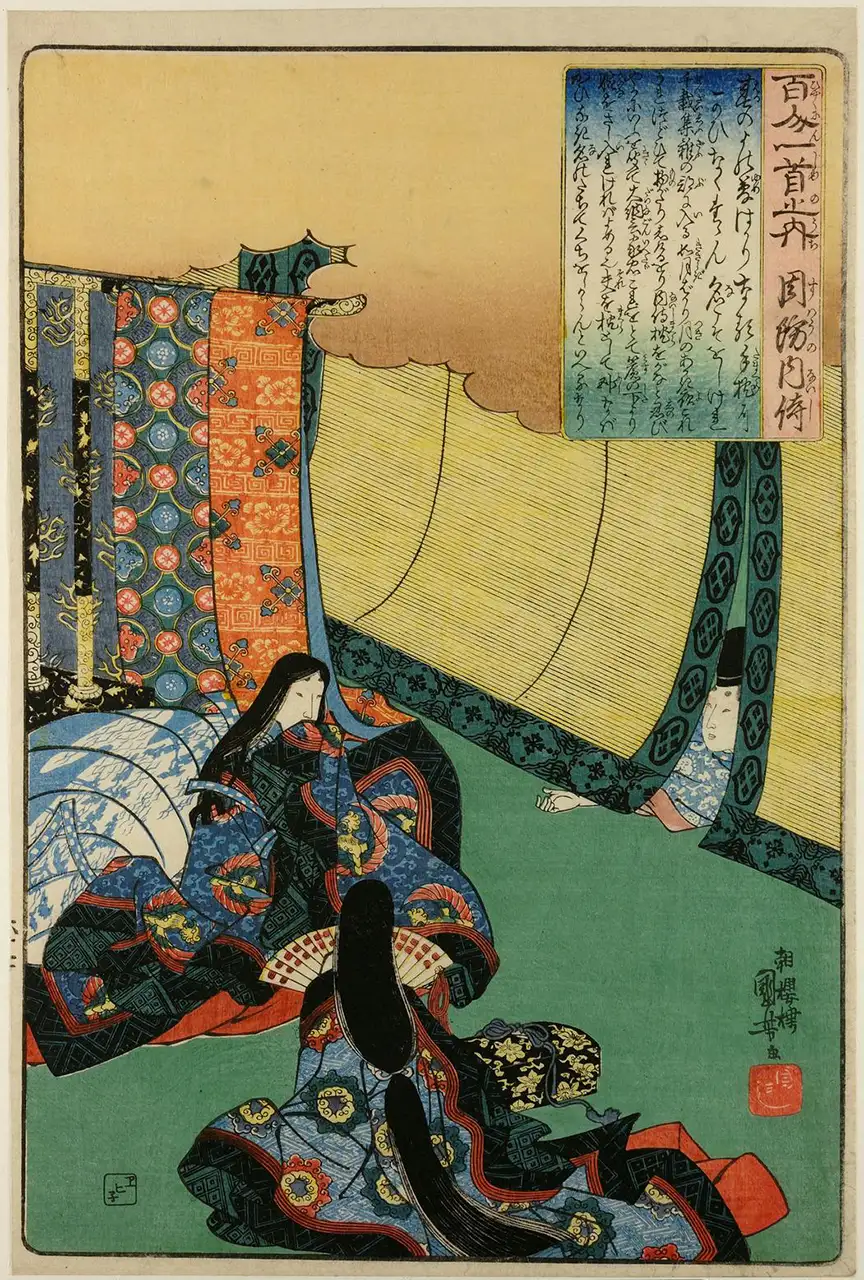
Front of the Card
Back of the Card
Japanese
English
Audio: NHK Creative Library
Read by LibriVox volunteer Larry Wilson.
Audio courtesy of LibriVox
周防内侍
春の夜の
夢ばかりなる
手枕に
かひなく立たむ
名こそをしけれ
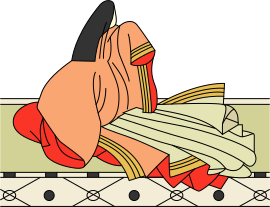
かひなくた
たむなこそ
をしけれ

はるの


- Poem 67
- 春の夜の
夢ばかりなる
手枕に
かひなく立たむ 名こそをしけれ
Author: Suō no Naishi (c. 1037–c. 1111)
Source: Senzai Wakashū, Miscellaneous
- English Verse Translation
- If I had made thy proffered arm A pillow for my head For but the moment's time, in which A
summer's dream had fled, What would the world have said?
— William N. Porter, 1909
- Modern Translation
- In the spring night, resting my head on an arm for just a brief dream — how I grieve that my name might spread for such a fleeting thing.
- Commentary
- One night at the Nijō palace, as people talked till late, Suō no Naishi said she was sleepy and wanted a pillow. Fujiwara no Tadaie slipped his arm under the blinds and said, "Use this as your pillow." She politely turned him down with this poem on the spot. Tadaie was Fujiwara no Sadaie's great-grandfather.
- About the Poet
- Suō no Naishi's name comes from her father, governor of Suō; her real name was Taira no Chūshi. She served four emperors, Go-Reizei, Go-Sanjō, Shirakawa, and Horikawa, and was a famous court poet with 35 poems in imperial anthologies.
- Poem Illustration
-
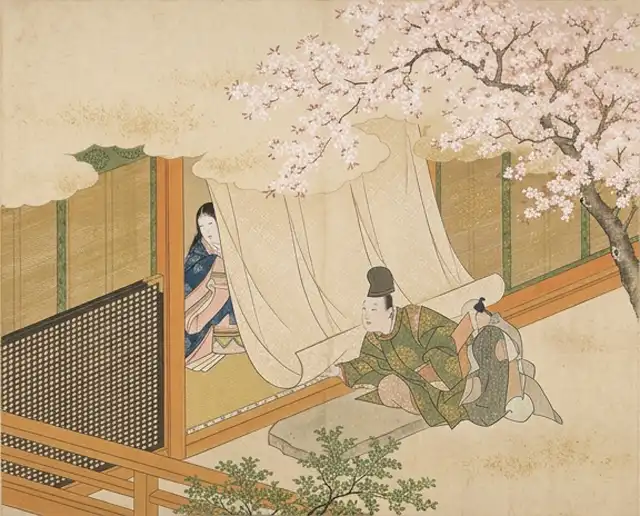
This image is based on an illustration from William N. Porter's A Hundred Verses from Old Japan, his 1909 English translation of the Hyakunin Isshu published in England, colorized and reworked using Adobe Firefly (generative AI).
- Suō no Naishi: A Short Timeline
-
- c. 1037
- Born
- Unknown
- Begins serving Emperor Go-Reizei
- 1068
- Leaves court when Emperor Go-Reizei dies, but returns at Emperor Go-Sanjō's request
- 1093
- Takes part in the Root Contest held by Ikuhōmon-in
- c. 1108
- Becomes a nun because of illness
- c. 1111
- Dies
- Suō no Naishi's Relationship Chart
-
Suō no Naishi served Emperor Go-Reizei, the 70th emperor, as a lady-in-waiting.
Her Hyakunin Isshu poem was written one night when the ladies-in-waiting were talking all night long at the palace of Princess Shōshi, empress (chūgū) of Emperor Go-Reizei. Fujiwara no Tadaie slipped his arm in under the blind, and that led to the poem.
- Appendix
-
- Fujiwara no Tadaie's Answer
- Fujiwara no Tadaie answered Suō no Naishi's poem "Haru no yo no..." as follows.
In Japanese
契りありて 春の夜深き 手枕を
いかがかひなき 夢になすべき chigiriarite harunoyofukaki tamakurao
ikagakahinaki yumeninasubeki Senzai Wakashū, Fujiwara no TadaieIn English
Fate brought me to offer you my arm as a pillow late on this spring night. How could I let it become an empty dream?
- The Famous "Shitamoe" Poem
-
Shitamoe (smoldering underneath) is a word used for burning with love in secret. This poem became famous, so much so that Suō no Naishi came to be called "Shitamoe no Naishi."
In Japanese
恋ひわびて 眺むる空の 浮雲や
わが下萌えの 煙なるらむ kohiwabite nagamurusorano ukigumoya
wagashitamoeno keburinaruramu Kin'yō Wakashū, Suō no NaishiIn English
Are the drifting clouds I gaze at, worn out with love, the smoke from my secret burning, turned into clouds?
- A Poem Written on a Pillar
of the House She Had to Give Up - When Suō no Naishi had to give up a house full of memories, she wrote this poem on one of its pillars.
In Japanese
住みわびて 我さへ軒の 忍草
しのぶかたがた しげき宿かな sumiwabite waresahenokino shinobukusa
shinobukatagata shigekiyadokana Kin'yō Wakashū, Suō no NaishiIn English
It has become hard to live here, and I must leave. O shinobu fern growing on the eaves: this house is thick with things to remember (shinobu).
- A Poem Saigyō Wrote
at Suō no Naishi's Ruined House - Saigyō visited the house where Suō no Naishi had once lived and later left, as if visiting a sacred place, and wrote the next poem there.
In Japanese
古は ついゐし宿も あるものを
何をか今日の しるしにはせん inishieha tsuiishiyadomo arumonoo
naniokakyouno shirushinihasen Sankashū, SaigyōIn English
The house where she lived long ago still stands, but what shall I take as a sign of my visit today?
- Utagawa Kuniyoshi's Hyakunin Isshu no Uchi
-
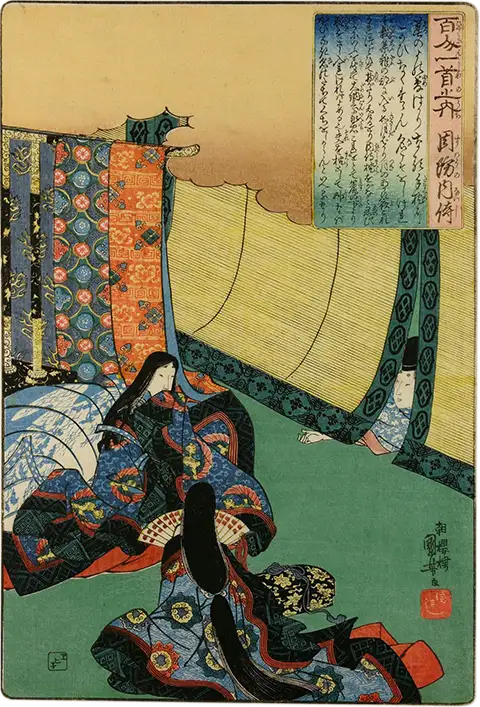
British Museum, Public domain, via Wikimedia Commons This ukiyo-e print is by Utagawa Kuniyoshi, an artist of the Edo period.
It shows a scene to go with the Hyakunin Isshu poem.It shows Fujiwara no Tadaie slipping his arm in under the blind.