Front of the Card
Back of the Card
Japanese
English
Audio: NHK Creative Library
Read by LibriVox volunteer Larry Wilson.
Audio courtesy of LibriVox
西行法師
嘆けとて
月やは物を
思はする
かこち顔なる
わが涙かな
かこちかほ
なるわかな
みたかな

なげけ


- Poem 86
- 嘆けとて
月やは物を
思はする
かこち顔なる わが涙かな
Author: Priest Saigyō (1118–1190)
Source: Senzai Wakashū, Love
- English Verse Translation
- O'ercome with pity for this world, My tears obscure my sight; I wonder, can it be the moon
Whose melancholy light Has saddened me to-night?
— William N. Porter, 1909
- Modern Translation
- Did the moon ask me to grieve? These tears on my face — it is as if I am blaming the moon for making me feel this way.
- Commentary
- Written on the theme "love before the moon." The poet seems to blame the moon for the tears he sheds for his love, quietly holding back his sorrow.
- About the Poet
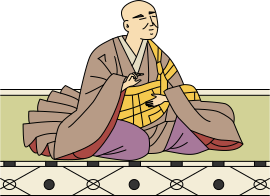
- Saigyō, born Satō Norikiyo, was a guard serving Retired Emperor Toba, but at 23 he left his post and family to become a monk. One theory says he did so to give up his love for Taikenmon-in, Toba's empress. He then traveled the country as a wandering poet, writing many poems about nature.
- Poem Illustration
-
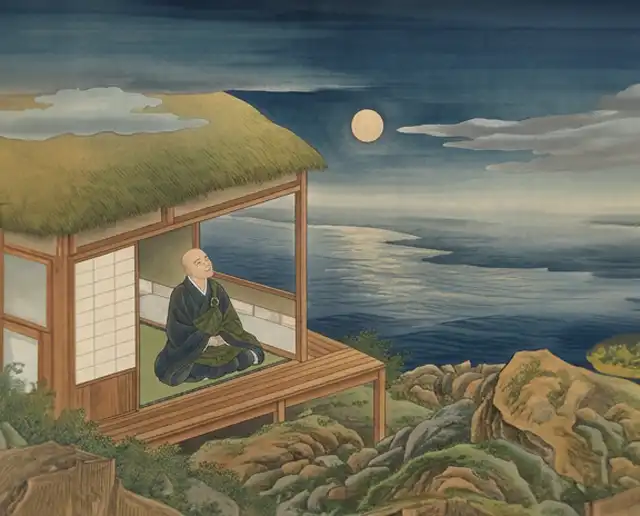
This image is based on an illustration from William N. Porter's A Hundred Verses from Old Japan, his 1909 English translation of the Hyakunin Isshu published in England, colorized and reworked using Adobe Firefly (generative AI).
- Priest Saigyō: A Short Timeline
-
- 1118
- Born as a son of Satō no Yasukiyo
- 1135
- Becomes an officer of the Left Military Guards and serves Retired Emperor Toba as one of his North Guards
- 1140
- Becomes a monk and takes the name Saigyō
- c. 1149
- Goes to Mount Kōya
- 1168
- Travels to Shikoku to visit Retired Emperor Sutoku's tomb at Shiramine
- 1186
- Travels to Mutsu Province to collect donations for rebuilding Tōdai-ji Temple
- 1190
- Dies at Hirokawa-dera Temple in Kawachi Province
- Priest Saigyō's Family Tree
-
- Appendix
-
- The Poem He Wrote When He Decided to Become a Monk
- The next poem is in Saigyō's personal collection, the Sankashū. It is said to have been written around age 23, when he decided to leave the world and become a monk.
In Japanese
空になる 心は春の 霞にて
世にあらじと 思ひ立つかな soraninaru kokorohaharuno kasuminite
yoniarajito omohitatsukana Sankashū, Priest SaigyōIn English
My heart, emptied, is like the spring haze rising in the sky. Having reached that state, I have resolved that I should no longer stay in this world, and to become a monk.
- The Story of Lost Love That Led Him to Become a Monk
-
One theory says that Saigyō became a monk because of a lost love, and it is based on the Genpei Jōsuiki (a war tale). According to that story, Saigyō fell in love with a woman of such high rank that he could not even say her name. After they had met, he asked, "When can I see you next?" and she answered, "Akogi no ura zo" ("It is Akogi Bay"). The next poem is said to have been written by Saigyō while he was carried away by love.
In Japanese
思ひきや 富士の高嶺に 一夜寝て
雲の上なる 月を見んとは omohikiya fujinotakaneni hitoyonete
kumonouenaru tsukiomintoha Genpei Jōsuiki, Priest SaigyōIn English
I never dreamed I would spend a night with you, a flower on a peak higher than Mount Fuji, or watch the moon with you, as far out of reach as the clouds.
The woman's words, "Akogi no ura zo," come from the following anonymous poem. The poem is connected with a sad tale called Akogi Heiji, which goes like this.
Long ago, there was a young man named Heiji at Akogi Beach. He badly wanted to get a fish called yagara (cornetfish) for his sick mother. Yagara lived only in Akogi Bay, but Akogi Bay was where fish were caught as offerings for Ise Shrine, and the rule was that anyone who fished there would be drowned in the sea. Still, Heiji fished there in secret. He meant to do it only once, but soon he went again and again. In the end, what he was doing was discovered, and as the rule required, he was rolled up in a reed mat and sunk in the sea.
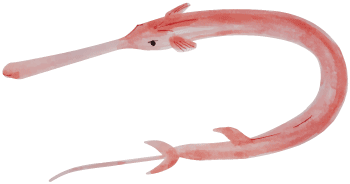
In Japanese
伊勢の海 あこぎが浦に
引く網も
たびかさなれば 人もこそ知れ isenoumi akogigaurani hikuamimo
tabikasanareba hitomokososhire Genpei Jōsuiki, AnonymousIn English
If you cast your net again and again in Akogi Bay in the sea of Ise, people will come to know of it.
- Saigyō's Poem in Memory of Sanekata
- The next poem by Saigyō is in the Shin Kokin Wakashū and in his personal collection, the Sankashū. He wrote it when he visited the grave of Fujiwara no Sanekata, who had been sent away to Mutsu Province and died in an accident.
In Japanese
朽ちもせぬ その名ばかりを 留め置きて
枯野のすすき 形見にぞ見る kuchimosenu sononabakario todomeokite
karenonosusuki kataminizomiru Shin Kokin Wakashū, Priest SaigyōIn English
They say he was buried here, leaving behind only his undying fame as a poet;
all I can see as a keepsake is the pampas grass of the withered field. - Saigyō's Death Poem
-
The next poem, in Saigyō's personal collection, the Sankashū, is his death poem (jisei). "The time of the full moon" in the poem means the 15th day of the second month, the day the Buddha died. Saigyō died on the 16th day of the second month of 1190, almost the very day he had wished for. This date is in the old lunar calendar; in today's calendar, it would fall in mid- to late March.
In Japanese
願はくは 花の下にて 春死なむ
そのきさらぎの 望月のころ negawakuha hananomotonite harushinamu
sonokisaragino mochizukinokoro Sankashū, Priest SaigyōIn English
If I could have my wish, I would die in spring beneath the cherry blossoms,
at the time of the full moon of the second month, the day the Buddha entered nirvana. - Hirokawa-dera Temple
-
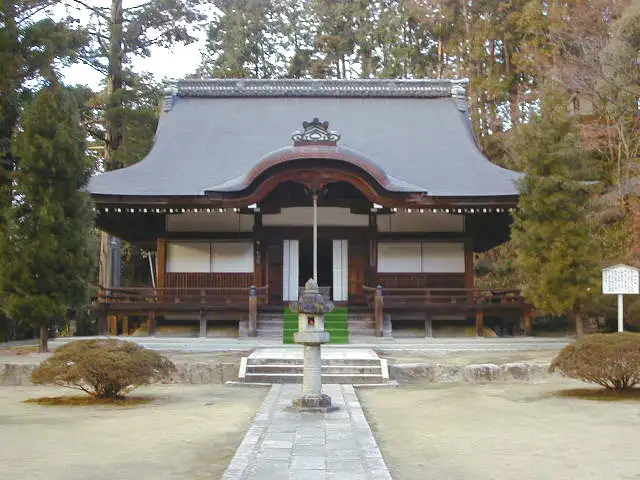
Otraff, CC BY-SA 3.0 <http://creativecommons.org/licenses/by-sa/3.0/>, via Wikimedia Commons Hirokawa-dera (Kanan Town, Minamikawachi District, Osaka Prefecture) is an old temple at the foot of Mount Yamato Katsuragi. Saigyō ended his life here. The grounds have Saigyō's grave mound, a stone carved with his poem, and the Saigyō Memorial Hall. The temple and its surroundings are also famous for cherry blossoms.
See it on the map - Saigyō's Poem About an Autumn Evening
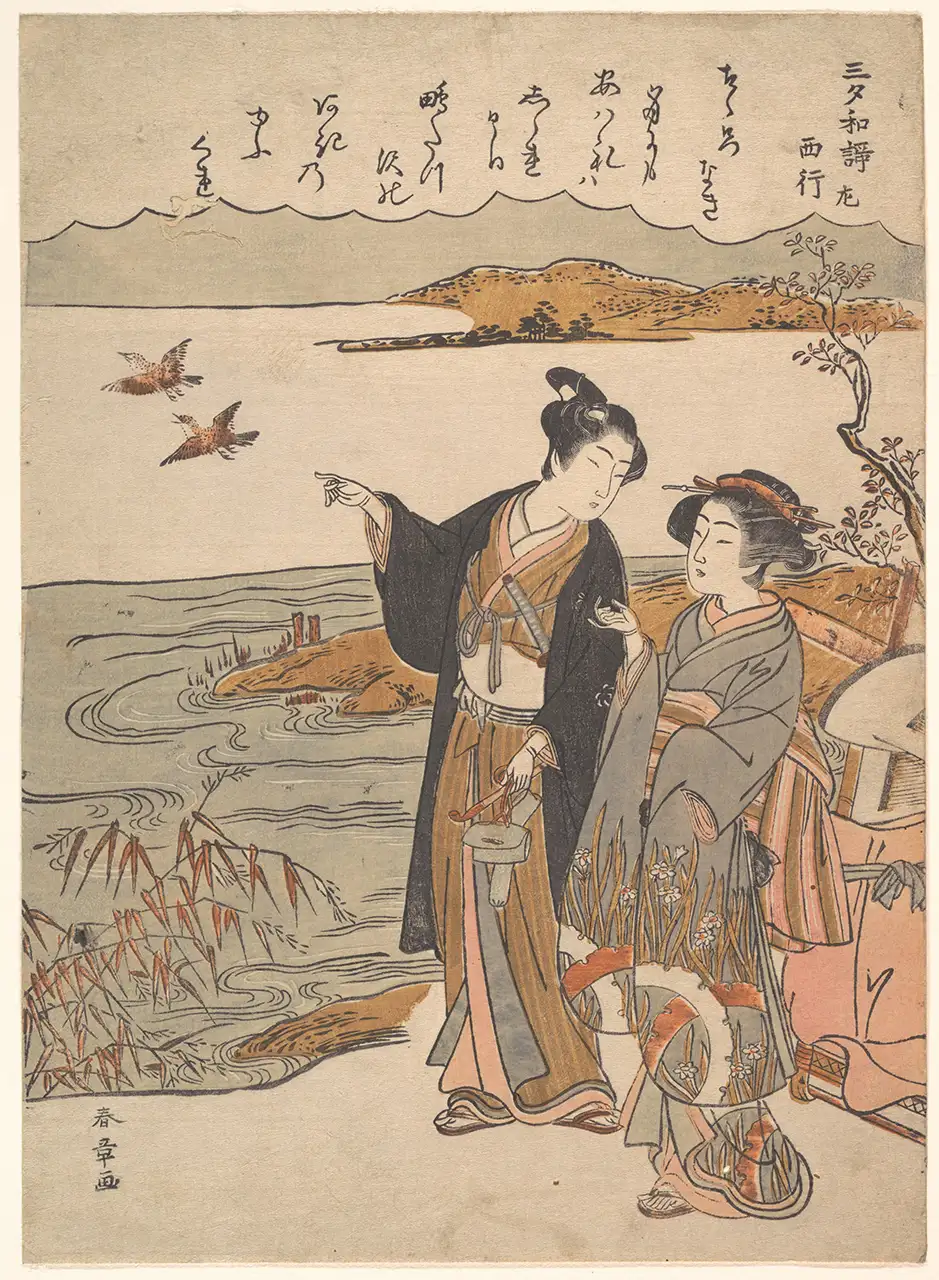
- This poem is about the evening, when snipes have flown up all at once and quiet has returned to the marsh.
It is one of the Sanseki no Uta ("Three Evening Poems"), three famous poems that all end with the noun phrase "aki no yūgure" (an autumn evening).In Japanese
心なき 身にもあはれは 知られけり
鴫立つ沢の 秋の夕暮れ kokoronaki minimoahareha shirarekeri
shigitatsusawano akinoyuugure Shin Kokin Wakashū, Priest SaigyōIn English
Even I, who became a monk and gave up the heart that feels such things, am deeply moved by the quiet of the autumn evening that falls on the marsh after the snipes fly up.
- An Ukiyo-e Print by Katsukawa Shunshō
-
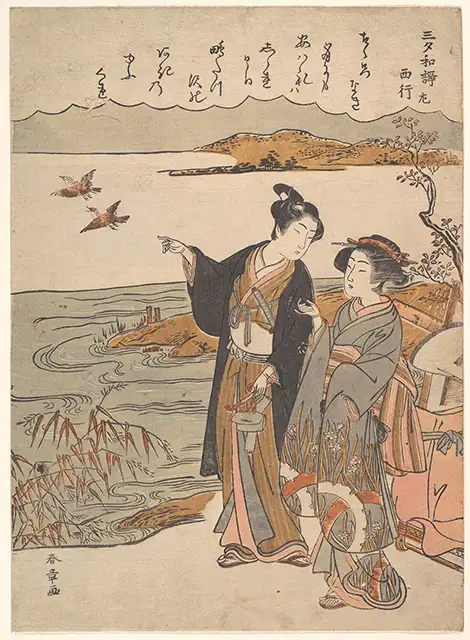
An ukiyo-e print by Katsukawa Shunshō, an ukiyo-e artist of the mid-Edo period. It is based on Saigyō's poem among the Sanseki no Uta ("Three Evening Poems").
- Saigyō's Poem on Viewing Mount Fuji
-
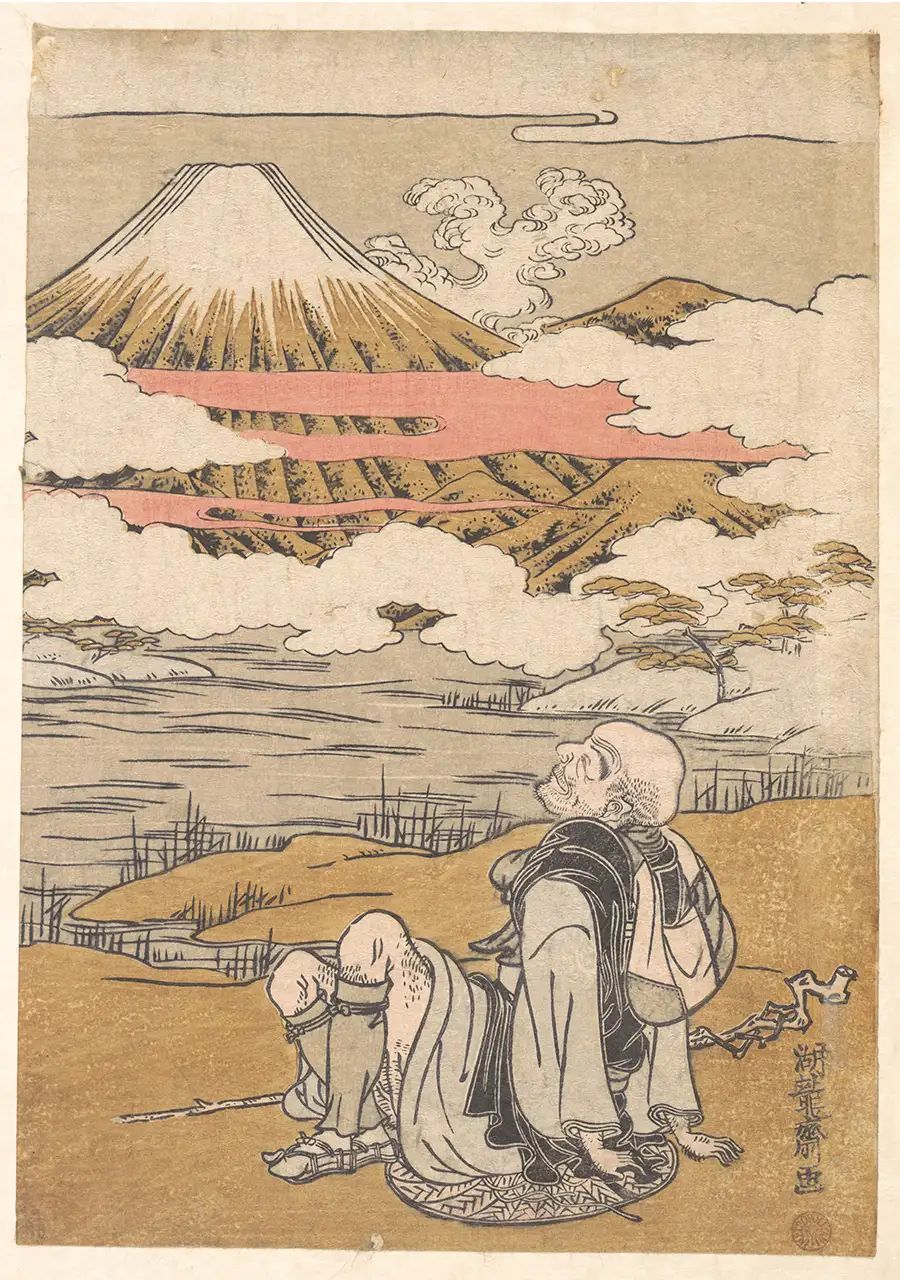
The next poem by Saigyō is in the Shin Kokin Wakashū. Its headnote says, "Written about Mount Fuji while traveling in the east as a monk." He seems to compare the smoke of Mount Fuji, drifting off who knows where, to his own journey, whose end he could not see.
In Japanese
風になびく 富士の煙の 空に消えて
ゆくへもしらぬ わが思ひかな kazeninabiku fujinokeburino soranikiete
yukuhemoshiranu wagaomohikana Shin Kokin Wakashū, Priest SaigyōIn English
Like the smoke of Mount Fuji that bends in the wind and vanishes into the sky, I do not know where my thoughts will end up.
- Isoda Koryūsai's Fujimi Saigyō
-
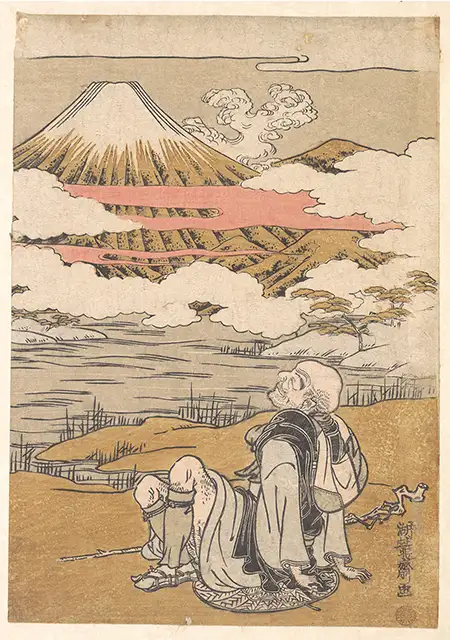
Priest Saigyō gazing at Mount Fuji (Fujimi Saigyō), drawn by Isoda Koryūsai, an ukiyo-e artist of the mid-Edo period.
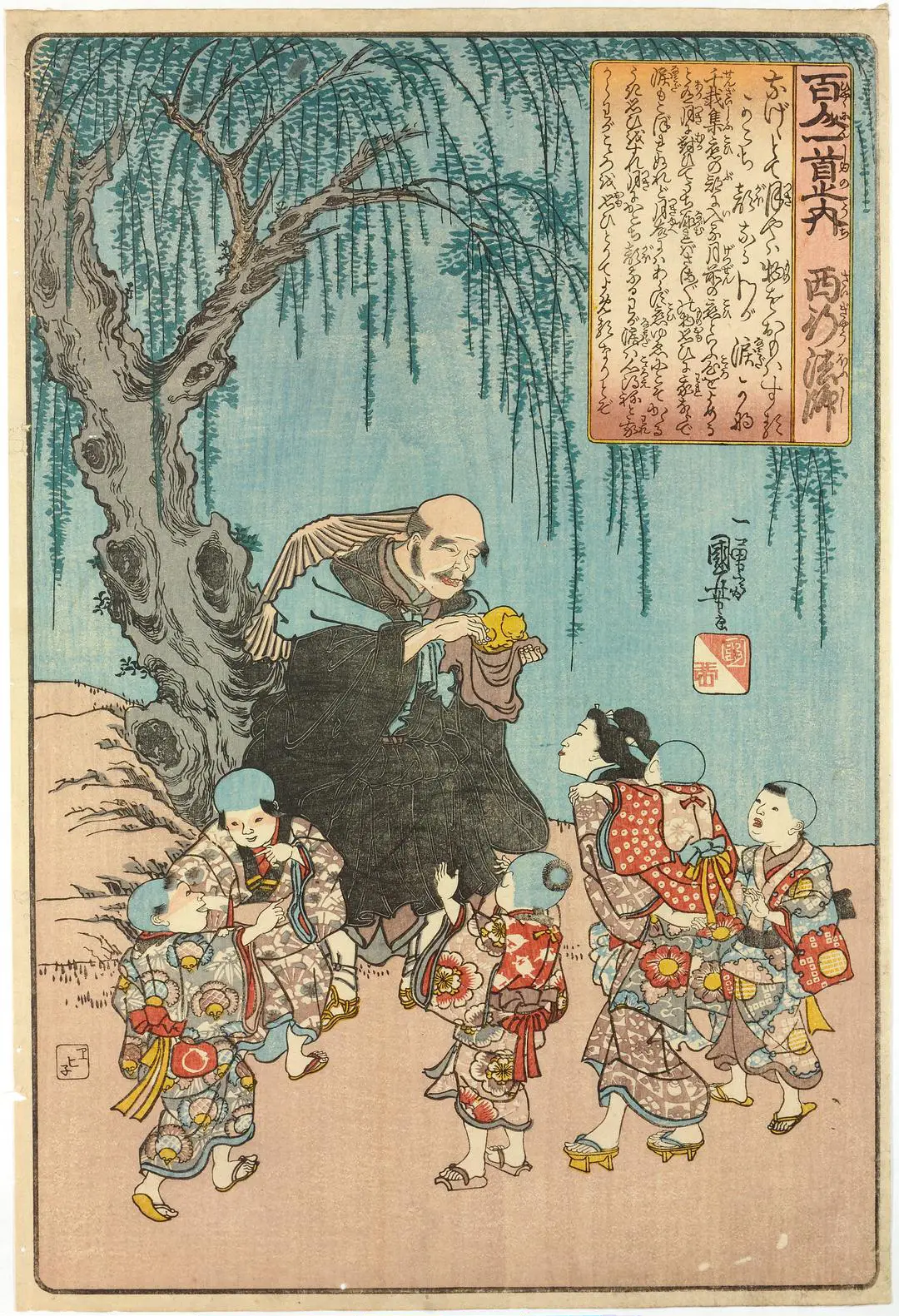
- Utagawa Kuniyoshi's Hyakunin Isshu no Uchi
-
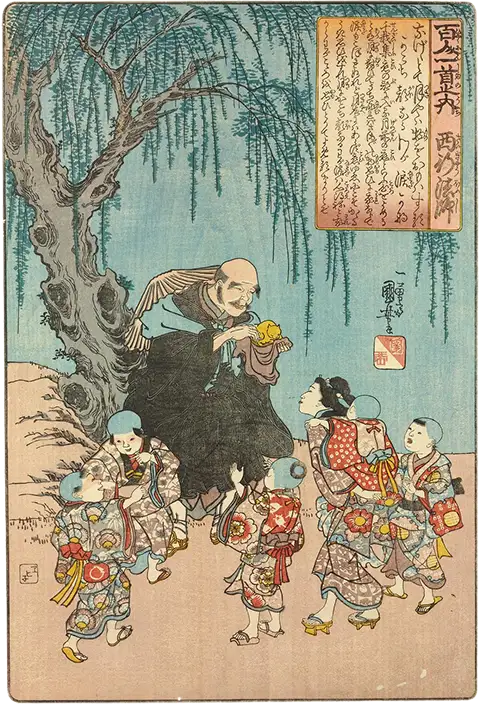
British Museum, Public domain, via Wikimedia Commons An ukiyo-e print by Utagawa Kuniyoshi, an ukiyo-e artist of the Edo period. According to the Azuma Kagami (a history of the Kamakura shogunate), when Priest Saigyō visited Minamoto no Yoritomo, he was given a silver cat as a parting gift. But after leaving the garden, Saigyō decided he had no need for it and gave the silver cat to some children nearby. The story shows how free of desire Saigyō was, and this print shows that scene.