Front of the Card
Back of the Card
Japanese
English
Audio: NHK Creative Library
Read by LibriVox volunteer Larry Wilson.
Audio courtesy of LibriVox
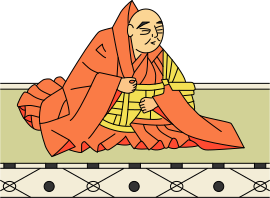
大僧正行尊
もろともに
あはれと思へ
山桜
花よりほかに
知る人もなし
はなよりほ
かにしるひ
ともなし

もろ


- Poem 66
- もろともに
あはれと思へ
山桜
花よりほかに 知る人もなし
Author: Senior High Priest Gyōson (1055–1135)
Source: Kin'yō Wakashū, Miscellaneous
- English Verse Translation
- In lonely solitude I dwell, No human face I see; And so we two must sympathize, Oh mountain
cherry tree; I have no friend but thee.
— William N. Porter, 1909
- Modern Translation
- O mountain cherry — feel moved together with me. There is no one else here who knows me but you.
- Commentary
- The Kin'yō Wakashū says this was written on unexpectedly seeing cherry blossoms in Ōmine. Gyōson was training as a mountain monk deep in the Ōmine mountains. A lone cherry tree in bloom may have seemed like himself enduring hard training, as if he had met a true friend, a feeling close to Ki no Tsurayuki's poem (Poem 35).
- About the Poet
- Gyōson was a great-grandson of Retired Emperor Sanjō. He lost his father at 10 and became a monk at Mii-dera at 12, studying esoteric Buddhism. After long mountain training he headed Mii-dera and Tennō-ji, and became Senior High Priest (Daisōjō) at 71.
- Poem Illustration
-
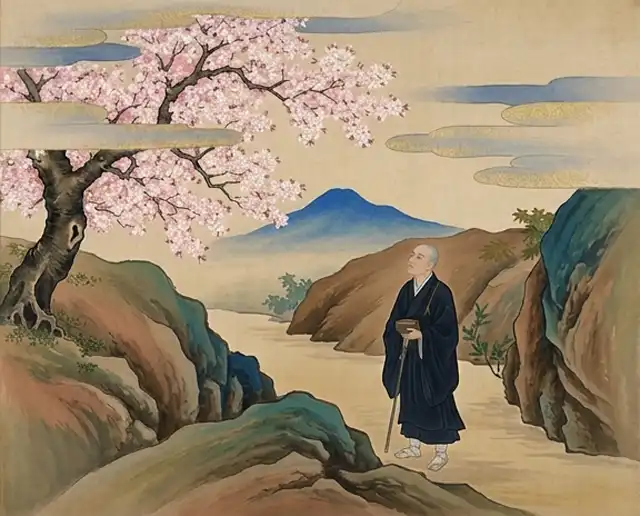
This image is based on an illustration from William N. Porter's A Hundred Verses from Old Japan, his 1909 English translation of the Hyakunin Isshu published in England, colorized and reworked using Adobe Firefly (generative AI).
- Gyōson: A Short Timeline
-
- 1055
- Born as a son of Minamoto no Motohira
- c. 1070
- Begins religious training in the mountains at Ōmine, Katsuragi, and Kumano
- 1107
- Becomes a guardian monk who prays for Emperor Toba
- 1116
- Becomes head of Onjō-ji Temple
- 1123
- Becomes head of the Tendai school, but soon resigns
- 1125
- Becomes Senior High Priest (Daisōjō)
- 1135
- Dies
- Gyōson's Relationship Chart
-
Retired Emperor Sanjō was Gyōson's great-grandfather, and Prince Atsuakira, who was born as Emperor Sanjō's first son but gave up his place as crown prince under pressure from Fujiwara no Michinaga, was Gyōson's grandfather. So Gyōson's father left the imperial family and took the family name Minamoto.
Though he had imperial blood, Gyōson did not rest on his family ties; he chose Shugendō, centered on hard training in the mountains. As a guardian monk (gojisō) who protected the emperor's health with prayers, he served Emperors Shirakawa, Toba, and Sutoku.
- Appendix
-
- In the Drama Umi ni Nemuru Daiyamondo
-
Gyōson's Hyakunin Isshu poem, "Morotomo ni aware to omoe yamazakura," appeared in episode 3 of the TBS drama Umi ni Nemuru Daiyamondo (The Diamond Sleeping in the Sea), broadcast in autumn 2024. The drama is set on Hashima in Nagasaki, now known as Gunkanjima (Battleship Island).
An old woman from Hashima, now the head of a company in Tokyo, recites the poem from memory and then says:Remember the old days with me, mountain cherry.
No one but you truly knows my heart.
Even if you don't understand me,
even if I can't understand you, that can't be helped.
Everyone has a mountain cherry in their heart.Everyone reads a poem differently, which is fascinating. It was a moving scene in which the strength of a woman who had lived through a hard life rang out together with the poem.
- Irakamichi (Setagaya, Tokyo)
-
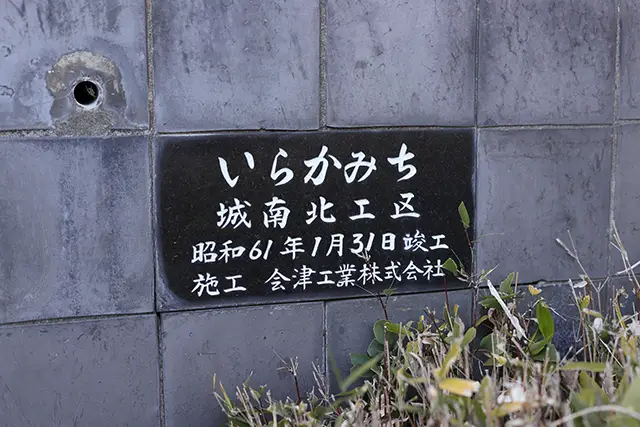
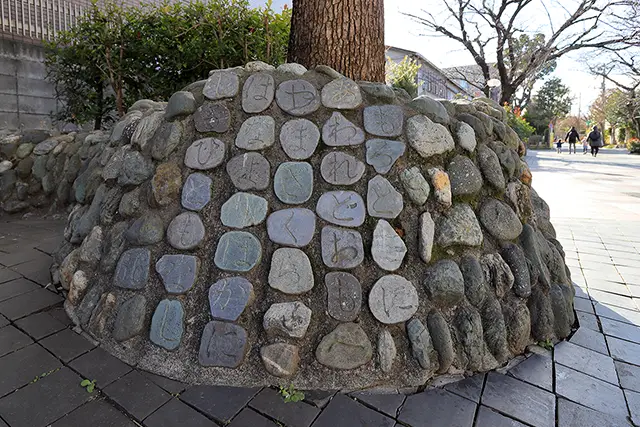
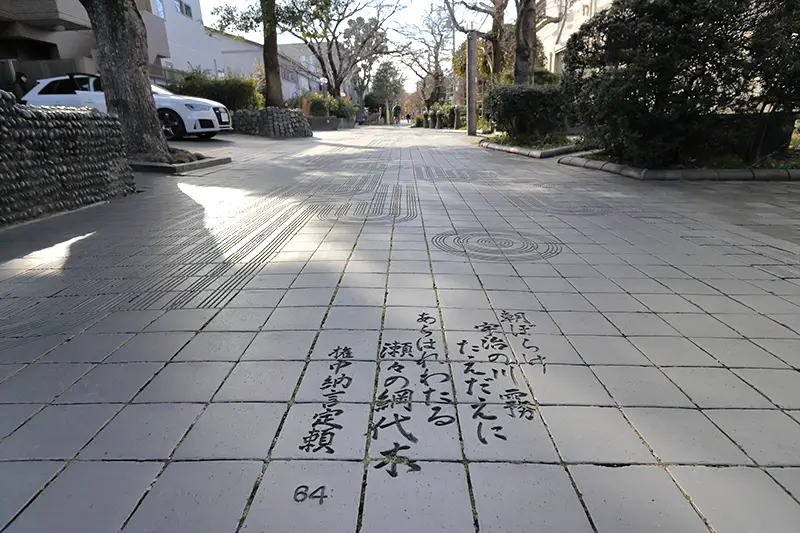
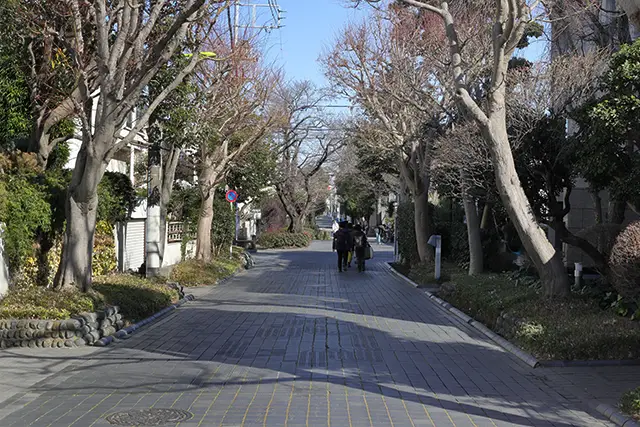
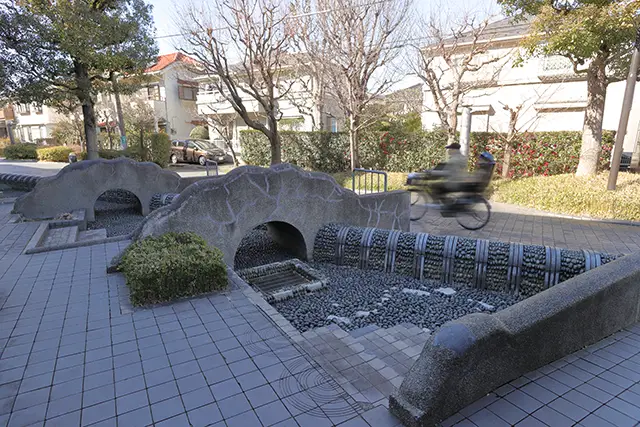
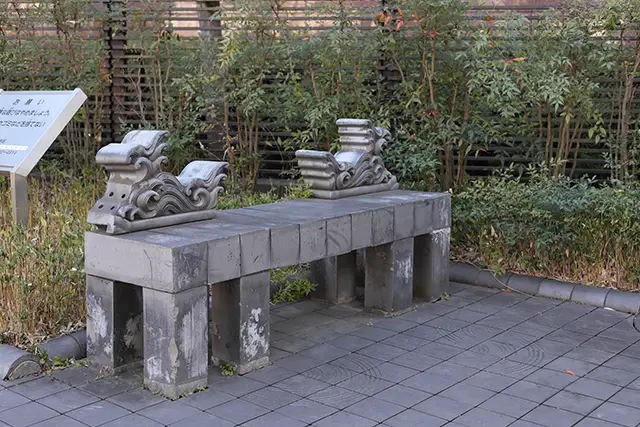
On the road from the north exit of Yōga Station on the Tōkyū Den-en-toshi Line to Kinuta Park and the Setagaya Art Museum, there is a street paved with roof tiles called "Irakamichi" (Tile Road). Hyakunin Isshu poems are carved here and there along it. Most of the poems are carved into the pavement, but Gyōson's poem is carved into a stone wall and really stands out. Along the street there are benches designed with tiles and a small stream that seems to run with water in summer. The Hyakunin Isshu blends nicely into this street where local people come to relax.
(February 9, 2025) - A Poem Written During His Training
- According to the headnote in the Shin Kokin Wakashū, Gyōson wrote this poem at the end of spring while training in the mountains.
In spring, people may have come to his hermitage in the mountain village to enjoy the blossoms.
When the crowds were gone and spring came to an end, the quiet must have made him feel even lonelier.In Japanese
木のもとの すみかも今は 荒れぬべし
春し暮れなば 誰か訪ひこむ konomotono sumikamoimaha arenubeshi
harushikurenaba tarekatohikomu Shin Kokin Wakashū, GyōsonIn English
My hut under the trees will surely fall into ruin now. Once spring is over, who will come to visit?
- Onjō-ji (Mii-dera)
-
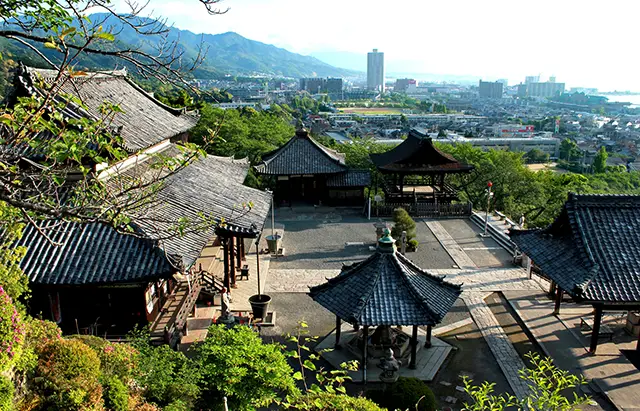
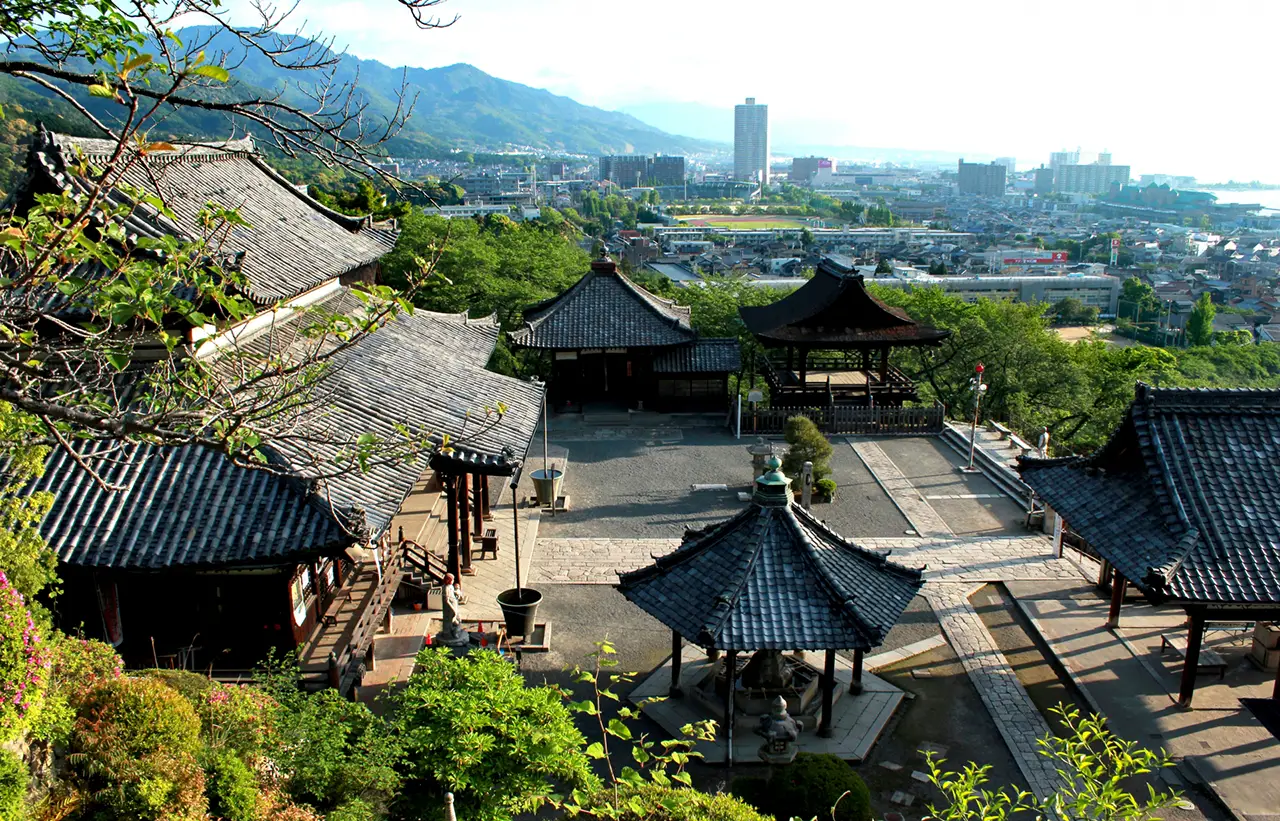
The head temple of the Tendai Jimon school, in Ōtsu City, Shiga Prefecture. It is commonly known as Mii-dera. Gyōson became a monk at this temple at 12 and studied esoteric Buddhism here.
See it on the map - The Ōmine Mountains
-
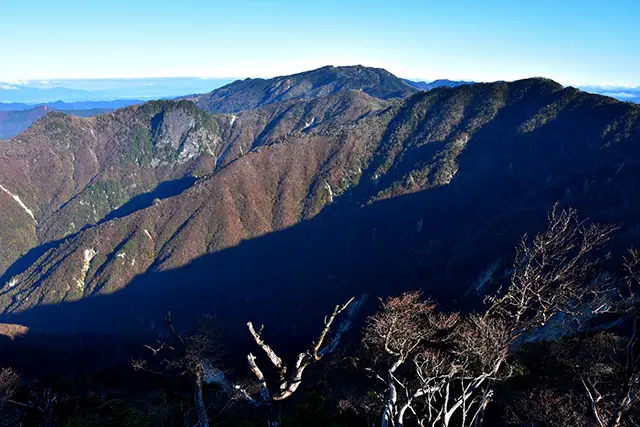
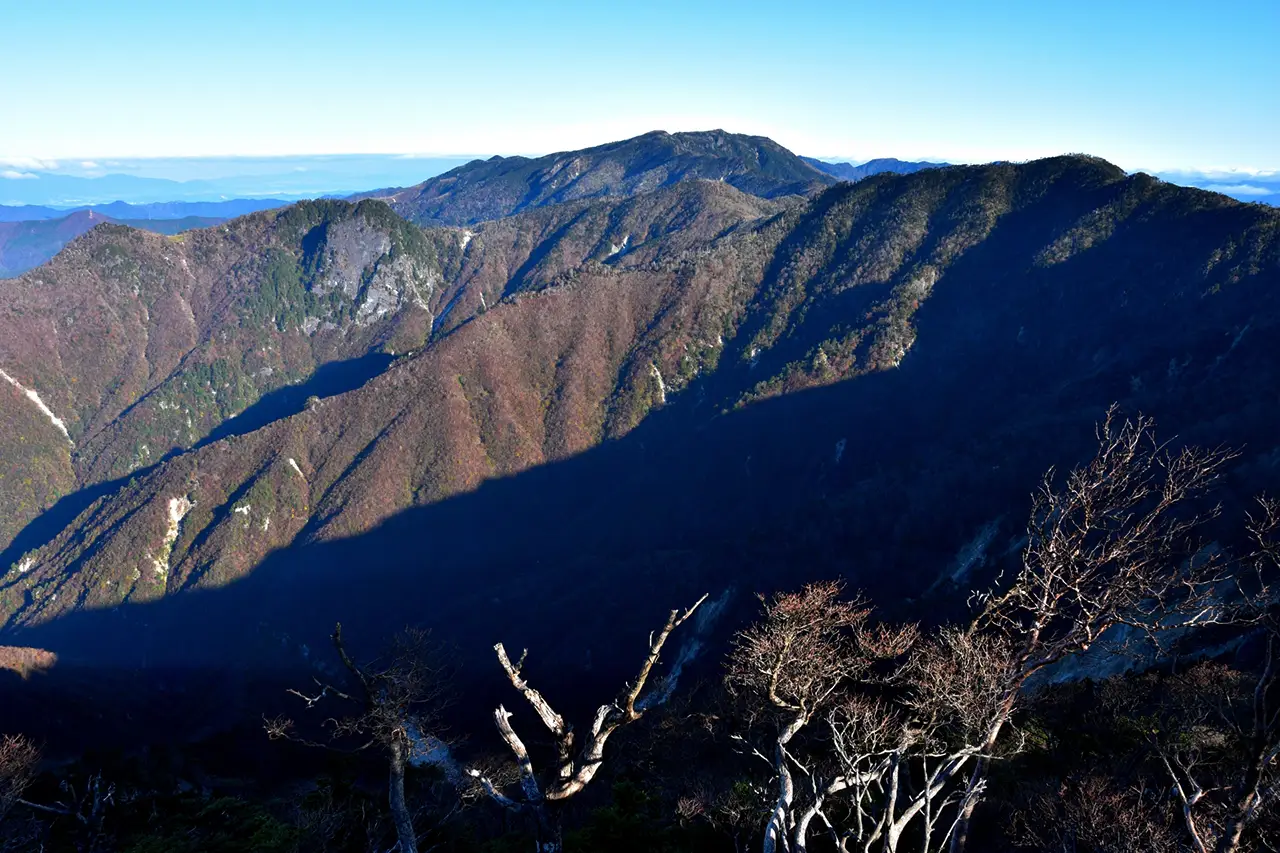
The Ōmine Mountains, called "the roof of the Kinki region." Gyōson came upon the mountain cherry while training on the Shugendō paths of these mountains.
See it on the map