


The Lost Poem of the Hyakunin Isshu:
Empress Teishi's Death Poems
Have you heard of the Hyakunin Shūka, the anthology said to be the basis of the Hyakunin Isshu? Both the Hyakunin Isshu and the Hyakunin Shūka were compiled by Fujiwara no Sadaie. Three poets who appear in the Hyakunin Shūka were left out of the Hyakunin Isshu, and one of them is Fujiwara no Teishi, empress of Emperor Ichijō.
In this column, we introduce the life of Fujiwara no Teishi and her death poem, which was included in the Hyakunin Shūka yet left out of the Hyakunin Isshu.
Teishi's Birth
Fujiwara no Teishi was born in 976 into the Naka-no-Kanpaku family, founded by her father, Fujiwara no Michitaka.
In 990, at the age of 15, she entered the court of Emperor Ichijō as a consort (nyōgo), and in the same year she became empress (chūgū).
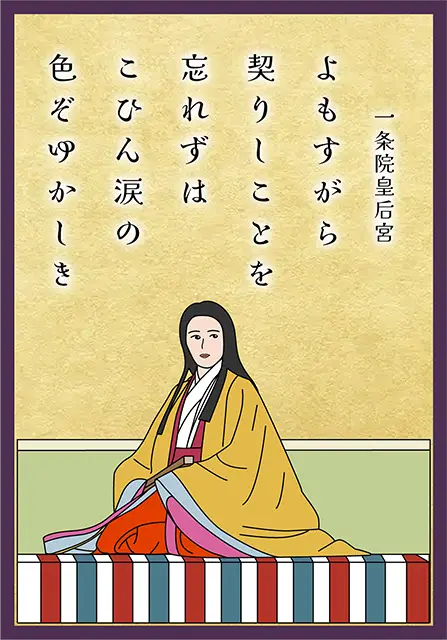
Teishi learned Chinese writing from her mother, Takako, and was well versed in learning. Cheerful and talented, she was deeply loved by Emperor Ichijō, who himself loved learning. Her father, Fujiwara no Michitaka, served as Kampaku, and the Naka-no-Kanpaku family reached the height of its power. Despite opposition from the nobles around him, Michitaka openly promoted Teishi's elder brother, Korechika. Korechika jumped ahead of his uncle, Fujiwara no Michinaga, eight years his senior, and was promoted to Palace Minister at just 21.
The Fall of the Naka-no-Kanpaku Family
The Naka-no-Kanpaku family was at the peak of its power, but in 995 Teishi's father, Fujiwara no Michitaka, died suddenly. Heavy drinking is thought to have given him diabetes. Just before his death, Michitaka tried to pass the post of Kampaku to his eldest son, Korechika, but Emperor Ichijō did not allow it, and instead Michitaka's younger brother, Fujiwara no Michikane, became Kampaku. Only days later, however, Michikane fell to an epidemic, and his younger brother, Fujiwara no Michinaga, took the important post of nairan, next in rank to Kampaku.
The Chōtoku Incident and Teishi Becomes a Nun
In 996, when Korechika went to visit his lover, the Third Daughter (San no Kimi), a splendid ox carriage was standing in front of her house. Jumping to the conclusion that someone had stolen his lover, Korechika talked it over with his younger brother, Takaie. Takaie ordered his retainers to shoot arrows at the owner of the carriage, and an arrow went right through the sleeve of none other than the Cloistered Emperor Kazan. Kazan had come not to see the Third Daughter but only to see the Fourth Daughter (Yon no Kimi), yet Korechika's misunderstanding grew into a serious incident. Shooting at a cloistered emperor was bad enough, but the retainers of Korechika and Takaie also killed two of Kazan's attendants on the spot. Because of this incident, Korechika was demoted to Provisional Governor-General of Dazaifu (Dazai no gon no sochi), and Takaie to Provisional Governor of Izumo. This upheaval is called the "Chōtoku Incident."
Afterward, Korechika and Takaie shut themselves up in the residence of the pregnant Teishi, but on Emperor Ichijō's orders they were searched by the imperial police (kebiishi) and taken away. Shocked at seeing Korechika arrested, Teishi cut off her hair on the spot and became a nun. After that, the Nijō residence where Teishi lived burned down, and in the tenth month her mother, Takako, died: misfortune kept following Teishi.
Teishi's Family Tree
Teishi Returns to Court After Giving Birth to a Princess
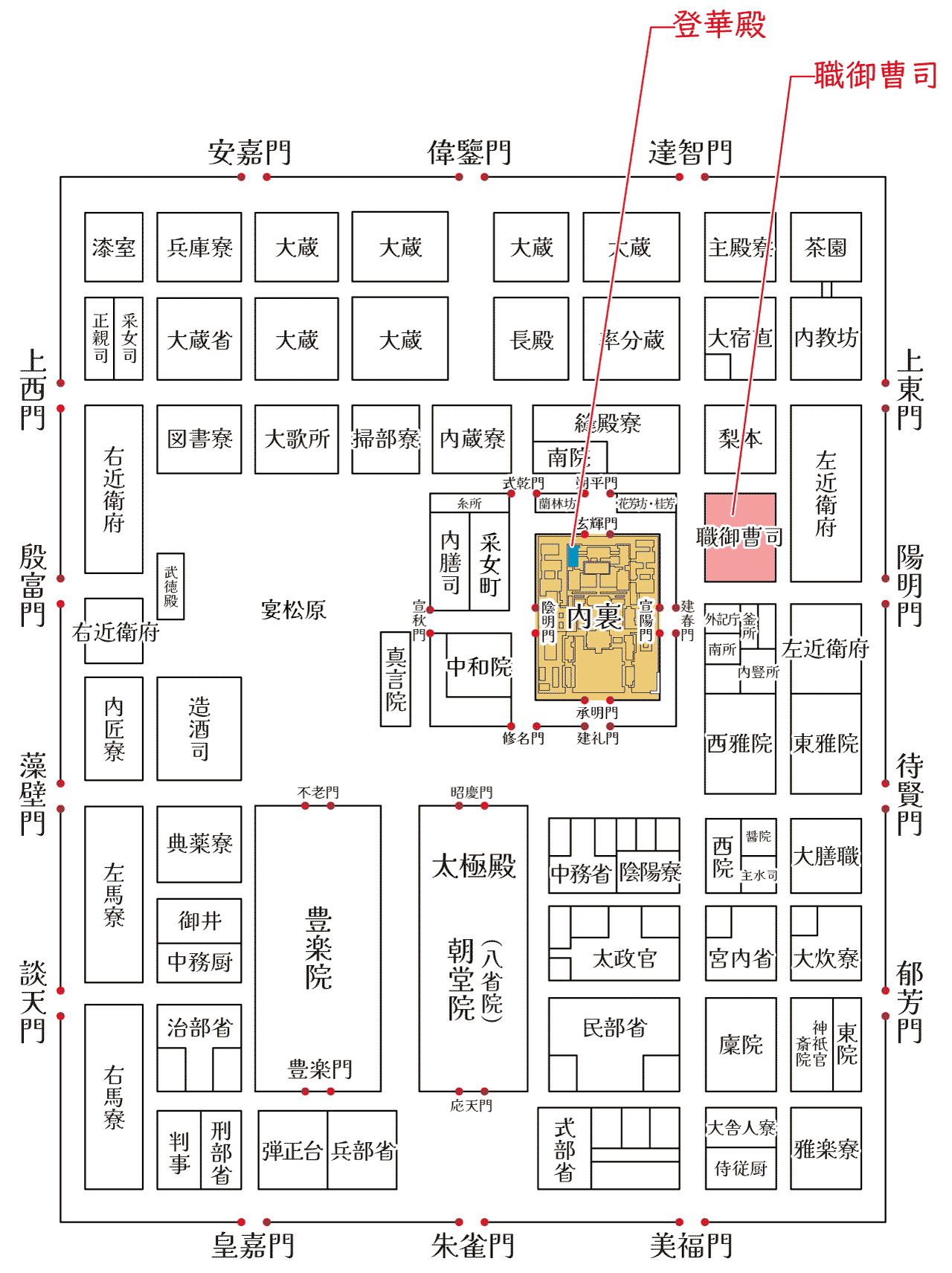
In 997, Teishi gave birth to Princess Shūshi. Emperor Ichijō, who longed to meet the princess, called mother and daughter back to court. Before becoming a nun, Teishi had lived in the Tōkaden in the inner palace, but the nobles strongly opposed the return to the palace of a woman who had once become a nun, so Teishi made her temporary residence in the Shiki no mizōshi, an office of the empress's household just to the right of the palace. Even so, it is said that the nobles looked on her coldly.
"One Emperor, Two Empresses"
In 999, Teishi gave birth to the long-awaited son, Prince Atsuyasu. On that same day, Akiko, daughter of Fujiwara no Michinaga, was made a consort of Emperor Ichijō. In 1000, through Michinaga's scheming, Teishi became kōgō and Akiko became chūgū. Chūgū and kōgō meant the same thing, but by using the two titles separately, Michinaga brought about the unprecedented "one emperor, two empresses" (ittei nikō), in which one emperor had two empresses. Although Teishi had borne a son, her son Prince Atsuyasu never became crown prince in the end. The one who actually became crown prince was Prince Atsuhira (later Emperor Go-Ichijō), born to the chūgū Akiko.
Teishi's Death
At the end of 1000, Teishi died at the young age of 25, just after giving birth to Princess Bishi. Childbirth is hard even today, but it was far riskier then. Perhaps sensing her own death, Teishi had tied three death poems to the cords of the curtain-stand (kichō) in the room where she slept.
What Became of Prince Atsuyasu
Prince Atsuyasu, who lost his mother Teishi at just two years old, was taken in by Teishi's younger sister. But when that sister died suddenly while carrying Emperor Ichijō's child, the chūgū Akiko raised him with deep affection. It is said that when Akiko's son, Prince Atsuhira, became crown prince and it became clear that Teishi's son, Prince Atsuyasu, would never be named crown prince, Akiko did not hide her anger toward her father, Fujiwara no Michinaga.
Teishi's Death Poems
The First Poem
This poem became her last love letter to Emperor Ichijō. It was included in the Hyakunin Shūka but left out of the Hyakunin Isshu. At the time, it was said that when grief reached its height, one wept tears of blood, "crimson tears" (kōrui). Teishi seems to have wanted to see Emperor Ichijō shed crimson tears and so to confirm that their love had been true.
In Japanese
夜もすがら 契りしことを 忘れずは
こひむ涙の 色ぞゆかしき yomosugara chigirishikotoo wasurezuha
kohimunamidano irozoyukashiki
In English
If you have not forgotten the promises you made me all through the night, I long to see the color of the tears you will shed in missing me.
The Second Poem
This poem expresses her anxiety about dying.
In Japanese
知る人もなき 別れ路に 今はとて
心細くも 急ぎたつかな shiruhitomonaki wakarejini imahatote
kokorobosokumo isogitatsukana
In English
On the road to the other world, where there is no one to rely on, now that the time has come, I can only hurry on my way, though my heart is uneasy.
The Third Poem
This poem was taken to mean that Teishi wished to be buried in the earth. At the time, people of high rank were usually cremated, but on the strength of this poem, Teishi was buried in the earth at Toribeno.
In Japanese
煙とも 雲ともならぬ 身なりとも
草葉の露を それとながめよ kemuritomo kumotomonaranu minaritomo
kusabanotsuyuo soretonagameyo
In English
Though I will become neither smoke nor cloud, look upon the dew on the leaves of grass and think of it as me.
Emperor Ichijō's Poem
It is recorded that snow was falling on the day of Teishi's funeral. Emperor Ichijō composed the following poem, using miyuki as a pivot word (kakekotoba) meaning both "imperial outing" (御幸) and "deep snow" (深雪).
In Japanese
野辺までに 心ばかりは 通へども
わが御幸とも 知らずやあるらん nobemadeni kokorobakariha kayohedomo
wagamiyukitomo shirazuyaaruran
In English
My heart alone goes with you all the way to the burial field, but will you know that I am going with you through the deep snow?
Trivia
Funerals in the Heian Period
In Heian-kyō, the privileged classes, such as the imperial family, aristocrats, and high-ranking monks, were usually cremated. Cremation required a great deal of firewood and was expensive, so ordinary people usually had wind burial or sky burial, leaving the body to weather naturally, and it was not unusual for bodies to be left exposed in the open.
Teishi's Tragedy, Left Out of The Pillow Book
The Pillow Book (Makura no Sōshi) contains Sei Shōnagon's peaceful, beautiful memories of the time she spent with Teishi in the inner palace. It does not touch on the decline of the Naka-no-Kanpaku family or the tragic side of Teishi's life; it captures only Teishi's bright and beautiful side. Sei Shōnagon served Teishi until Teishi's death.
See Sei Shōnagon's Hyakunin Isshu page.
About the Hyakunin Shūka
The Hyakunin Shūka was made before the Hyakunin Isshu. The reason is that the rank of Fujiwara no Ietaka is given as Senior Third Rank in the Hyakunin Shūka but as Junior Second Rank in the Hyakunin Isshu. Fujiwara no Ietaka was promoted to Junior Second Rank in 1235. For this reason, the Hyakunin Shūka is thought to have been made before 1235, and the Hyakunin Isshu after 1235. The main differences are shown in the table below.
Differences Between the Hyakunin Shūka and the Hyakunin Isshu
| Hyakunin Shūka | Hyakunin Isshu | |
| Compiled | Before 1235 | 1235 or later |
| Number of poems | 101 | 100 |
| Arrangement | Paired, like a poetry contest | In order of time |
| Poets in only one of them | Empress of Retired Emperor Ichijō (Teishi), Acting Middle Counselor Kuninobu, Acting Middle Counselor Nagakata |
Retired Emperor Go-Toba, Retired Emperor Juntoku |
There is also a minor difference: only for Minamoto no Toshiyori is the poem chosen different in the Hyakunin Shūka and the Hyakunin Isshu. For details, see Hyakunin Isshu Poem 74, Minamoto no Toshiyori.