


The Changing Culture
of Flower Viewing
To the Japanese, the cherry blossom is a flower loved at special events such as flower viewing (hanami) and the Doll Festival (Hina Matsuri). In the Nara period, however, the star of flower viewing was actually the plum. The plum came from China, and Chinese poets wrote about it in a great many poems. Japanese aristocrats, who admired Tang China, then advanced in every field, naturally came to long for the plum as well, and it is said that they eagerly planted plum trees in their own gardens to enjoy them.
Poems About Plum Blossoms
The Man'yōshū, completed at the end of the Nara period, contains about 110 poems about the plum, but only 43 about the cherry, which shows how popular the plum was at the time. Incidentally, most of the plum poems in the Man'yōshū are about white plum blossoms; only a few are clearly about red ones. The white plum was loved for its grace and for the noble image of a flower that blooms through the bitter cold, and poets prized the sensibility of mistaking it for snow: is it fallen snow, or plum blossoms in full bloom? Beyond its looks, the plum was valued above all for its fragrance.
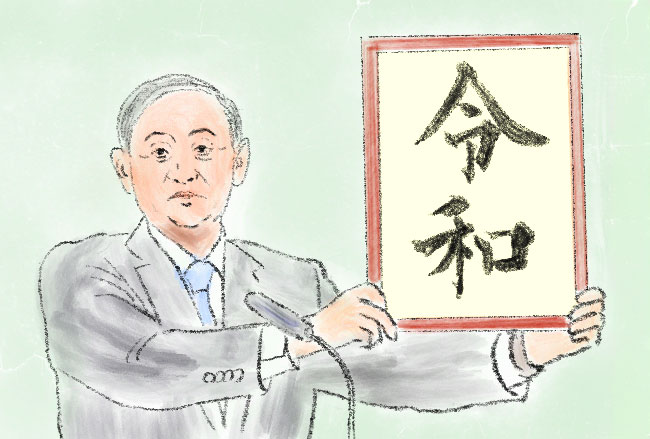
The era name "Reiwa," announced in 2019, was taken from a passage of the Man'yōshū about plum blossoms. "Reiwa" combines one character each from "reigetsu" (an auspicious month) and "fū wa" (the wind is gentle). The passage conveys how the people of the time prized the noble grace and fragrance of the plum: the dignity of the white plum, blooming proudly after enduring the bitter cold, and its scent drifting on the soft spring breeze. That sense of beauty lives on in the new era name today.
In Japanese (Chinese original)
于時、初春令月、氣淑風和、
梅披鏡前之粉、蘭薫珮後之香。 Read in Japanese (kakikudashi-bun):
時に、初春の令月にして、気淑く風和らぎ、梅は鏡前の粉を披き、蘭は珮後の香を薫らす。 toki ni, shoshun no reigetsu ni shite, ki yoku kaze yawaragi, ume wa kyōzen no ko o hiraki, ran wa haigo no kō o kaorasu
In English
It is now the auspicious month of early spring;
the air is clear and the wind is gentle.
The plum blossoms open white,
like a beauty powdering her face before the mirror,
and the orchids are fragrant,
like a scent pouch worn at the waist.
The next poem, by an unknown author, is in the Kokin Wakashū. It is written from the point of view of the bush warbler (uguisu), which loves plum blossoms.
In Japanese
梅の花 見にこそ来つれ 鶯の
ひとくひとくと 厭ひしもをる umenohana minikosokitsure uguhisuno
hitokuhitokuto itohishimooru Kokin Wakashū, author unknown
In English
I only came to see the plum blossoms, yet the warbler cries "hitoku, hitoku" ("someone's coming, someone's coming") as if it wished I would go away.
The plum had long been loved, but when national-style culture (kokufū bunka) flourished in the Heian period, the cherry blossom grew more popular too. The Kokin Wakashū contains 18 poems about the plum, but as many as 70 about the cherry.
What Made the Cherry Blossom Popular
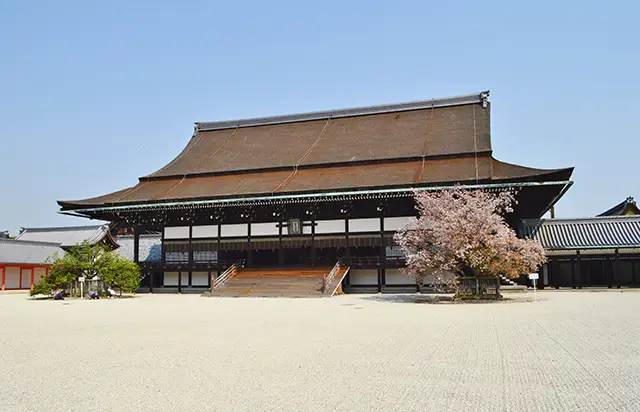
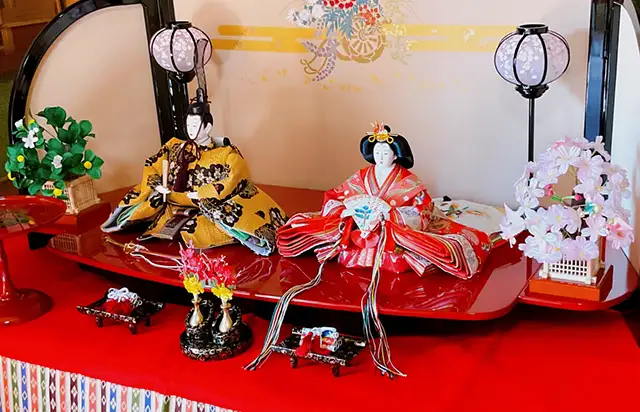
One event that symbolizes the cherry blossom's popularity: when the "plum of the left" (sakon no ume), planted in the garden of the Shishinden, the main ceremonial hall of the Heian Palace, died during the Jōwa era (834–847), Emperor Ninmyō had a cherry tree planted in its place. The cherry blossoms of the Hina dolls are modeled on this cherry of the Shishinden, so if it had not been replaced with a cherry tree, the flower of the Doll Festival might have been the plum.
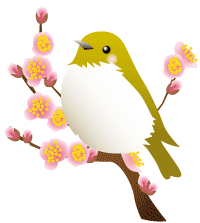
Even after the cherry was planted, the plum went on being treasured at court. According to a story called "Ōshukubai" (the Plum Where the Warbler Lodges), recorded in the Ōkagami, when the plum tree in front of the Seiryōden died in the reign of Emperor Murakami, the emperor had the whole capital searched for a plum as splendid as the one that had died. At last such a plum was found and was about to be planted, but the following poem had been tied to the tree.
In Japanese
勅なれば いともかしこし 鶯の
宿はと問はば いかが答へむ chokunareba itomokashikoshi uguhisuno
yadohatotohaba ikagakotahemu Ōkagami, Ki no Naishi
In English
Since it is the emperor's command, I humbly offer this tree. But if the warbler that comes to it asks, "Where is my lodging?", how shall I answer?
The sender of the poem was Ki no Naishi, a daughter of Ki no Tsurayuki. Moved by the poem, Emperor Murakami is said to have ordered the plum tree returned at once. Meanwhile, the cherry planted in the Shishinden garden in Emperor Ninmyō's reign has been handed down as the "cherry of the left" (sakon no sakura), which can still be seen at the Kyoto Imperial Palace today. Planted in such a symbolic place as the Shishinden garden, the cherry is thought to have won an unshakable place as a special flower close to the hearts of the Japanese.
Sugawara no Michizane's Poems
The cherry blossom rose in popularity under the influence of national-style culture. Here, let us look at poems by Sugawara no Michizane, who proposed ending the missions to Tang China and is said to have opened the way for that culture.
In Japanese
東風吹かば 匂ひおこせよ 梅の花
主なしとて 春を忘るな kochifukaba nihohiokoseyo umenohana
arujinashitote haruowasuruna Shūi Wakashū, Sugawara no Michizane
In English
When the east wind blows, send me your fragrance, plum blossoms. Even though your master is gone, do not forget the spring.
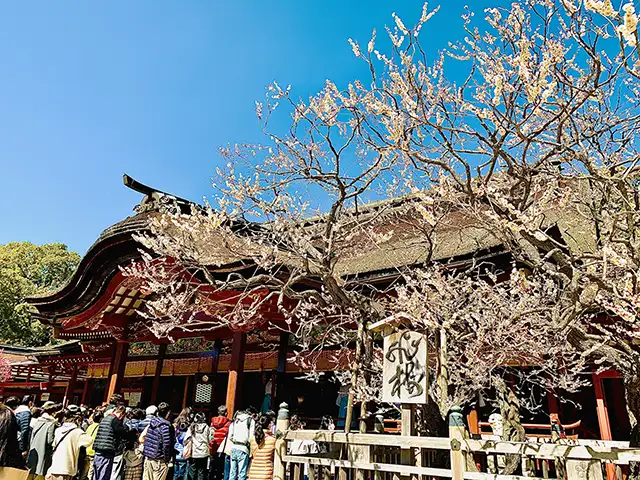
The plum Michizane wrote about is the subject of the "Flying Plum" (Tobiume) legend: missing its master, it flew overnight to Dazaifu, where Michizane had been sent. At Dazaifu Tenmangū there is a white plum tree named "Tobiume" after the legend.
The cherry tree, on the other hand, which had received no poem, is said to have withered overnight in grief. But Michizane had in fact composed a poem for the cherry too before leaving for Dazaifu. It is in the Gosen Wakashū, and its headnote says: "Tied to the cherry blossoms in front of the garden when I was leaving for a place far from home."
The "place far from home" is Dazaifu, where he was exiled. Michizane set out for Dazaifu in late February by today's calendar, so he is thought to have tied this poem to a branch while the cherry blossoms were still in bud. Since he took the trouble to compose a poem for a cherry tree that had not yet bloomed, his love for the cherry must have been no less than his love for the plum.
In Japanese
桜花 主をわすれぬ ものならば
吹き来む風に 言伝てはせよ sakurabana nushiowasurenu mononaraba
fukikomukazeni kotozutehaseyo Gosen Wakashū, Sugawara no Michizane
In English
Cherry blossoms, if you have not forgotten your master, send me word from the capital on the wind that blows my way.
Poems in the Hyakunin Isshu That Say Only "Flower"
After the mid-Heian period, the Japanese heart moved from the plum to the cherry, and in waka, when the word "flower" (hana) appeared alone, it was tacitly understood to mean the cherry blossom. The Hyakunin Isshu, a collection of the finest poems, contains four poems that say only "flower." Is that "flower" the cherry, or the plum? In fact, if you savor the words of each poem, the answer comes naturally.
To check your answer, click "In English" at the top right of each poem.
|
|
|
|