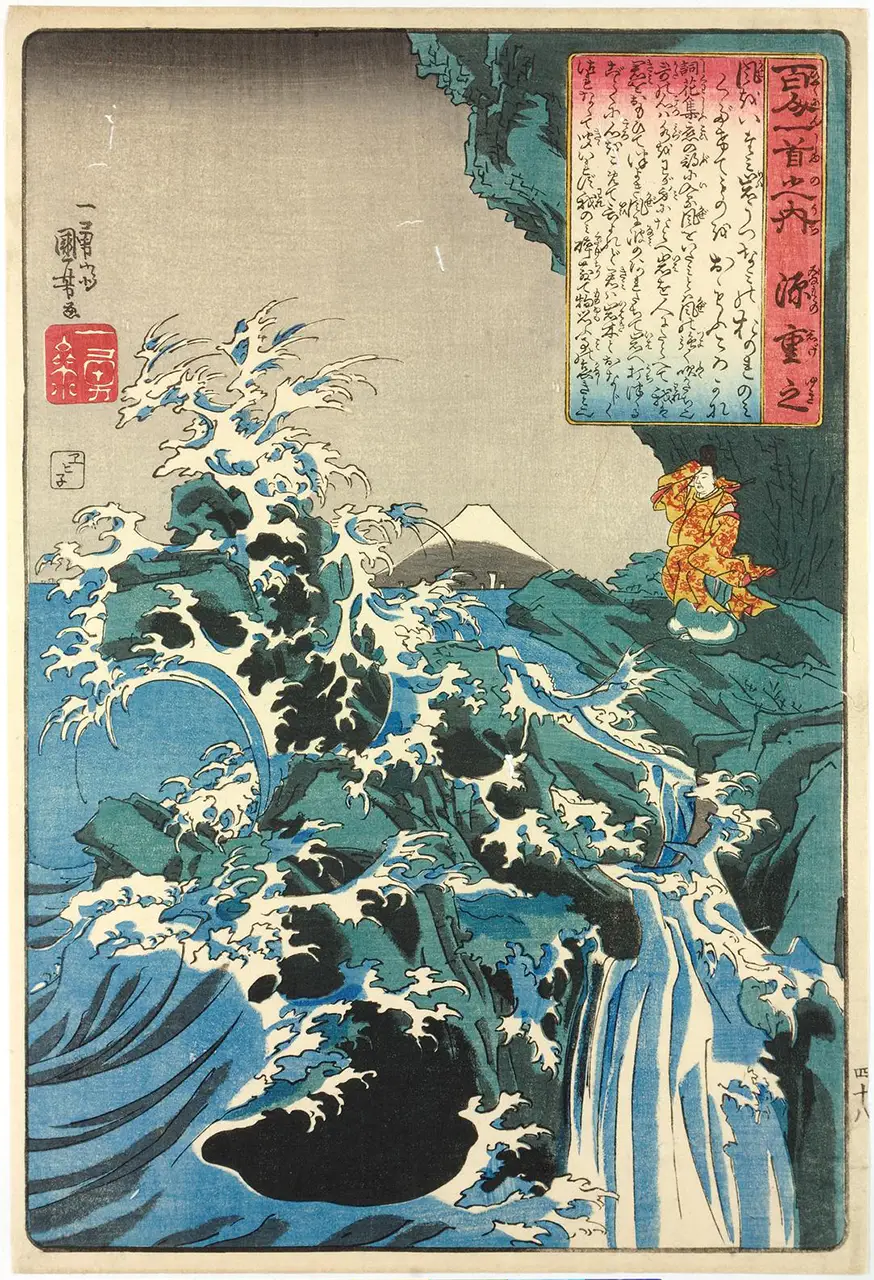
Front of the Card
Back of the Card
Japanese
English
Audio: NHK Creative Library
Read by LibriVox volunteer Larry Wilson.
Audio courtesy of LibriVox
源重之
風をいたみ
岩うつ波の
おのれのみ
くだけて物を
思ふころかな
くたけても
のをおもふ
ころかな

かぜを


- Poem 48
- 風をいたみ
岩うつ波の
おのれのみ
くだけて物を 思ふころかな
Author: Minamoto no Shigeyuki (dates unknown–1000)
Source: Shika Wakashū, Love
- English Verse Translation
- The waves that dash against the rocks Are broken by the wind And turned to spray; my loving
heart Is broken too, I find, Since thou art so unkind.
— William N. Porter, 1909
- Modern Translation
- Like the waves crashing against the rocks in the fierce wind, I alone am broken to pieces by this sorrow.
- Commentary
- The poet compares the one he loves to a rock and himself to the waves breaking against it. However hard he tries, his love never reaches her, and the stormy sea shows this sorrow dramatically.
- About the Poet
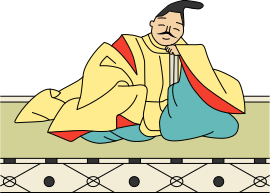
- Minamoto no Shigeyuki was a great-grandson of Emperor Seiwa and wrote poetry while serving in provincial posts. He gave the future Emperor Reizei a set of a hundred poems, said to be the oldest such set surviving. He was a friend of Sone no Yoshitada and went with Fujiwara no Sanekata when Sanekata was posted to Mutsu.
- Poem Illustration
-
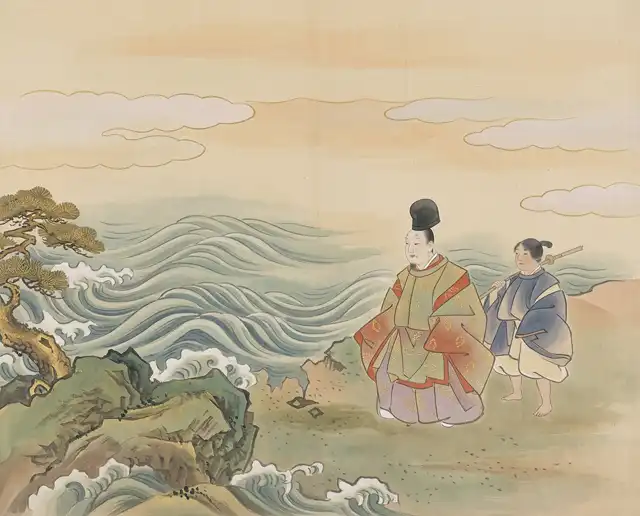
This image is based on an illustration from William N. Porter's A Hundred Verses from Old Japan, his 1909 English translation of the Hyakunin Isshu published in England, colorized and reworked using Adobe Firefly (generative AI).
- Minamoto no Shigeyuki: A Short Timeline
-
- 967
- Becomes an officer of the Palace Guards and is given Junior Fifth Rank, Lower Grade
- 975
- Becomes Assistant Head of the Left Stables
- 976
- Becomes Acting Governor of Sagami Province
- c. 995
- Goes to Mutsu Province with its governor, Fujiwara no Sanekata
- 1000
- Dies in Mutsu Province
- Notes
-
- Counted as one of the Thirty-Six Immortal Poets
- Minamoto no Shigeyuki's Family Tree
-
Minamoto no Shigeyuki was the son of Minamoto no Kanenobu, but he was adopted by his uncle, Councillor Minamoto no Kanetada. He was a great-grandson of Emperor Seiwa, but he never rose high and served in one provincial post after another. His final post and rank were Acting Governor of Chikuzen and Junior Fifth Rank, Lower Grade.
He was friends with Minamoto no Shitagō, Sone no Yoshitada, Taira no Kanemori, and others.
Shigeyuki wrote a set of a hundred poems, the Shigeyuki Hyakushu, and presented it to the future Emperor Reizei when he was crown prince. He was influenced by Sone no Yoshitada, who had written a set of a hundred poems earlier, though privately, and the two were friends.
Late in life, when Fujiwara no Sanekata went to Mutsu Province as its governor, Shigeyuki went with him and died there.
- Appendix
-
- A Poem About Sleeves Wet with Tears
-
The next poem is by Minamoto no Shigeyuki and is in the Go Shūi Wakashū.
Later, Attendant to Empress Inpu wrote a new poem based on it, and that poem was chosen for the Hyakunin Isshu.In Japanese
松島や 雄島の磯に 漁りせし
海人の袖こそ かくは濡れしか matsushimaya ojimanoisoni asariseshi
amanosodekoso kakuhanureshika Go Shūi Wakashū, Minamoto no ShigeyukiIn English
Would even the sleeves of the divers fishing on the rocky shore of Ojima at Matsushima be as wet as my sleeves, soaked with tears?
- Utagawa Kuniyoshi's Hyakunin Isshu no Uchi
-
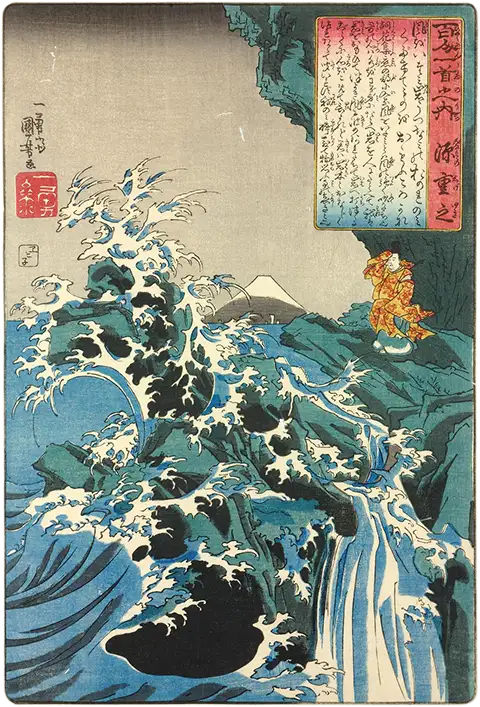
British Museum, Public domain, via Wikimedia Commons This ukiyo-e print is by Utagawa Kuniyoshi, an artist of the Edo period.
It shows a scene to go with the Hyakunin Isshu poem.