Front of the Card
Back of the Card
Japanese
English
Audio: NHK Creative Library
Read by LibriVox volunteer Larry Wilson.
Audio courtesy of LibriVox
藤原基俊
契りおきし
させもが露を
いのちにて
あはれ今年の
秋もいぬめり
あはれこと
しのあきも
いぬめり

ちぎりお


- Poem 75
- 契りおきし
させもが露を
いのちにて
あはれ今年の 秋もいぬめり
Author: Fujiwara no Mototoshi (1060–1142)
Source: Senzai Wakashū, Miscellaneous
- English Verse Translation
- It is a promise unfulfilled, For which I humbly sue The dainty little mugwort plant Relies
upon the dew, And I rely—on you.
— William N. Porter, 1909
- Modern Translation
- You promised me, and I staked my life on it like the morning dew on the wormwood. But another autumn is passing, alas.
- Commentary
- Mototoshi asked Fujiwara no Tadamichi to choose his son Kōkaku, a monk at Kōfuku-ji, as lecturer at the Yuima-e ceremony. Tadamichi answered with a line from an old poem that seemed to promise yes, but Kōkaku was not chosen. Disappointed, Mototoshi wrote this poem.
- About the Poet
- Fujiwara no Mototoshi was a great-grandson of Fujiwara no Michinaga but never rose above a low rank. He valued the traditional style and clashed with the new-style Minamoto no Toshiyori, yet the two were the leading poets of their time. Fujiwara no Toshinari was his student.
- Poem Illustration
-
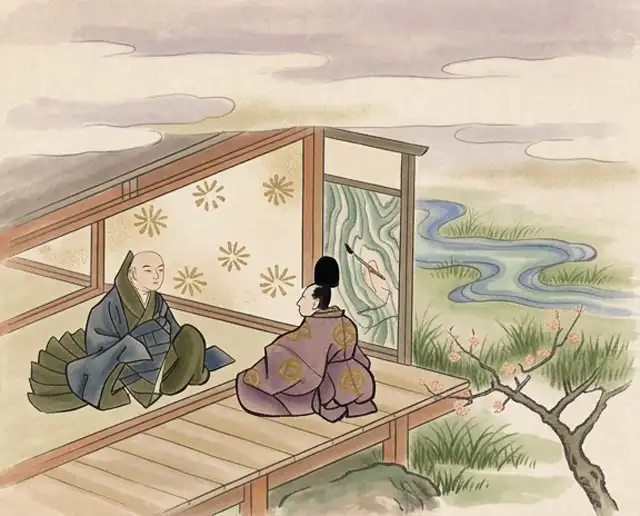
This image is based on an illustration from William N. Porter's A Hundred Verses from Old Japan, his 1909 English translation of the Hyakunin Isshu published in England, colorized and reworked using Adobe Firefly (generative AI).
- Fujiwara no Mototoshi: A Short Timeline
-
- 1060
- Born as a son of Fujiwara no Toshiie
- c. 1105
- Becomes one of the poets of the Horikawa Hundred-Poem Sequence
- 1138
- Becomes a monk and takes the name Kakushun
- 1142
- Dies
- Notes
-
- In his later years, took Fujiwara no Toshinari as his student
- Fujiwara no Mototoshi's Family Tree
-
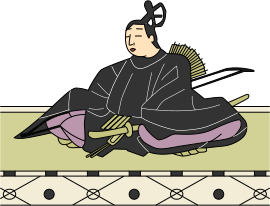
Fujiwara no Mototoshi was a great-grandson of Fujiwara no Michinaga. He rose no higher than Junior Fifth Rank, Upper Grade, as Assistant Captain of the Left Gate Guards (Saemon no suke, the deputy head of the Left Gate Guards).
Perhaps because of his low rank, he seems to have had few chances to take part in poetry events at court. His first public poetry event was the Horikawa-in Ontoki Hyakushu Waka (the Horikawa Hundred-Poem Sequence), when he was already about 46. After that he took part in poetry contests as a poet and a judge. Known for his learning in Chinese poetry and prose as well as waka, he was, together with Minamoto no Toshiyori, one of the leading figures of the poetry world in the age of rule by retired emperors.
Late in life he took Fujiwara no Toshinari as his student.
- Appendix
-
- The "Shimeji ga Hara" Poem
- In answer to Fujiwara no Mototoshi's request for a favor, Fujiwara no Tadamichi quoted a line from the next poem.
This poem is said to have been composed by the Kannon of Kiyomizu.
"Shimeji ga hara no sashimogusa" (the mugwort of Shimeji Field) is an introductory phrase (jokotoba) in which the following words, "sashimo ari tomo" (even if things are so), are left out.In Japanese
なほ頼め 標茅が原の さしも草
われ世の中に あらむ限りは nahotanome shimejigaharano sashimogusa
wareyononakani aramukagiriha Shin Kokin Wakashū, the Kannon of KiyomizuIn English
Rely on me, even if you are troubled enough to burn like the mugwort of Shimeji Field,
for as long as I am in this world. - The Yuima-e Ceremony
-
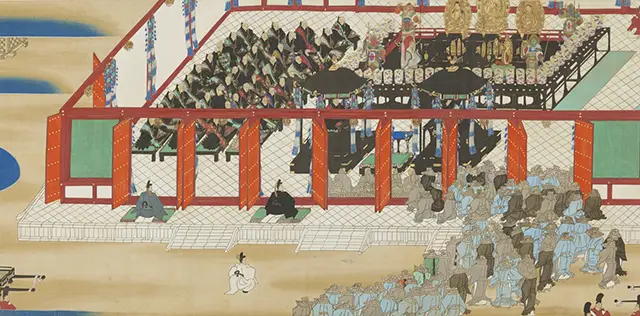
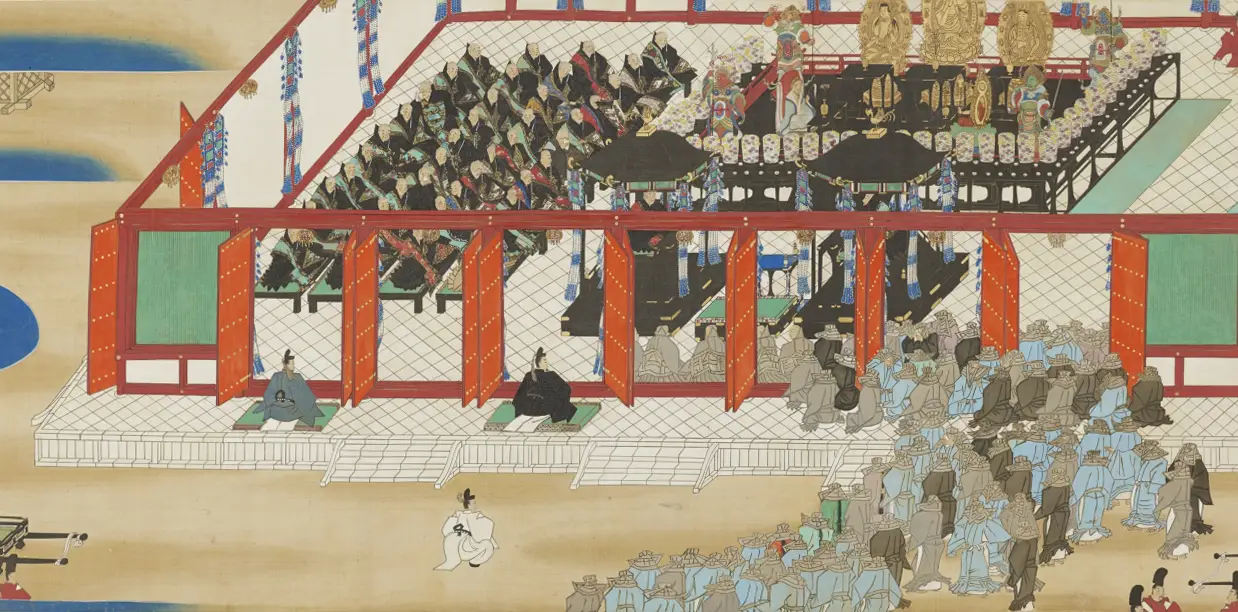
Source: Tokyo National Museum A Buddhist service held every year for seven days from the tenth day of the tenth month at Kōfuku-ji, with lectures on the Vimalakirti Sutra (Yuimakyō). Being chosen as the lecturer was an honor for a monk, and it is said that a monk could not be promoted to the temple's leadership without serving as lecturer. Kōfuku-ji was the family temple of the Fujiwara, and Fujiwara no Tadamichi, as head of the Fujiwara clan, was involved in running it and had the power to choose the lecturer. His reply quoting "Nao tanome Shimeji ga hara no..." is thought to have meant that he had accepted the request: "Don't worry; rely on me and wait calmly."